Sir Peter Paul Rubens (Flemish, 1577-1640)
Overview
The most sought-after painter in northern Europe during the seventeenth century, Peter Paul Rubens, was also a diplomat, linguist, and scholar. His dynamic, emotional style with its rich texture, vivid color, and lively movement has influenced Western art to the present day.
Born the son of a lawyer and educated at a Jesuit school in Antwerp, Flanders, Rubens learned classical and modern languages. He spent the years 1600 to 1608 studying and working in Italy. Returning to Antwerp, he continued to travel as both courtier and painter. His repeated visits to Madrid, Paris, and London allowed him to negotiate treaties while accepting royal commissions for art.
One of Rubens' major innovations in procedure, which many later artists have followed, was his use of small oil studies as compositional sketches for his large pictures and tapestry designs. Rather than merely drawing, Rubens painted his modelli, or models, thereby establishing the color and lighting schemes and the distributions of shapes simultaneously.
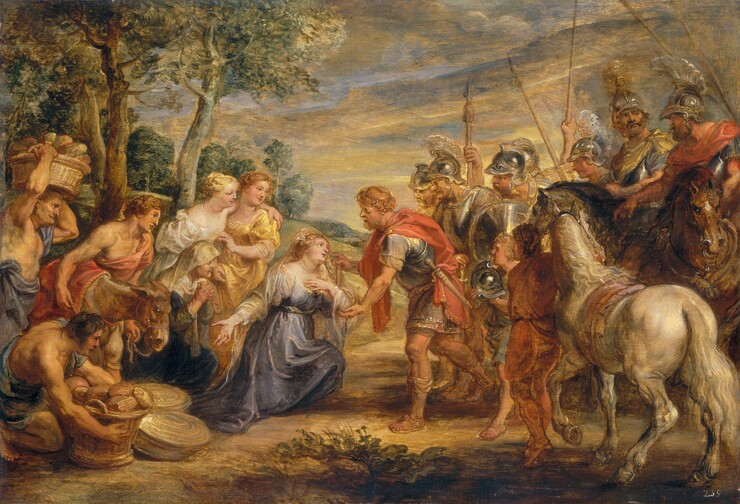
Sir Peter Paul Rubens, The Meeting of David and Abigail, c. 1630, oil on panel, Bequest of Lore Heinemann in memory of her husband, Dr. Rudolf J. Heinemann, 1997.57.8
Rubens and the Baroque Style
The dramatic artistic style of the seventeenth century is now called "baroque," a term apparently derived at a later time from ornate jewelry set with irregular pearls. At its most exuberant, the baroque involves restless motion, startling color contrasts, and vivid clashes of light and shadow. Baroque art often appeals directly to the emotions, exemplified by three of the life-size beasts in Rubens' Daniel in the Lions' Den that stare hungrily at the viewer.
Rubens managed a very large studio in Antwerp, training many apprentices and employing independent colleagues to help execute specific projects. Among his mature collaborators whose baroque works are on view in the National Gallery of Art are Anthony van Dyck, Jacob Jordaens, Jan Brueghel, and Frans Snyders.
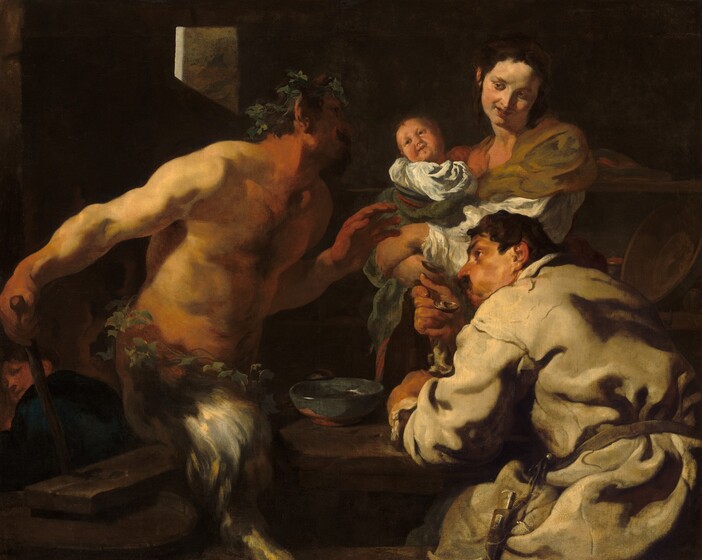
Rubens' style tremendously influenced baroque painters throughout Europe, even those such as the German-born Johann Liss who had no documented contact with the master. Liss' The Satyr and the Peasant, for instance, is Rubensian in its lively gestures and telling expressions. Painted during the 1620s in Italy, it illustrates a tale from Aesop's Fables in which an immortal satyr helped a peasant find his way through a winter storm. The goat-legged creature was astonished when the man put his chilled hands to his mouth to warm them. In thanks for the satyr's guidance, the peasant invited him home to eat. The satyr was further perplexed when the man blew on his spoon to cool the hot soup. The satyr jumped up in disgust at human hypocrisy, proclaiming, "I will have nothing to do with someone who blows hot and cold with the same breath!"
Johann Liss, German, c. 1597 - 1631, The Satyr and the Peasant, possibly c. 1623/1626, oil on canvas, Widener Collection, 1942.9.39
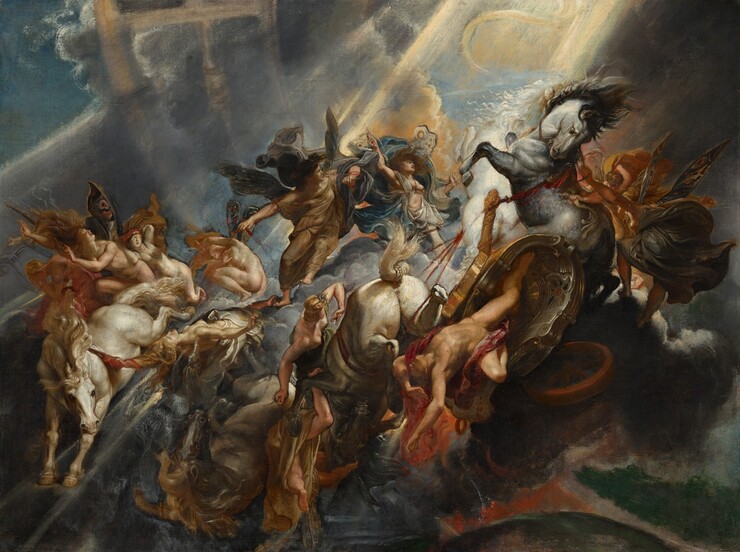
Phaeton, Apollo’s son, begged his father to allow him to drive the chariot of the sun across the sky. In the hands of the rash youth, who had neither the strength nor the experience to control the chariot, the horses bolted, scorching everything in their path with the sun's heat. The butterfly–winged female figures, personifying the seasons and hours, react in terror as the earth below bursts into flame. Even the great astrological bands that arch through the heavens are disrupted. To save the universe from destruction, Zeus, king of the gods, throws a thunderbolt, represented here by a blinding shaft of light. As the chariot disintegrates, Phaeton plunges to his death.
Rubens painted The Fall of Phaeton in Rome. His study of works by Leonardo da Vinci, Raphael, and Michelangelo influenced his evocation of complex poses and a powerful sense movement. The lighting reveals the artist’s attention to Venetian artists as well. Rubens continued to work on the painting over a number of years. He likely found the subject—which warned of the need for personal restraint and responsibility—congenial to his own philosophical beliefs.
Sir Peter Paul Rubens, The Fall of Phaeton, c. 1604/1605, probably reworked c. 1606/1608, oil on canvas, Patrons' Permanent Fund, 1990.1.1
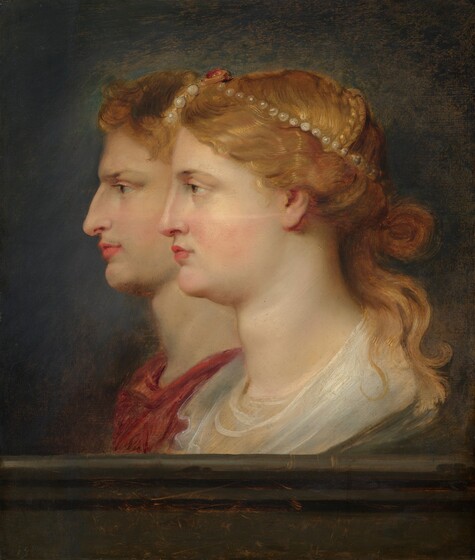
Roman historians directed glowing praise to Agrippina and her husband Germanicus (died A.D. 19). Tacitus described her as "the glory of her country," while Suetonius claimed he "possessed all the highest qualities of body and mind." Germanicus, adopted son of the emperor Tiberius, was a brilliant general. Agrippina, granddaughter of Augustus, Rome's first emperor, was renowned for devotion and bravery.
For Rubens, the couple's moral virtue was reflected in their physical beauty. Agrippina has a strong face, with glowing skin and golden hair. Notice how subtly Rubens distinguished her ivory complexion from the slightly ruddier face of her husband.
The unusual double-bust format, like the paint's luminous translucent quality, is explained by Rubens' inspiration: ancient cameos. The artist was a great collector of antiquities, including engraved gems. He planned to illustrate a publication of these small-scale sculptures, but the project was never completed. Germanicus' profile here—with aquiline nose, arched brows, and rounded chin—is similar to a design Rubens made possibly after one of his own cameos.
Sir Peter Paul Rubens, Agrippina and Germanicus, c. 1614, oil on panel, Andrew W. Mellon Fund, 1963.8.1
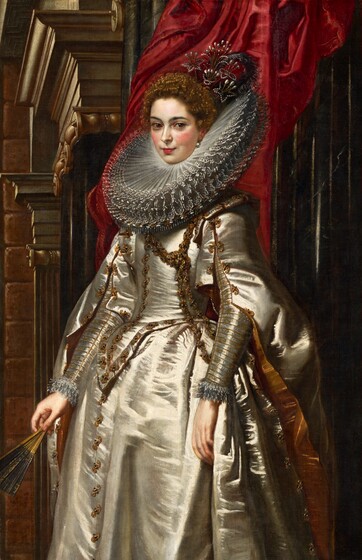
On at least four occasions during his long stay in Italy (1600–1609), Rubens worked in Genoa, a prosperous seaport. He painted this proud Genoese aristocrat in 1606, the year following her marriage. It is one of a number of female portraits Rubens made in Genoa, a city renowned as a paradiso delle donne (a paradise of women). The Genoese republic, governed by a wealthy oligarchy, granted women unusual respect and constitutional freedoms. The marchesa's image conveys both lively humanity and dignity and commands real physical presence. Her gaze, as well as the angle of the architecture, indicates the painting was meant to be seen from below. The painting was much larger and more imposing before the canvas was cut down in the nineteenth century.
The marchesa's stately pose is far from static; it is activated by light, by the diagonal flow of a red curtain, and by Rubens' bravura brushwork. The marchesa's silvery satin dress is built up of layers of translucent glazes and highlighted with thick, freely painted strokes. Rubens combined this bold, painterly style—which he learned from his study of Venetian artists like Veronese, Tintoretto, and Titian—with the tradition for detailed, carefully observed surfaces from his native Flanders. Compare, for example, the expressive painting technique in the dress and curtain with the precise handling of the architecture.
Sir Peter Paul Rubens, Marchesa Brigida Spinola Doria, 1606, oil on canvas, Samuel H. Kress Collection, 1961.9.60
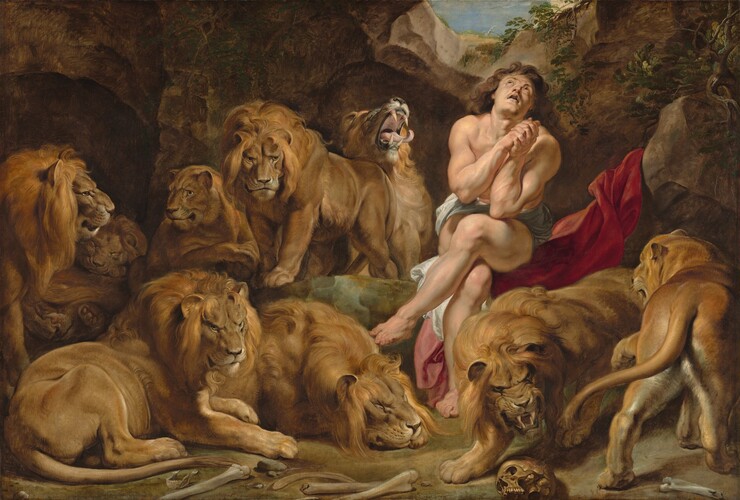
The Old Testament prophet Daniel, as chief counselor to the Persian king Darius, aroused the envy of the other royal ministers. Conspiring against the young Hebrew, they forced the king into condemning Daniel to a den of lions. The following dawn Darius, anxious about his friend, had the stone that sealed the entrance rolled away to discover Daniel had been miraculously saved. Rubens depicted this deliverance when, as the beasts squint and yawn at the morning light streaming into their lair, Daniel gives thanks to his God.
The monumental size of the ten lions and their placement close to the viewer heighten the sense of immediacy. Within the asymmetrical, baroque design, Daniel is the focal point even though his position is off-center. Against the brown tones of animals and rocks, his pale flesh is accented by his red and white robes as well as by the blue sky and green vines overhead.
In 1618, Rubens traded Daniel along with eight other paintings and some cash for a collection of over a hundred ancient Roman busts and statues—the prize material of any art gallery in that era. During the transaction, Rubens described this canvas as: "Daniel among many lions, taken from life. Original, entirely by my hand." The North African lions Rubens used as his models were kept in the royal menagerie at Brussels. The Gallery has in its collection a study for the lion facing the viewer, standing to Daniel's right. (This Moroccan species, now extinct in the wild, may be seen at Washington's National Zoo.)
Sir Peter Paul Rubens, Daniel in the Lions' Den, c. 1614/1616, oil on canvas, Ailsa Mellon Bruce Fund, 1965.13.1
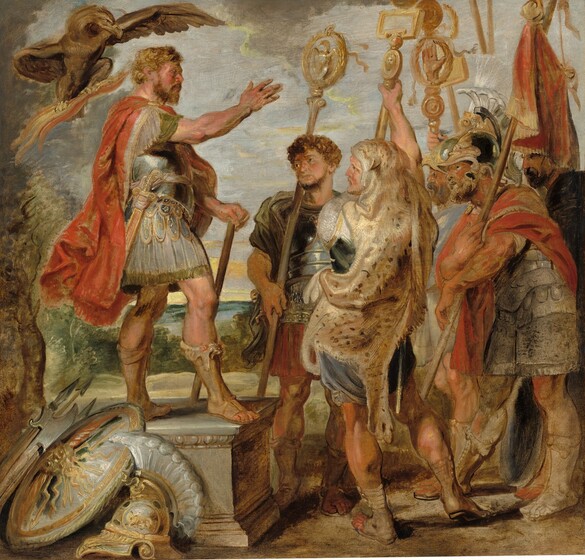
About 340 B.C., the cities of southern Italy revolted against the authority of Rome. At their camp near Naples, the Roman leaders were visited by a divine apparition who declared that the army of one side and the commander of the other must be sacrificed to the Underworld. The prophecy meant that the side that lost its general would be victorious. Here Decius Mus, standing on a dais, tells his troops that, for the sake of Roman victory, he would allow himself to be killed.
Symbolizing Jupiter, the Roman king of the gods, a mighty eagle clutches lightning bolts in its talons and hovers behind Decius Mus. Rubens derived the soldiers' armor, helmets, shields, and military standards from ancient Roman sculpture. The whole composition, in fact, with its large figures silhouetted in the foreground, recalls the appearance of bas-reliefs carved on Roman victory monuments.
The subject is the first in a series of eight tapestry designs on the theme of Decius Mus, which Rubens completed for a Genoese patron. The panel is a small model, that was enlarged by workshop assistants into the full-size picture, called a cartoon, that was sent to weavers in Brussels.
Sir Peter Paul Rubens, Decius Mus Addressing the Legions, probably 1616, oil on hardboard, transferred from wood and canvas, Samuel H. Kress Collection, 1957.14.2
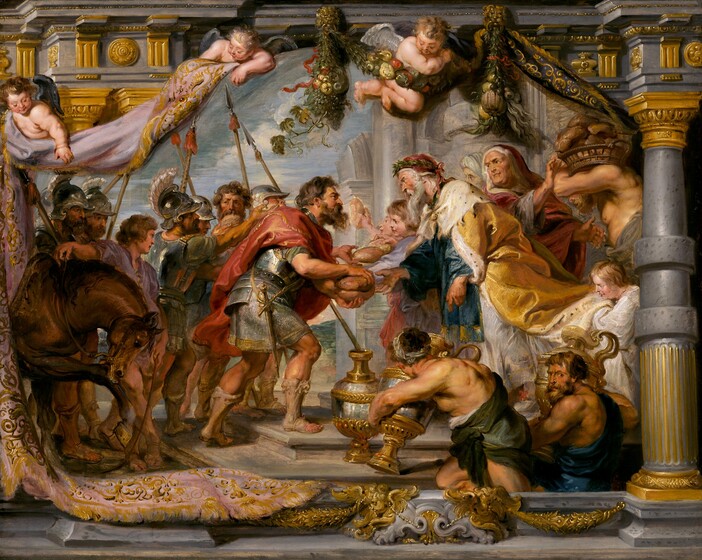
Rubens served Albert and Isabella, the Spanish governors of the Netherlands, as both court artist and diplomat. Isabella commissioned Rubens to design twenty tapestries for the Convent of the Poor Clares in Madrid, where she had lived and studied as a girl. Woven in Brussels, the series—which is still in the convent (now a museum)—celebrated the Eucharist, the Christian sacrament that reenacts Jesus' transformation of bread and wine into his body and blood at the Last Supper.
This painting is a modello, or oil sketch, for one of the tapestries. It depicts the meeting of Abraham and Melchizedek (Genesis 14:1–20). Returning victorious from battle, Abraham is greeted by Melchizedek, high priest and king of Salem, who presents him with loaves of bread as attendants bring vessels of wine. Catholic theologians considered the scene to prefigure the Eucharist.
Rubens presents the narrative as though it appears on a tapestry itself. Cherubs carry the heavy, fringed fabric before an imposing architectural setting. On the right, two attendants seem to climb from a wine cellar. Are they real men standing in front of the tapestry, or images woven inside it? Such confounding illusion delighted baroque audiences.
Sir Peter Paul Rubens, The Meeting of Abraham and Melchizedek, c. 1626, oil on panel, Gift of Syma Busiel, 1958.4.1
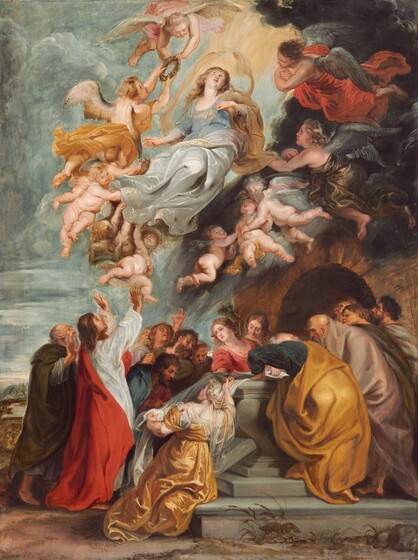
As recounted in the New Testament's Apocrypha, Jesus' mother was physically raised (assumed) to heaven after her death. A choir of angels lifts Mary's body upward in a dramatic spiraling motion toward a burst of divine light. The twelve apostles gather around her tomb. Some raise their hands in awe; others reach down to touch her discarded shroud. The three holy women are probably Mary Magdalene and the Virgin Mary's two sisters. The kneeling woman holds a flower, referring to the blossoms that miraculously filled the empty coffin.
In 1611, the cathedral at Antwerp announced a competition for an Assumption altar. On February 16, 1618, Rubens submitted two models. He finished the huge altarpiece on September 30, 1626. Thus, fifteen years elapsed between the beginning and conclusion of this project. The cathedral needed the time to complete a majestic marble frame.
This oil sketch is probably a replica of Rubens' original modello, which is now in the Mauritshuis, in The Hague. The Hague study has livelier, more spontaneous brushwork, and it is arched at the top, reflecting the marble frame of the cathedral altarpiece.
Studio of Sir Peter Paul Rubens, The Assumption of the Virgin, probably mid 1620s, oil on panel, Samuel H. Kress Collection, 1961.9.32
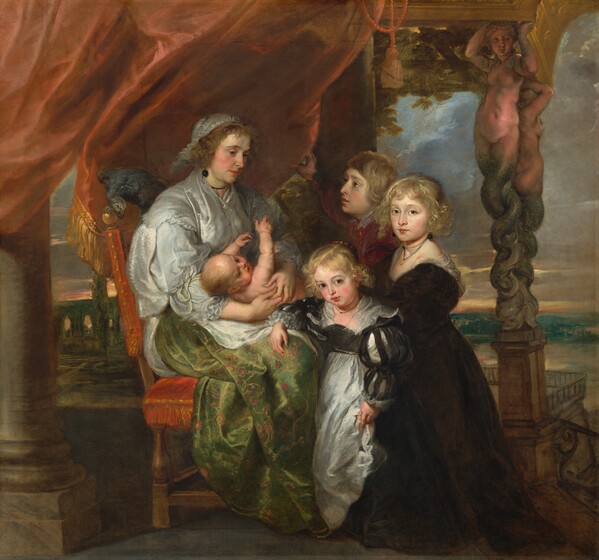
As she embraces a squirming baby, this mother's cradling arm traces an oval that visually encompasses the faces of her children, uniting the family.
The mother is Deborah Kip, wife of Flemish art dealer and diplomat Balthasar Gerbier. Gerbier's absence from the family portrait is a bit unusual—perhaps Rubens' focus was primarily on Deborah's maternal role. In 1629, when Rubens was sent to London as an emissary of Spanish king Phillip IV he lived for several months in the Gerbier household. He may have painted this portrait in gratitude for their hospitality or as a keepsake out of affection for the family. It is also possible that he intended to use it as a model for other compositions. The three older children appear in an ambitious political allegory Rubens presented to English king Charles I in 1630. When Rubens returned to Antwerp he took the still unfinished portrait of the Gerbier family with him. It was probably completed by one of his workshop assistants—possibly Jacob Jordaens—after Rubens' death.
Sir Peter Paul Rubens (and possibly Jacob Jordaens), Deborah Kip, Wife of Sir Balthasar Gerbier, and Her Children, 1629/1630, reworked probably mid 1640s, oil on canvas, Andrew W. Mellon Fund, 1971.18.1