18th-Century France — The Rococo and Watteau
Overview
In 1715 the French greeted a new king for the first time in seventy-two years. Louis XV, a boy only five years old, succeeded his great-grandfather Louis XIV, the Sun King, who had made France the preeminent power in Europe. For the next eight years the late king's nephew, the duc d'Orléans, governed as regent. His appetite for beauty and vivaciousness was well known, and he set aside the piety enforced by Louis XIV at Versailles. France turned away from imperial aspirations to focus on more personal—and pleasurable—pursuits. As political life and private morals relaxed, the change was mirrored by a new style in art, one that was intimate, decorative, and often erotic.
The Rococo Style
Louis XIV's desire to glorify his dignity and the magnificence of France had been well served by the monumental and formal qualities of most seventeenth-century French art. But members of the succeeding court began to decorate their elegant homes in a lighter, more delicate manner. This new style has been known since the last century as "rococo," from the French word, rocaille, for rock and shell garden ornamentation. First emerging in the decorative arts, the rococo emphasized pastel colors, sinuous curves, and patterns based on flowers, vines, and shells. Painters turned from grandiloquence to the sensual surface delights of color and light, and from weighty religious and historical subjects—though these were never ignored completely—to more intimate mythological scenes, views of daily life, and portraiture. Similarly, sculptors increasingly applied their skills to small works for the appreciation of private patrons.
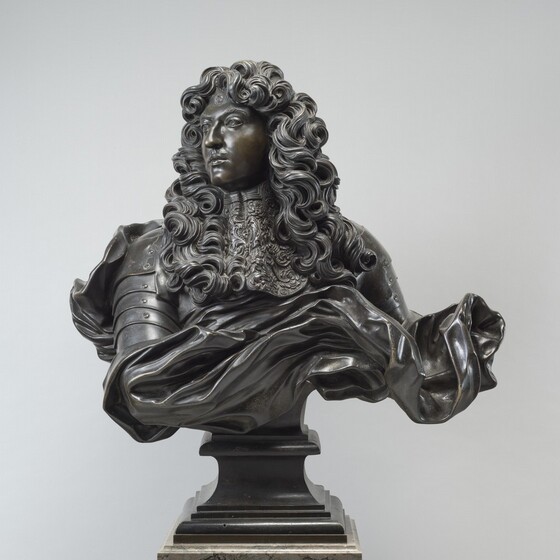
After Gian Lorenzo Bernini, Louis XIV, c. 1700, bronze, Samuel H. Kress Collection, 1943.4.87
Antoine Watteau and the Fête Galante
Though several painters of the preceding generation had experimented with the ingredients of rococo—emphasizing color, a lighthearted approach, and close observation—Antoine Watteau merged them into something new.
Born near the Flemish border, Watteau was influenced by the carefully described scenes of everyday life popular in Holland and Flanders. Arriving in Paris in 1702, he first made his living by copying these genre paintings, which contained moralizing messages not always fully understood by French collectors. He worked for a painter of theatrical scenes and encountered the Italian commedia dell'arte and its French imitators. The stock characters of these broadly drawn, improvised comedies appear often in Watteau's paintings, and the world of the theater inspired him to mingle the real and imagined in enigmatic scenes. Through work with a fashionable rococo decorator, Watteau came eventually to the attention of patrons and established artists. He began studies at the official Royal Academy of Painting and Sculpture—membership in which was necessary for important commissions—and gained access to new art collections being amassed by aristocrats and members of the expanding bourgeoisie. Influenced by his study of Rubens and Venetian Renaissance artists, Watteau developed a free, delicate painting technique and a taste for warm, shimmering colors.
In 1717 Watteau's "masterpiece" submitted for admission to the Academy was accepted as a "fête galante." With this new category, the Academy recognized the novelty of his work. The immediate popularity of these garden scenes, in which aristocratic young couples meet in amorous pursuits, suggests how well the fête galante matched the pleasure-seeking spirit of the early eighteenth century. Engravings made Watteau's subjects and manner widely known. Though the lyrical mystery of his own work remained unique, other painters who specialized in the fête galante, notably Pater and Lancret, also enjoyed international popularity.
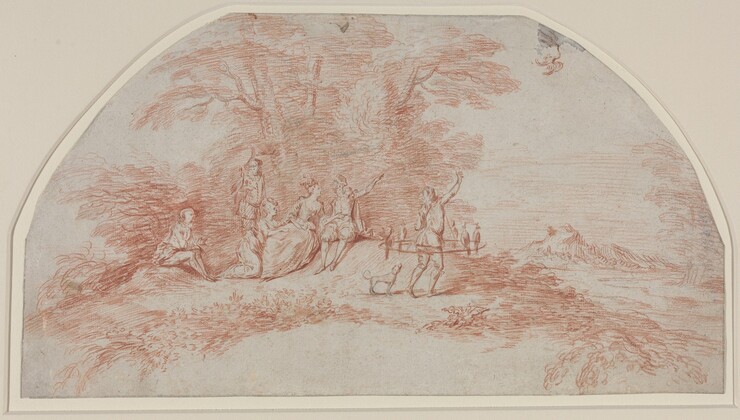
Antoine Watteau, French, 1684 - 1721, A Fête Galante with Falconers, c. 1711-1712, red chalk over graphite on laid paper, Gift of Neil and Ivan Phillips, 1988.1.1
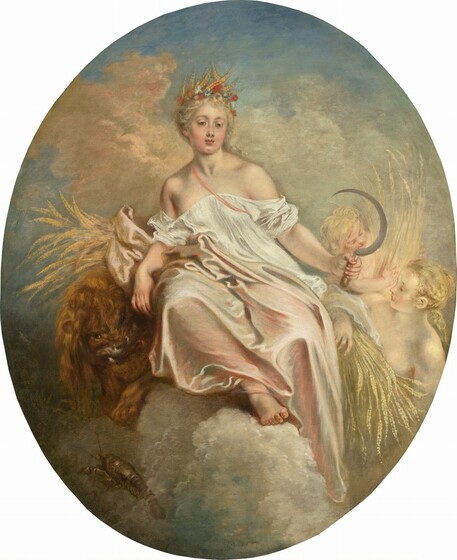
Ceres, Roman goddess of the harvest, is surrounded by signs of the summer zodiac: Gemini, Cancer, and Leo. This is one of four paintings of the seasons in mythological garb that Watteau painted for the home of Pierre Crozat. None of the others survive.
Watteau lived briefly in the Crozat household, studying the wealthy banker's impressive art collection, particularly works by Veronese. The shimmering brightness and lively pastel colors in Ceres reflect the influence of the Venetian painter and soften her large figure and formal pose.
Watteau was probably introduced to Crozat by Charles de La Fosse, a well-known painter and established member of the Academy, and it is likely that Watteau painted Ceres after sketches made by the older artist. Their collaboration stands at the transition between the monumental forms of the preceding century and the rococo.
Antoine Watteau, French, 1684 - 1721, Ceres (Summer), c. 1717/1718, oil on canvas, Samuel H. Kress Collection, 1961.9.50
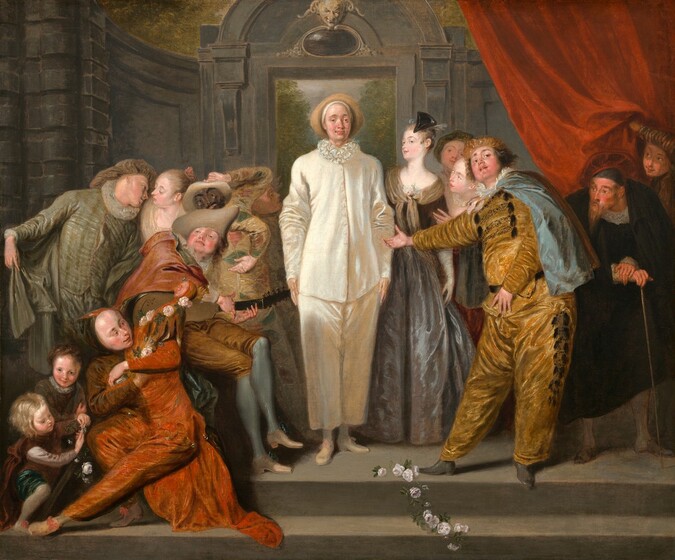
A troupe of the popular Italian comedy (commedia dell'arte) is gathered on stage, perhaps at curtain call. Standing awkwardly in the center is the vulnerable figure of Pierrot, the simple-minded valet and unlucky lover who was the most human of the commedia's stock characters. Scaramouche, the braggart, introduces him while the other characters interact around the strangely still Pierrot.
A brilliant draftsman, Watteau frequently sketched friends posed in theatrical costumes. Possibly their faces, not those of actors, are painted here. It has been suggested that the figures illustrate the passage from youth on the left to old age on the right, or that the melancholic Watteau saw himself in the sad Pierrot. Watteau's intention was to evoke a mood, not simply describe a scene, and his greatest paintings, like this one, remain puzzling and oddly poignant.
Italian Comedians was among Watteau's last works. Ill most of his life, he traveled to England in 1719 for treatment by the fashionable physician Robert Mead. This painting was probably the doctor's payment. Unfortunately, Watteau died of tuberculosis soon after, not yet thirty-seven years old.
Antoine Watteau, French, 1684 - 1721, The Italian Comedians, probably 1720, oil on canvas, Samuel H. Kress Collection, 1946.7.9
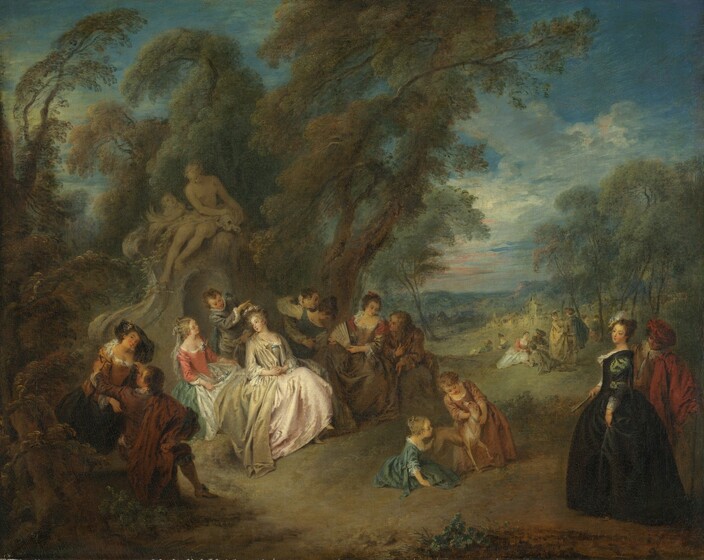
In this lush park elegant young aristocrats flirt, dance, and engage in intimate conversation, each couple an "episode" in the progress of courtship. Their anecdotal character makes Pater's paintings less ambiguous than Watteau's enigmatic works, which a contemporary criticized as having "no subject."
Pater studied under Watteau—who admitted to being an impatient master—and took over his commissions after he died. Haunted by fear of poverty, Pater worked incessantly but also rather mechanically, reusing figure groups and motifs from one painting to the next. He was received by the Academy as a painter of "modern subjects," and more than six hundred of his fêtes galantes survive today.
Several of the poses in this painting and Pater's unfinished On the Terrace can be traced to seventeenth-century Flemish artist Peter Paul Rubens, whose works could be seen in Paris during the 1700s. The dark dress of the woman on the right, fashionable in the preceding century, and the garden sculpture of Venus, which underscores the painting's focus on love, also reflect his influence. But Pater, in keeping with rococo tastes, has refined Rubens' robust figures. They are composed in graceful groups, their fine silks painted with cool, powdery colors, applied in feathery brushstrokes.
Jean-Baptiste Joseph Pater, French, 1695 - 1736, Fête Champêtre, c. 1730, oil on canvas, Samuel H. Kress Collection, 1946.7.19
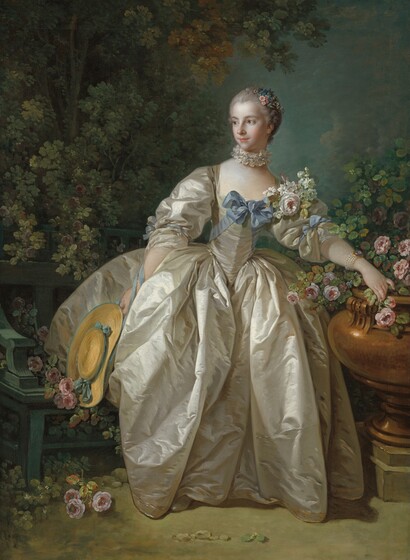
As a young artist, Boucher engraved the works of Watteau for publication. Engravings like his, often with verses added, spread the rococo style across Europe. Boucher himself became the most fashionable artist in France under the patronage of Madame de Pompadour, Louis XV's powerful mistress, whose refined tastes influenced French art for two decades. It may have been either the husband or the brother of the woman in this painting who introduced the young artist to his future patron.
Of the more than one thousand paintings Boucher produced, only about twenty are portraits. Contemporaries noted that the artist had difficulty capturing a likeness, a handicap thought in the 1700s to be less severe for women's portraits than men's, since flattery could substitute for veracity. The pale colors, rich fabrics, and rustic touch of the straw hat are typical of Boucher's style. It captured the grace of a pampered way of life, in which, as a contemporary noted, "we really have nothing else to do but to seek pleasant sensations and feelings."
François Boucher, French, 1703 - 1770, Madame Bergeret, possibly 1766, oil on canvas, Samuel H. Kress Collection, 1946.7.3
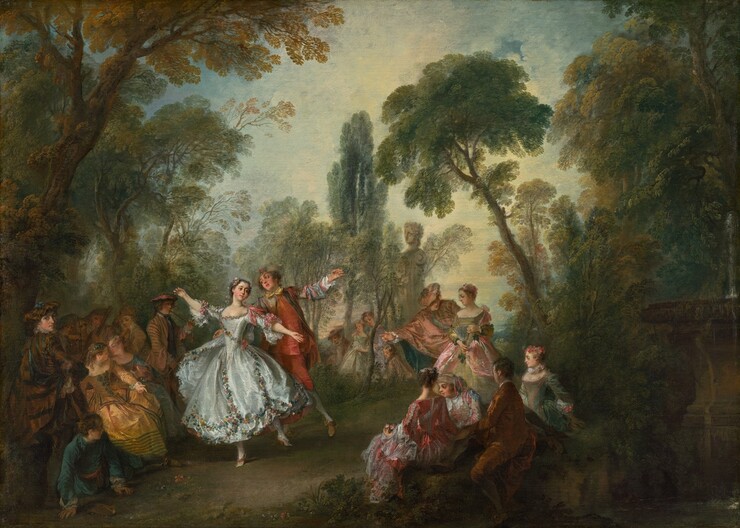
Of the artists who followed Watteau's lead, Lancret was the most talented and inventive. More a rival than an imitator, he was admitted to the Academy as a painter of fêtes galantes but also produced historical and religious paintings—and portraits, especially of actors and dancers.
In this inspired hybrid Lancret set such a portrait within the elegant garden of a fête galante. As if spotlit, the famous dancer La Camargo shares a pas de deux with her partner Laval. They are framed by lush foliage, which seems to echo their movements. Marie-Cuppi de Camargo (1710–1770) was widely praised for her sensitive ear for music, her airiness, and her strength. Voltaire likened her leaps to those of nymphs. Fashions and hairstyles were named after her, and her real contributions to dance were substantial. She was the first to shorten her skirts so that complicated steps could be fully appreciated, and some think she invented toe shoes.
Nicolas Lancret, French, 1690 - 1743, La Camargo Dancing, c. 1730, oil on canvas, Andrew W. Mellon Collection, 1937.1.89
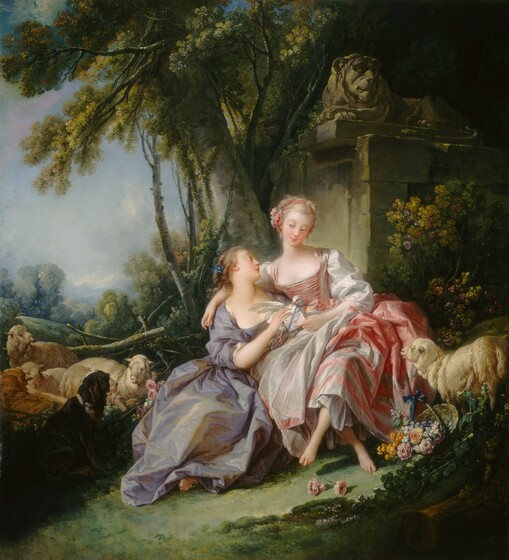
The Love Letter was commissioned by Madame de Pompadour herself. The king's mistress ordered it and a companion painting for her chateau at Bellevue, where they probably hung over doorways, built into curving oval frames. Pieces of canvas were later added at the corners to make this painting rectangular.
The scene is a pastoral idyll. The young "shepherdesses" wear fine silks, and a contemporary audience would understand an erotic promise in the display of pink toes. Idealized visions of country life were common on the stage and in real-life masquerades. Denis Diderot, disdainful of the frivolity of Boucher's scenes, complained, "Shall I never be rid of these damned pastorals?" Yet the encyclopedist, who was an influential critic, also appreciated the brilliance of Boucher's painting, which captures the luminous colors of shells, butterflies, and polished stones—objects the artist collected so he could copy their fragile iridescence.
François Boucher, French, 1703 - 1770, The Love Letter, 1750, oil on canvas, Timken Collection, 1960.6.3
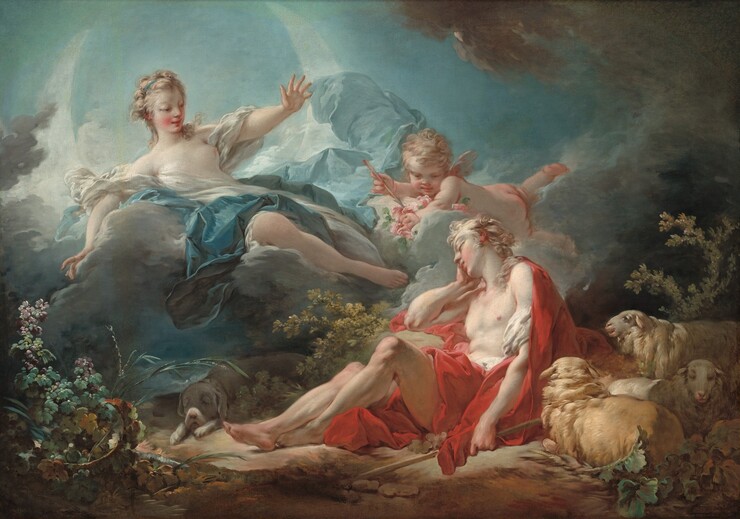
In this scene Diana, virgin goddess of the hunt, steals forth through the moonlight to kiss the sleeping shepherd Endymion, whom the gods granted eternal sleep to preserve his beauty and youth. Diana and Endymion was painted when Fragonard was still a student at the Academy and heavily influenced by Boucher, who was his teacher. It was one of several mythological vignettes set at different times of the day; another depicts Aurora (Dawn) rising. Both compositions, painted as over-door decorations, were based on designs Boucher had done for the Beauvais tapestry works. Despite similarities to the older artist's work, Diana and Endymion already displays important elements of what would become Fragonard's own style: rich colors and a fluid handling of paint.
Jean-Honoré Fragonard, French, 1732 - 1806, Diana and Endymion, c. 1753/1756, oil on canvas, Timken Collection, 1960.6.2
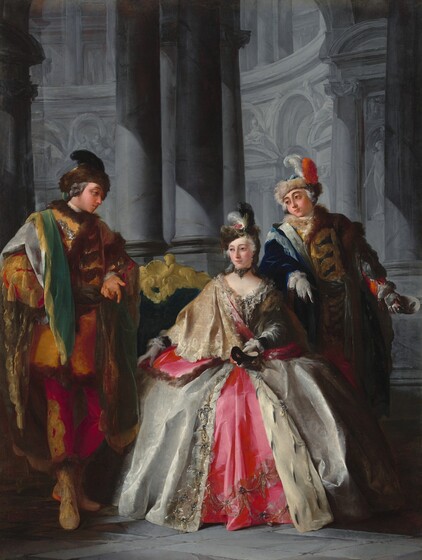
The costumes and setting here suggest a masquerade, perhaps in Venice. Like the elegant and enigmatic trio depicted, however, the painting remains mysterious. It has been attributed to many different artists, most recently Le Lorrain, a little-known artist who spent nine years in Italy and was recognized primarily as a "painter of ruins." Le Lorrain also designed interiors, furniture (including a neoclassical suite in a portrait by Greuze in the Gallery's collection), and sets for public spectacles (like Louis XV's coronation). The frosty colors and cold, hard light in this painting appear similar to those in another work by Le Lorrain, but few of his works exist for comparison. Eventually he accepted an invitation from Catherine the Great to head the Academy of Fine Arts in St. Petersburg, dying there only a few months after he arrived.
Louis-Joseph Le Lorrain, French, 1715 - 1759, Three Figures Dressed for a Masquerade, c. 1740s, oil on canvas, Samuel H. Kress Collection, 1961.9.92
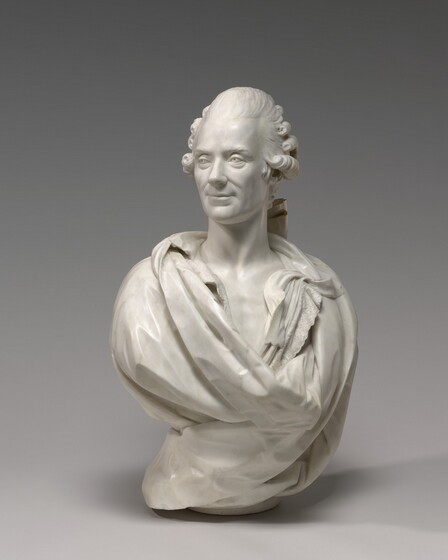
Sweeping drapery and a taut twist of the head create movement and energy in this portrait bust. The slightly parted lips, drilled pupils, and carefully detailed features—the lines etched around eyes and mouth—animate the personality of the subject, who was a counselor to Louis XV and whose son fought in the American War of Independence. Both painted and sculpted portraits of the period sought to capture more than a sitter's likeness, and Lemoyne has conveyed a sense of Cromot's strong character and lively intelligence. His voluminous robes are a convention from ancient sculpture and partly cover his informal modern dress.
Jean-Baptiste Lemoyne II, French, 1704 - 1778, Jules-David Cromot, Baron du Bourg, c. 1757, marble, Gift of Camille de Nucheze, direct descendant, and her husband, John Hadley Cox, 1985.39.1