Paul Cézanne
Overview
How should we look at Cézanne? Pablo Picasso regarded him as a "mother hovering over," Henri Matisse as "father to us all." Inevitably, our understanding of Cézanne's painting is colored by later cubism and abstraction, focusing attention on the formal aspects of his work. His reduction of the visible world into basic, underlying shapes, the faceted brushstrokes that seem to reconstruct nature through purely painterly forms, the fracture and flattening of space—all these can be seen as the beginnings of modern art. Yet Cézanne himself stressed that he painted from nature and according to his sensations, seeking to realize a "harmony parallel to nature."
Cézanne was born in Provence and spent most of his life there. He never tired of painting its sun-baked landscape. Cézanne moved to Paris in the early 1860s and associated with advanced artists such as Edouard Manet and the young impressionists. His own early works, however, were very different from theirs. His pigments were dark and heavy, applied with emphatic brushstrokes or palette knife; his subjects were "difficult," sometimes violent and erotic, deeply personal.
In the early 1870s his style changed. Working alongside Camille Pissarro in the open air, Cézanne turned to landscapes and adopted the impressionists' broken brushwork and brighter colors. He exhibited with them in 1874 and 1877. Beginning in the late 1870s and increasingly through the next decade, Cézanne's handling of paint became more ordered and systematic. Back in Provence, rejected by critics and working in isolation, his style developed independently. His "constructive stroke," as it is often described, results from penetrating analysis. It represents rather than imitates visual effects. Color relationships render the fundamental nature and connectedness of what Cézanne saw and felt. In his late paintings, those made after about 1895, these color harmonies become more sonorous, autumnal, and the paintings more meditative and melancholy.
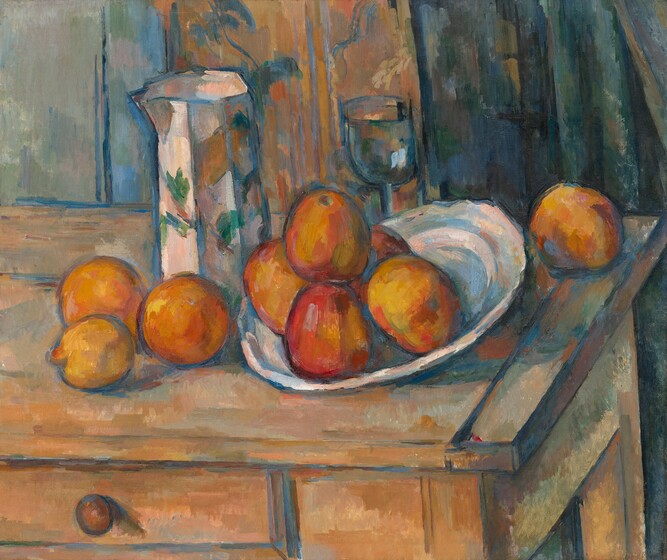
Still Life with Milk Jug and Fruit, c. 1900, oil on canvas, Gift of the W. Averell Harriman Foundation in memory of Marie N. Harriman, 1972.9.5
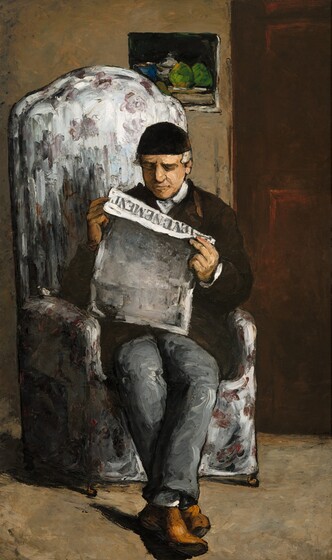
Cézanne's relationship with his father was not an easy one. The elder Cézanne, a successful banker, was unimpressed with his son's intention to become a painter. Some of the tension between them can be sensed here: the father seems precarious on the edge of his overlarge, chintz-covered "throne," his toes barely contained on the painted surface. The newspaper is not the journal that the senior Cézanne habitually read. It betrays Cézanne's intentions: it was in this newspaper, L'Événement, that Cézanne's boyhood friend Emile Zola had published favorable reviews of painters like Gustave Courbet and Manet.
The small framed picture behind Cézanne's father makes another pointed statement. It is a still life Cézanne had painted a short while before. Here it becomes an emblem for his career and devotion to a bold, modern manner. It and the portrait are both aggressively painted—"with a pistol," a critic said. The paints are thick—some applied with a heavily laden brush, others troweled on in thick runnels with a palette knife. This is typical of Cézanne's early works, as are the dark, somber colors, blacks and grays. It was impressionist Pissarro, Cézanne would say later, who rid his palette of "black, bitumen, burnt sienna. . . . "
The Artist's Father, Reading "L'Événement", 1866, oil on canvas, Collection of Mr. and Mrs. Paul Mellon, 1970.5.1
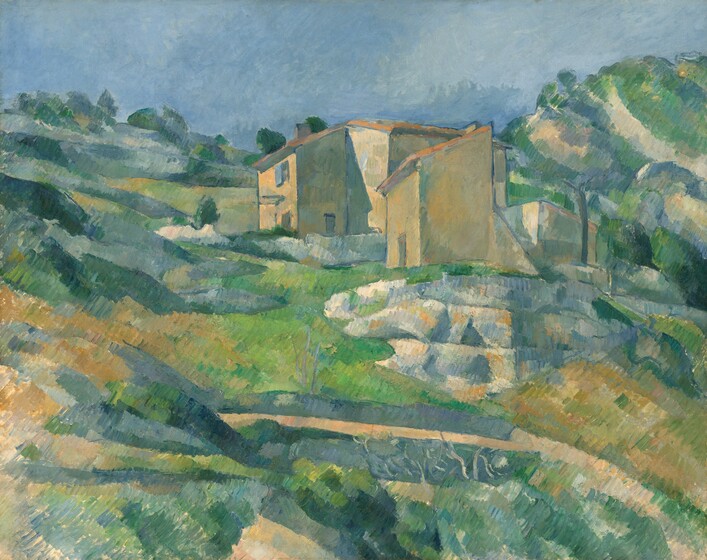
In the late 1870s and 1880s Cézanne tried to impose greater order in his paintings by systematizing his brushwork. Here, almost every part of nature is defined by the same close parallel strokes. This landscape is more fully finished than several others in the Gallery's collection. In Riverbank (c. 1895), for example, the primed white of the canvas shows through thinly washed pigments. It is difficult to know whether Cézanne considered the work complete; the color scheme and harmonies seem yet to be worked out. For Cézanne, these harmonies were all important. He modulated hues to ensure that, like notes in music, all were in proper relation to each other. In this painting, blue shadows help unify the surface. All the colors have an equal intensity, and this, combined with the uniform brushstrokes, tends to flatten the space—there is no distinction between near objects and far ones.
Many of the places Cézanne painted have been identified, including this spot near L'Estaque. By comparing his pictures with the actual locations, it becomes clear that he often moved his easel, juxtaposing different points of view as he worked over successive days.
Houses in Provence: The Riaux Valley near L'Estaque, c. 1883, oil on canvas, Collection of Mr. and Mrs. Paul Mellon, 1973.68.1
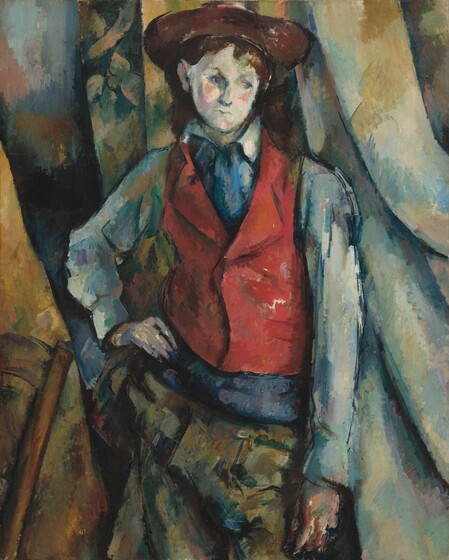
This is, at once, an astonishingly modern painting and one that reflects Cézanne's admiration for and connection to the past. He said himself that he "wanted to make of impressionism something solid and durable like the art of the museums." The boy's pose is that of an academic life study, and for some art historians it has recalled the languid elegance of sixteenth–century portraiture. As a young man in Paris, Cézanne had learned his art not only from his impressionist colleagues but also through studying old masters in the Louvre.
On the other hand, it is possible to see this so–called portrait as an entity of shapes and colors. Notice the paints used in the hands and face: these greens and mauves have little to do with human flesh. The almost dizzying background of angles and gentle arcs, which are difficult at first to "read" as draperies and a chair back, divide space rather than define it. A work such as this looks forward to the reconstructed pictorial space of the cubists Georges Braque and Pablo Picasso, leading one noted critic to write, "Cézanne's art . . . lies between the old kind of picture, faithful to a striking or beautiful object, and the modern 'abstract' kind of painting, a moving harmony of color touches representing nothing."
Boy in a Red Waistcoat, 1888-1890, oil on canvas, Collection of Mr. and Mrs. Paul Mellon, in Honor of the 50th Anniversary of the National Gallery of Art, 1995.47.5
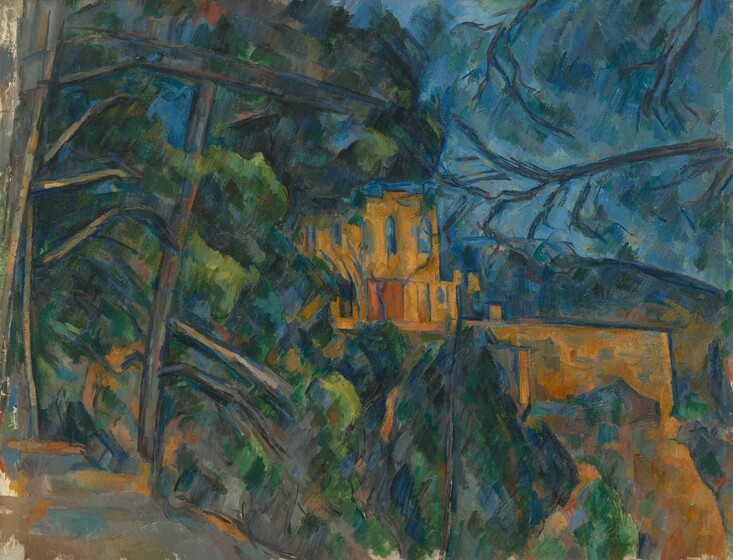
Cézanne's paintings after about 1895 are more somber, more mysterious than those of earlier years. His colors deepen, and his brushwork assumes greater expression. Spaces become more enclosed. Compare this landscape with Houses in Provence: The Riaux Valley near L'Estaque, c.1883, executed 20 years earlier.
That painting is open, while a web of branches screens this one. This place is crabbed and remote—much more difficult and forbidding. Compare the skies, too. This blue is no longer airy, but leaden, darkened with touches of purple and green. Even the pale buildings have been replaced by a deeper ocher. Late in his life Cézanne was attracted not only to the fundamental order of nature, but also its chaos and restlessness. The moody loneliness of this place seems matched to his own. He painted Château Noir several times. It was the subject of local legends and had earlier been called Château Diable, "Castle of the Devil." With its Gothic windows and incomplete walls, it has the look of a ruin.
Cézanne still painted in the open air, directly in front of his subject, as impressionist Camille Pissarro had encouraged him to do. But this is far from a quick recording of fleeting visual effects. It is a long and intense meditation, an attempt to "realize"—to use Cézanne's word—his complete sensation of this place, which involves his temperament, his vision, and his mind equally.
Château Noir, 1900/1904, oil on canvas, Gift of Eugene and Agnes E. Meyer, 1958.10.1
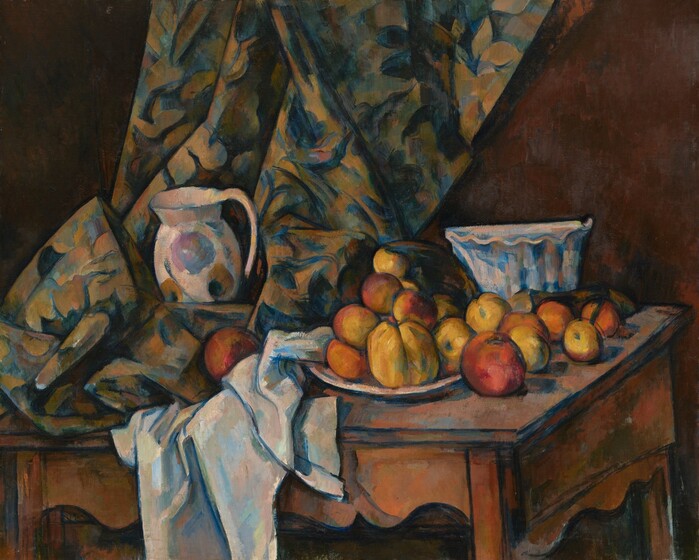
"The eye must grasp, bring things together," Cézanne said, "The brain will give it shape." In a still life, where the artist also creates the world he paints, each object, each placement, each viewpoint represents a decision. Cézanne painted and repainted the objects pictured here many times. The table, patterned cloth, and flowered pitcher were all props he kept in his studio. Every different arrangement was a new exploration of forms and their relationships.
Here the table tilts unexpectedly, defying traditional rules of perspective. Similarly, we see the pitcher in profile but are also allowed a look down into it. Paradoxically, it is Cézanne's fidelity to what he saw that accounts for this "denial" of logic and three–dimensional space. It is not so much that he is deliberately flattening space. Rather he is concentrating on the objects themselves instead of the perspectival scheme—the "box of air"—in which they exist. Cézanne worked slowly and deliberately. Over the course of days, he would move his easel, painting different objects—or even the same one—from different points of view. Each time, he painted what he saw. It was his absorption in the process of painting that pushed his work toward abstraction.
Still Life with Apples and Peaches, c. 1905, oil on canvas, Gift of Eugene and Agnes E. Meyer, 1959.15.1
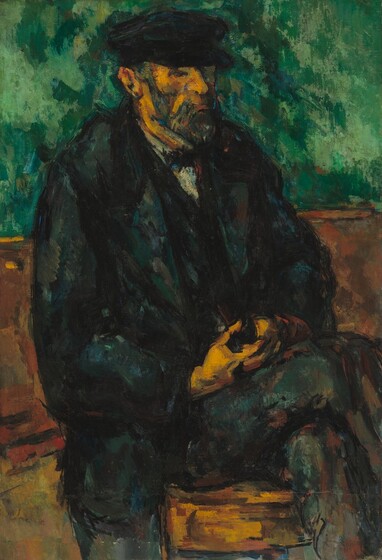
This portrait of Cézanne's longtime gardener is one of the paintings he was working on in the days just before his death. It occupied him for quite some time. A look at the canvas from an angle reveals heavy ridges of paint, especially along the contours where one shape meets another. Around Vallier's head extends a thick, dark penumbra—evidence of extensive reworking. Similar evidence of his struggles to attain just the right contour can be seen on many of his late works. Pigments on Vase of Flowers (1900/1903), for example, bubble up on the surface of the canvas.
Dark colors contribute to a sense of airlessness, even gloom. Little characterization comes from the face—more than expression it is the gardener's pose that conveys his simple, solid nature. Cézanne apparently attached great importance to this painting, one of several of Vallier begun several years earlier. He told visitors who saw it still unfinished in his studio, "If I succeed with this fellow, it will mean that the theory was correct." As late as 1906, the year he died, associates said Cézanne was still planning to "write out his ideas on painting." But he did not. We have only letters and comments recalled by others. Out of context, many seem contradictory, and others are colored by the ideas of those reporting them.
The Gardener Vallier, 1906, oil on canvas, Gift of Eugene and Agnes E. Meyer, 1959.2.1