


Bagpipe Player
1624
Hendrick ter Brugghen
Painter, Dutch, 1588 - 1629
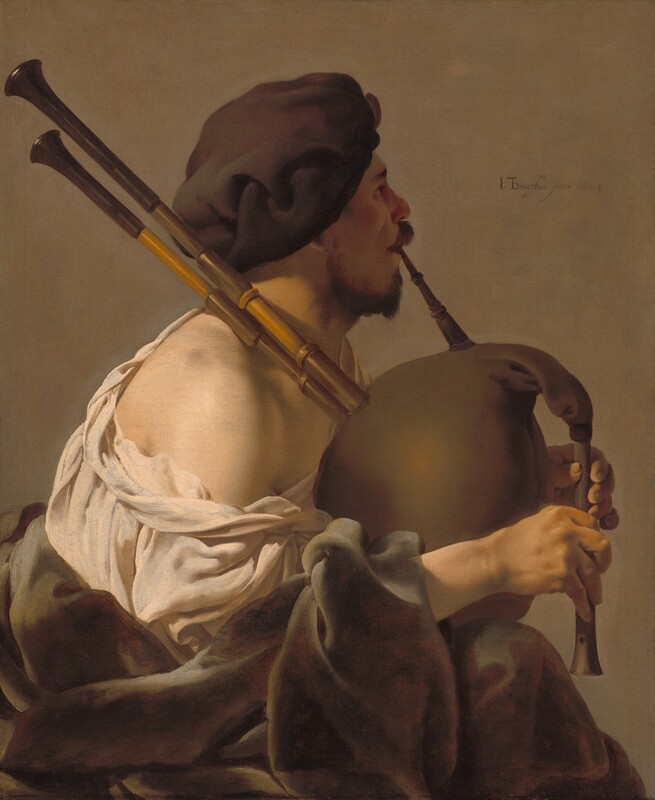
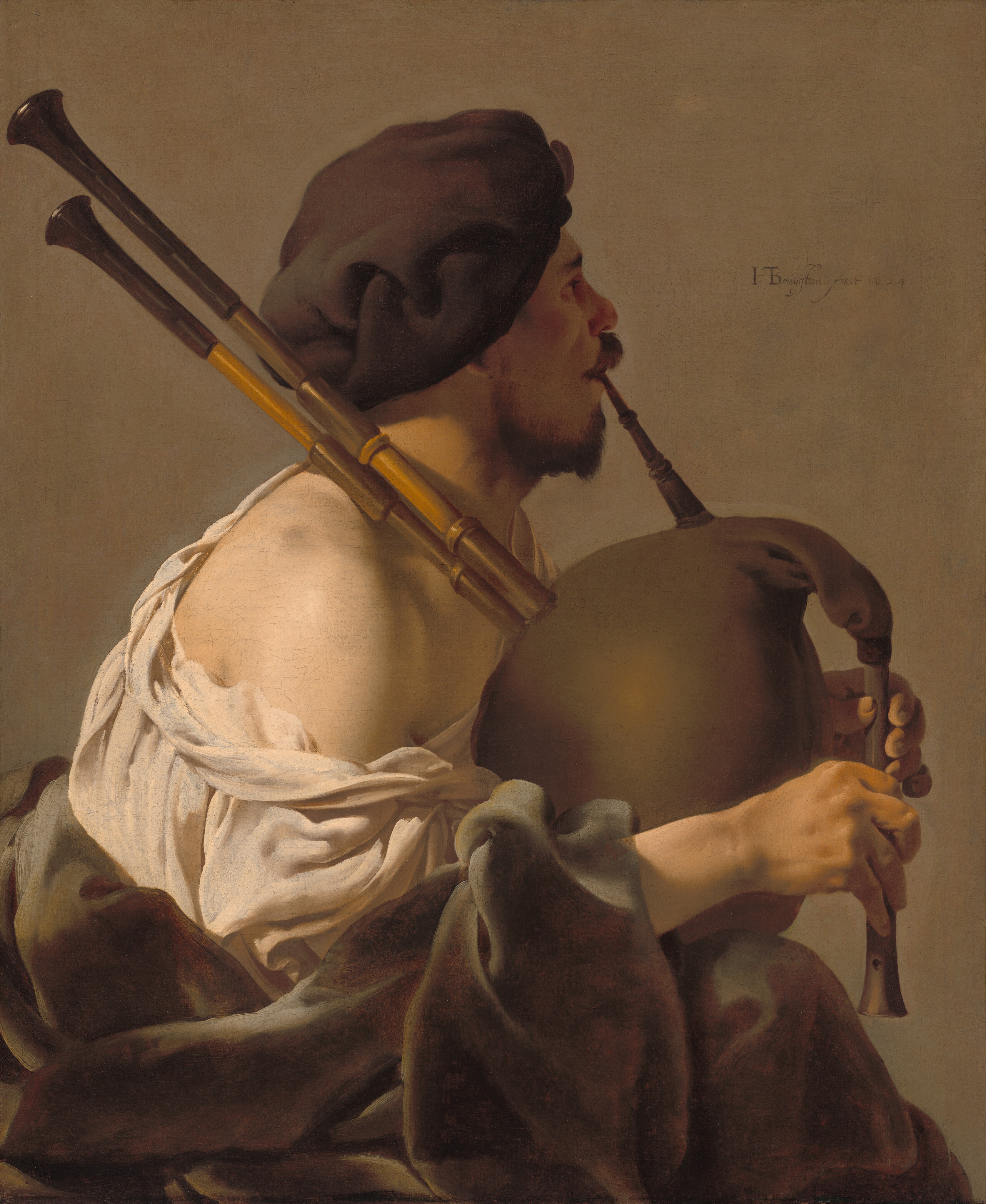
Hendrick ter Brugghen excelled at capturing the rhythms of music in the very way he composed his paintings. In this remarkable image a bagpipe player, seen in strict profile, squeezes the leather bag between his forearms as he blows through the instrument’s pipe and fingers a tune on the chanter. Two large drones, composed of different wooden sections, rest on his bare shoulder. The interlocking rhythms of this ensemble—the broad, round shapes of the musician’s shoulder, beret, and brown bagpipe bag; the flowing patterns of folds in his creamy shirt and taupe robe; the pronounced diagonals of the drones and pipe; and the verticality of the chanter—parallel those of a musical score. Ter Brugghen’s Bagpipe Player should be seen as part of a broad cultural interest in depictions of the idyllic pleasures of country existence, particularly as experienced through music. Ter Brugghen fully embraced this theme in a series of paintings of musicians and singers that capture both the joy and the sensuality of life.
The specific character of this painting, depicting a single, larger-than-life-size musician against a plain grayish ocher background, owes much to the influence of Gerrit van Honthorst (1592–1656) and Dirck van Baburen (c. 1595–1624), Dutch Caravaggist painters who returned to Utrecht from Rome in 1620. They brought with them a new sensuous style appropriate for expressing the idealized concepts of arcadian subject matter that they adapted from paintings by Caravaggio (1571–1610) and his followers. In 1624 Ter Brugghen painted no fewer than five separate compositions devoted to music, featuring not only bagpipe players but also musicians—sometimes singing—who play the lute and the violin. He continued this interest in the years to follow.
West Building Main Floor, Gallery M44
Artwork overview
-
Medium
oil on canvas
-
Credit Line
-
Dimensions
overall: 100.7 x 82.9 cm (39 5/8 x 32 5/8 in.)
framed: 129.54 × 111.76 × 7.62 cm (51 × 44 × 3 in.) -
Accession Number
2009.24.1
More About this Artwork
Artwork history & notes
Provenance
Possibly Aernout van Lingen, Utrecht, by 1676.[1] probably with (Glenz, Berlin), in 1915;[2] possibly Gustav Klemperer Edler von Klemenau [1852-1926], Dresden; his son, Dr. Herbert von Klemperer [1878-1951], Berlin;[3] (sale, Lange, Berlin, 18-19 November 1938, no. 151); acquired by Wallraf-Richartz-Museum, Cologne, inv. no. 2613; restituted July 2008 to Klemperer's heirs; (sale, Sotheby's, New York, 9 January 2009, no. 40); (Johnny Van Haeften London Ltd., London; Otto Naumann, New York; Bernheimer Fine Art Ltd., Munich); purchased April 2009 by NGA.
[1] The inventory of Aernout van Lingen, "raad in de Vroedshap," which was made in Utrecht in 1676, lists: "Een saakpijp van Ter Brugghen." The inventory, first published by Marten Jan Bok ("Hendrick Jansz. ter Brugghen," in Albert Blankert et al., Nieuw Licht op de Gouden Eeuw; Hendrick ter Brugghen en tijdgenoten, exh. cat., Centraal Museum, Utrecht; Herzog Anton Ulrich-Museum, Braunschweig, 1986-1987: 71), is in the Gemeentearchief Utrecht, Stadsarchief II, inv. no. 3146, 1676.
[2] A. von Schneider, Caravaggio und die Niederländer, Marburg-Lahn, 1933; 2nd ed., Amsterdam, 1967: 140.
[3] Dr. Klemperer was forced to surrender the painting when he left Germany in 1938.
Associated Names
Exhibition History
1984
Masters of Seventeenth-Century Dutch Genre Painting, Philadelphia Museum of Art; Gemäldegalerie, Staatliche Museen Preussischer Kulturbesitz, Berlin; Royal Academy of Arts, London, 1984, no. 24, pl. 9 (shown only in Philadelphia and Berlin).
2000
Dipingere la musica: strumenti in posa nell'arte del cinque e seicento, Santa Maria della Pietà, Cremona; Kunsthistorisches Museum at Palais Harrach, Vienna, 2000, no. I.22, repro.
2011
Larger than Life: Ter Brugghen's Saint Sebastian Tended by Irene, National Gallery of Art, Washington, D.C., 2011, no catalogue.
2018
In the Light of Caravaggio: Dutch and Flemish Paintings from Southeastern Museums, Muscarelle Museum of Art, Williamsburg, 2018, no catalogue.
Bibliography
1933
Schneider, Arthur von. Caravaggio und die Niederländer. 2nd ed. Marburg/Lahn, 1933: 140.
1938
Sammlung B., Wien, die Bestände der Firma Ziffer i. L., Berlin, Porzellan aus der Sammlung R., Wien, Frankfurter und anderer Privatbesitz (zum Teil nichtarisch). Berlin, 1938: 9, no. 151, repro.
1939
Moltke, Joachim Wolfgang von. "Ein unbekanntes Bild von Hendrik Terbrugghen." Wallraf-Richartz-Jahrbuch 11 (1939): 283–285, fig. 208.
Förster, Otto H., ed. Wallraf-Richartz-Museum der Hansestadt Köln. 2 vols. Wallraf-Richartz-Jahrbuch 11. Cologne, 1939: 308.
May, Helmut. "Das Wallraf-Richartz-Museum in Köln." _Die Weltkunst _ 13, nos. 24-25 (June 1939): 1, repro.
1941
May, Helmut. Die Niederländischen, Französischen, Italienischen und Spanischen Gemälde. Wallraf-Richartz-Museum der Hansestadt Köln 2. Cologne, 1941: 133.
1954
Wentzel, Hans. "Unbekannte Werke Terbrugghen in Dänemark und Schweden." _Die Kunst und das Schöne Heim _ 52 (4 January 1954): 124.
1955
Nicolson, Benedict. "Notable Works of Art now on the Market." The Burlington Magazine 97, no. 633 (December 1955): unpaginated, pl. XVIII.
1956
Nicolson, Benedict. "The Rijksmuseum 'Incredulity' and Terbrugghen's Chronology." The Burlington Magazine 98, no. 637 (April 1956): 108, 110.
1957
Wallraf-Richartz-Museum. Führer durch die Gemäldegalerie. Cologne, 1957: 92.
Nicolson, Benedict. "Ter Brugghen Repeating Himself" in Miscellanea Prof. Dr. D. Roggen. Antwerp, 1957: 194.
1958
Nicolson, Benedict. Hendrick Terbrugghen. London, 1958: 10, 16, 41, 104, 108, 118, no. A17, pl. 48.
1959
Wallraf-Richartz-Museum. Verzeichnis der Gemälde. Cologne, 1959: 166.
1960
Plietzsch, Eduard. Holländische und flämische Maler des XVII. Jahrhunderts. Leipzig, 1960: 146, fig. 250.
1961
Judson, J. Richard. "Review of Hendrick Terbrugghen by Benedict Nicolson." The Art Bulletin 43 (December 1961): 346.
1965
Slatkes, Leonard J. Hendrick Terbrugghen in America. Exh. cat. Dayton Art Institute; Baltimore Museum of Art. Dayton, 1965: 12.
Wallraf-Richartz-Museum. Verzeichnis der Gemälde. Cologne, 1965: 166.
Slatkes, Leonard J. Dirck van Baburen (c. 1595-1624); a Dutch painter in Utrecht and Rome. Orbis artium: Utrechtse Kunsthistorische Studiën 5. Utrecht, 1965: 158.
1966
Osten, Gert von der. Wallraf-Richartz-Museum Köln. Köln, 1966: 15, 62, fig. 237, repro.
Osten, Gert von der. Wallraf-Richartz-Museum Köln. Köln, 1966:15, 62, fig. 237, repro.
1967
Schneider, Arthur von. Caravaggio und die Niederländer. Reprint of 1933 edition. Amsterdam, 1967: 140.
Vey, Horst, and Anna Maria Kesting. Katalog der niederländischen Gemälde von 1550 bis 1800 im Wallraf-Richartz-Museum. Cologne, 1967: 26, fig. 26.
1978
Wright, Christopher. The Dutch Painters: 100 Seventeenth Century Masters. London, 1978: 192.
1979
Nicolson, Benedict. The international Caravaggesque movement: lists of pictures by Caravaggio and his followers throughout Europe from 1590 to 1650. Oxford, 1979: 100.
1981
Wright, Christopher. A golden age of painting: Dutch and Flemish paintings of the seventeenth century from the collection of the Sarah Campbell Blaffer Foundation. San Antonio, 1981: 96.
1984
Sutton, Peter C. Masters of Seventeenth-Century Dutch Genre Painting. Edited by Jane Iandola Watkins. Exh. cat. Philadelphia Museum of Art; Gemäldegalerie, Staatliche Museen Preussischer Kulturbesitz, Berlin; Royal Academy of Arts, London. Philadelphia, 1984: 168, no. 24, pl. 9.
Brown, Christopher. "Hendrick ter Brugghen." In Von Frans Hals bis Vermeer: Meisterwerke holländischer Genremalerei. Edited by Peter C. Sutton. Exh. cat. Philadelphia Museum of Art Gemäldegalerie, Staatliche Museen Preussischer Kulturbesitz, Berlin; Royal Academy of Arts, London. Berlin, 1984: 130, 131, no. 24, repro.
1986
Bok, Marten Jan. "Hendrick Jansz. ter Brugghen." In Holländische Malerei in neuem Licht: Hendrick ter Brugghen und seine Zeitgenossen. Edited by Albert Blankert and Leonard J. Slatkes. Exh. cat. Centraal Museum, Utrecht; Herzog Anton Ulrich-Museum, Braunschweig. Braunschweig, 1986: 71.
Blankert, Albert, and Leonard J. Slatkes. Nieuw licht op de Gouden Eeuw: Hendrick ter Brugghen en Tijdgenoten. Exh. cat. Centraal Museum, Utrecht; Herzog Anton Ulrich-Museum, Braunschweig. Utrecht, 1986: 113, fig. 79.
Hesse, Christian, and Martina Schlagenhaufer, eds. Wallraf-Richartz-Museum Köln, vol. 1: Vollständiges Verzeichnis der Gemäldesammlung, vol. 2: Von Stefan Lochner bis Paul Cézanne: 120 Meisterwerke der Gemäldesammlung. 2 vols. Cologne, 1986: 1:15-16, fig. 285; 2:148-149, color repro.
1989
Nicolson, Benedict. Caravaggism in Europe. 3 vols. Archivi di storia dell'arte. 2nd ed. Turin, 1989: 1:192, no. 129.
1990
Le Bihan, Olivier. L'Or & l'Ombre: catalogue critique et raisonné des peintures hollandaises du dix-septième et du dix-huitième siècles, conservées au Musée des beaux-arts de Bordeaux. Bordeaux, 1990: 73, 74.
1991
Brown, Christopher. Brief Encounters: Ter Brugghen: Jacob reproaching Laban. Exh. cat. National Gallery, London, 1991: unpaginated, repro.
Brown, Christopher. Hendrick ter Brugghen (1588-1629) 'Jakob, Laban und Lea', ein Bild in Vergleich. Exh. cat. Wallraf-Richartz-Museum, Cologne, 1991: 5, 14, fig. 9.
1993
Mai, Ekkehard, ed. Das Kabinett des Sammlers: Gemälde vom XV. bis XVII. Jahrhundert. Cologne, 1993: 250.
1994
Huys Janssen, Paul. "Jan van Bijlert (1597/98-1671), schilder in Utrecht." Ph.D. dissertation, Rijksuniversiteit Utrecht, 1994: 166.
1996
Slatkes, Leonard J. "Bringing Ter Brugghen and Baburen Up-to-Date." Bulletin des du Musée National de Varsovie 37 (1996): 210, 212, 213, 216, fig. 8.
1998
Huys Janssen, Paul. Jan Van Bijlert, 1597/98-1671: catalogue raisonné. Oculi 7. Amsterdam, 1998: 139.
1999
White, Christopher. Ashmolean Museum Oxford, catalogue of the collection of paintings: Dutch, Flemish, and German paintings before 1900. Oxford, 1999: 24.
2000
Gruber, Gerlinde. "Hendrick Terbrugghen." In Dipingere la musica: strumenti in posa nell'arte del cinque e seicento. Edited by Sylvia Ferino Pagden and Luiz C. Marques. Exh. cat. Santa Maria della Pietà, Cremona; Kunsthistorisches Museum, Vienna. Milan, 2000: 116-117, no. I.22, repro.
2001
Gruber, Gerlinde. "Hendrick Terbrugghen." In Dipingere la musica: Musik in der Malerei des 16. und 17. Jahrhunderts. Edited by Sylvia Ferino Pagden, Luiz C. Marques and Wilfried Seipel. Exh. cat. Kunsthistorisches Museum, Vienna. Milan, 2001: 142-143, no. I.22, repro.
.
2004
Harrison, Colin, Catherine Casley, and Jon Whiteley. The Ashmolean Museum: complete illustrated catalogue of paintings. Oxford, 2004: 35.
2005
Sutton, Peter C. Old master paintings from the Hascoe collection. Exh. cat. Bruce Museum of Arts and Science, Greenwich, Connecticut, 2005: 10.
2007
Slatkes, Leonard J., and Wayne E. Franits. The paintings of Hendrick ter Brugghen, 1588-1629: Catalogue raisonné. Oculi 10. Amsterdam, 2007: 50-51, 57, 118, 130n, 165-167, 171, 185-187, 193, 194, 218, 271, 377, cat. no. A71, pl. 70.
2009
Wheelock, Arthur K., Jr. "Hendrick ter Brugghen, Bagpipe Player." Bulletin / National Gallery of Art, no. 41 (Fall 2009): 14-16, 99-100, repro.
Pollock, Lindsay. "Old Masters Survive Test." The Art Newspaper 200 (March 2009): 47, repro.
Lopez, Jonathan. "A Holland - America Line: The National Gallery’s Acquisition of a Major Ter Brugghen Opens a Window on the History of Taste." Art and Antiques (May 2009): 42–44, repro.
2010
Wheelock, Arthur K., Jr. "A Painting by Hendrick ter Brugghen Acquired by the National Gallery of Art, Washington." The Burlington Magazine 32 (5 February 2010): 99-100.
2011
Bok, Marten Jan. "Een leven lang leren." Kunstschrift 55, no. 5 (October/November 2011): 28, 33, caption for fig. 38. [Fig. 38 shows the Oxford Ashmolean Portrait of a Man Playing the Bagpipes]
2014
Wheelock, Arthur K, Jr. "The Evolution of the Dutch Painting Collection." National Gallery of Art Bulletin no. 50 (Spring 2014): 2-19, repro.
2016
Warner-Johnson, Tim, and Jeremy Howard, eds. Colnaghi: Past, Present and Future: An Anthology. London, 2016: 188-189, color plate 3.
2020
Wheelock, Arthur K., Jr. Clouds, ice, and Bounty: The Lee and Juliet Folger Collection of Seventeenth-Century Dutch and Flemish Paintings. Exh. cat. National Gallery of Art, Washington, D.C., 2020: 38, fig. 17, 40.
Inscriptions
upper right, in brown paint, HTB in monogram: HTBrugghen fecit 1624
Wikidata ID
Q20177033