


Skating on the Frozen Amstel River
1611
Adam van Breen
Artist, Dutch, c. 1585 - 1640
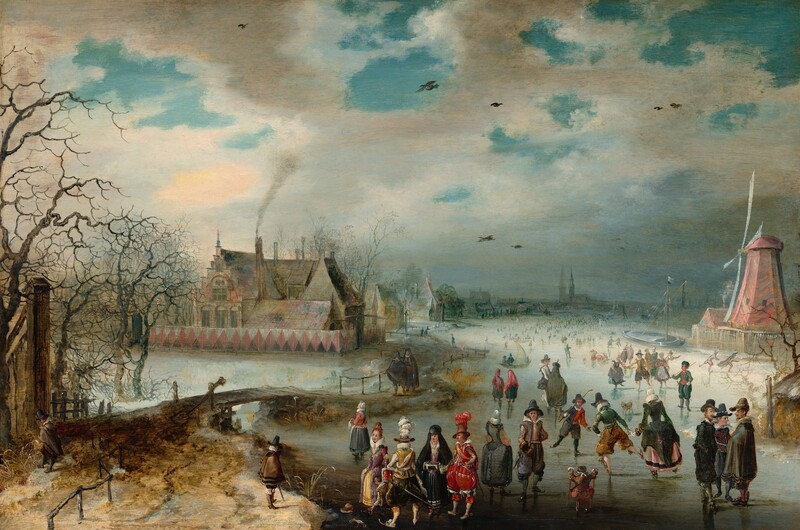
In this winter landscape, aristocrats, burghers, countrymen, and orphans take to the ice of the frozen Amstel River. From a young boy propelling himself with sticks on a prikslee (small push-sled) to the group of three stately men with no skates conversing by the riverbank, each of Van Breen's figures colorfully brings to life the possible actions and interactions of a winter's day on the ice. On the right, a man and woman glide hand-in-hand with the wide stride typical of Dutch 17th-century skating. The man's green jerkin and gold breeches tied at the knees with ribbon and the woman's black vlieger, a long garment worn over the bodice and skirt, reflect the height of early 17th-century fashion. As they skate, a young boy from the Amsterdam Burgerweeshuis (city orphanage), recognizable by his red and black shirt, approaches them clasping a kolf stick. Further back, men and women leisurely glide together, and a pair of boys race alongside a painted, pink mill.
Unlike many winter scenes that represent imaginary locales, this evocative landscape depicts an identifiable location on the Amstel River just south of Amsterdam. The profiles of three of the city's churches are visible in the distance: the large, wide building at the left is the Nieuwe Kerk; the distant church to its right with a tall steeple is the Oude Kerk; while the third church nearest the Amstel is the Zuiderkerk. Remarkably, the painting also depicts a large house surrounded by a painted wooden fence that can be seen on a contemporary map of the area.
West Building Main Floor, Gallery M50
Artwork overview
-
Medium
oil on panel
-
Credit Line
The Lee and Juliet Folger Fund, in honor of Arthur K. Wheelock, Jr.
-
Dimensions
overall: 44.3 × 66.5 cm (17 7/16 × 26 3/16 in.)
framed: 55.88 x 78.74 x 5.08 cm (22 x 31 x 2 in.) -
Accession Number
2010.20.1
More About this Artwork

Article: Painting Climate Change in the 17th Century
An environmental historian discusses how artists documented the Little Ice Age.

Artwork history & notes
Provenance
Foullon de Doué family, Château d'Ancise, Douy, France;[1] probably by inheritance to the d'Estampes family, Château d'Ancise;[2] (sale, at the Château de Cheverny by Philippe Rouillac, 7 June 2009, no. 40); (John Mitchell Fine Paintings, London); purchased 12 March 2010 by NGA.
[1] This information was provided by William Mitchell, e-mail to Arthur K. Wheelock, Jr., 22 February 2010, in NGA curatorial files. Douy is a small village in the Eure et Loir province of France, southwest of Paris between Orleans and Le Mans.
[2] The d'Estampes family is given as the consignor in the 2009 sale catalogue. Preliminary research into the connections between the Foullon de Doué and d'Estampes families is documented in NGA curatorial files.
Associated Names
Exhibition History
2018
Water, Wind, and Waves: Marine Paintings from the Dutch Golden Age, National Gallery of Art, Washington, D.C., 2018, unnumbered brochure.
2021
Clouds, Ice, and Bounty: The Lee and Juliet Folger Fund Collection of Seventeenth-Century Dutch and Flemish Paintings, National Gallery of Art, Washington, 2021, no. 9, repro.
Bibliography
2010
Landsman, Rozemarijn. "Adam van Breen, Skating on the Frozen Amsetel River." National Gallery of Art Bulletin 43 (Fall 2010): 32, repro.
Mitchell, William J.. "Adam van Breen (ca. 1585-1640)." Gallery Notes [John Mitchell Fine Paintings], Special Edition (February 2010): 13-16, repro. 15, as Winter Landscape with Skaters.
Mitchell, William J. "Foreword." Gallery Notes [John Mitchell Fine Paintings] (June 2010): repro., as Winter Landscape.
2011
Landsman, Rozemarijn. "Schilderachtig Borssenburg. Schaatsen op de Amstel door Adam van Breen." Amstelodamum 98-1 (January-March 2011): 18-30, fig. 1, figs. 3, 4, 8 (details).
Inscriptions
on gable of manor house: 16011
Wikidata ID
Q20176919