


Bouquet of Flowers in a Glass Vase
1621
Ambrosius Bosschaert
Painter, Dutch, 1573 - 1621
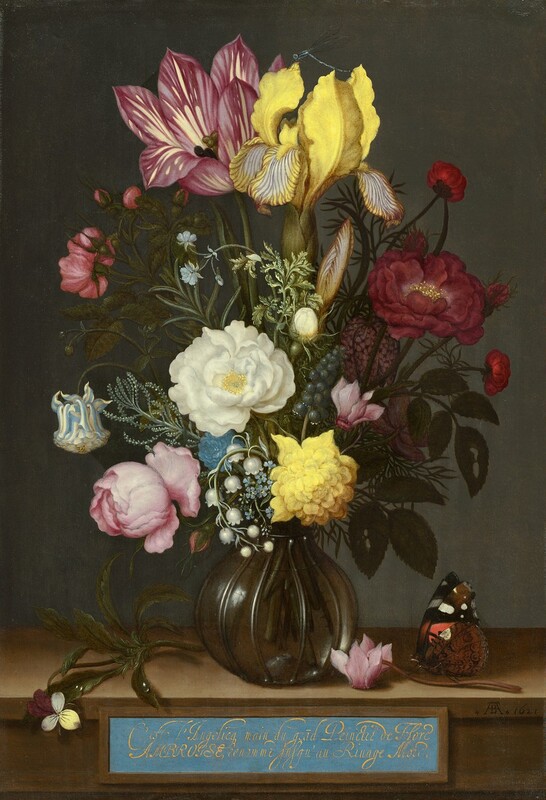
Ambrosius Bosschaert was a pioneer in the history of Dutch still lifes and a painter of joyful flower bouquets. He had an unerring awareness of composition, and delighted in combining flowers with a wide variety of colors and shapes to create a pleasing and uplifting visual experience. As in this exquisite work, Bosschaert generally arranged his blossoms symmetrically. Here, two spectacular blossoms, a yellow iris and a red-and-white striped tulip, surmount a bouquet composed of numerous species, among them roses, a blue-and-white columbine, fritillaria, grape hyacinth, lily of the valley, and a sprig of rosemary. A damselfly alighting on the iris and a butterfly on the cyclamen blossom that rests on the wooden tabletop further enliven the composition.
Following Antwerp’s reconquest by Spanish forces in 1585 and the subsequent expulsion of all non-Catholics, the Protestant Bosschaert family moved north to Middelburg in about 1589. Middelburg, a prosperous trading center and the capital of Zeeland, was renowned for its botanical gardens, the most important of which was established in the 1590s by the great botanist Matthias Lobelius. After 1602 this herb garden was transformed into a flower garden, and almost certainly filled with exotic species imported from the Balkan peninsula, the Near and Far East, and the New World. Bosschaert, who may have trained with his father, probably began his career making drawings of rare and exotic flowers in such gardens; he certainly used preparatory images drawn from life to compose his paintings, sometimes depicting individual flowers in reverse. His style of flower painting became more naturalistic over time, as he developed techniques for rendering petals with soft, velvety textures. He also introduced subtle tonal gradations in the backgrounds to enhance the sensation of light flooding the image.
Bouquet of Flowers in a Glass Vase occupies a special place in Bosschaert's oeuvre, not only because it was painted in the year of the artist’s death, but also because it contains a moving testimony to his enormous reputation. Inscribed on an illusionistic plaque attached to the table's front are the words: "C'est l'Angelicq[ue] main du gra[n]d Peinctre de Flore / AMBROISE, renommé jusqu'au Rivage Moré" (This is the angelic hand of the great painter of Flora, Ambrosius, renowned even to the banks of the Moré). The knowledge that the Moré River is located on the Gold Coast of Africa and that the name Ambrosius derives from the Greek word ambrotos, meaning "immortal," lends an even more laudatory note to the statement.
West Building Main Floor, Gallery M50
Artwork overview
-
Medium
oil on copper
-
Credit Line
-
Dimensions
overall: 31.6 x 21.6 cm (12 7/16 x 8 1/2 in.)
framed: 53.3 x 43.8 x 5.7 cm (21 x 17 1/4 x 2 1/4 in.) -
Accession Number
1996.35.1
More About this Artwork

Artwork history & notes
Provenance
Probably painted 1621 for Frederick van Schurman (or Schuermans) [1564-1623], The Hague.[1] (sale, Christie, Manson & Woods, London, 7 April 1922, no. 54); private collection, England; (John Mitchell & Sons, London); private collection, England; (Edward Speelman, Ltd., London); purchased 27 June 1996 by NGA.
[1] This painting is probably the one that Bosschaert took with him in 1621, when he traveled from Breda to The Hague to deliver a blompot (flower still-life painting) to Frederick van Schurman (or Schuermans), the bottelier of Prince Maurits. For this work Bosschaert received the extraordinary sum of 1,000 guilders. Maria Bosschaert, Ambrosius’ daughter, wrote the following: “Mijn vader Ambrosius Bosschaert is gesturven in Schravenhage in ‘t jaer als den 12 jarigen Trebes uut was, doch was woonachtig binnen Breda maer near den Hage getrocken om een blompot te leveren die hij hadde gemaeckt voor de bottelier van Sijn Hoochheyt daervoor hij dusent gulden hadde bedongen ende is aldaer sieck geworden ten huyse van joncker Schuermans, vader van Anna Maria Schuermans ende aldaer gesturven ende in Schravenhage begraven, tot droefheyt van veel liefhebbers.” See Abraham Bredius, “De bloemschilders Bosschaert,” Oud-Holland 31 (1913):138. Frederick van Schurman had been ennobled by the Holy Roman Emperor, and the phrase Maria Bosschaert used to refer to Van Schurman, a joncker (from the German Junker), is an honorary title that corresponds to the old inscription “Jonckheere …” on the verso of the painting.
Associated Names
Exhibition History
1976
The Inspiration of Nature, John Mitchell and Son, London, 1976, p. 24.
1998
A Collector's Cabinet, National Gallery of Art, Washington, D.C., 1998, no. 7, fig. 13.
Copper as Canvas: Two Centuries of Masterpiece Paintings on Copper, 1525-1775, Phoenix Art Museum; Nelson-Atkins Museum of Art, Kansas City; Royal Cabinet of Paintings Mauritshuis, The Hague, 1998-1999, not in catalogue (shown only in The Hague).
1999
From Botany to Bouquets: Flowers in Northern Art, National Gallery of Art, Washington, D.C., 1999, no. 11, fig. 32.
2000
Art for the Nation: Collecting for a New Century, National Gallery of Art, Washington, D.C., 2000-2001, unnumbered catalogue, repro.
2016
Drawings for Paintings in the Age of Rembrandt, National Gallery of Art, Washington; Fondation Custodia, Collection Frits Lugt, Paris, 2016-2017, no. 12, repro. (Washington only).
Bibliography
1973
Mitchell, Peter. European Flower Painters. London, 1973: 59, repro.
1984
Bakker, Noortje, et al. Masters of Middelburg: exhibition in the honour of Laurens J. Bol. (Exh. cat. Waterman Gallery, Amsterdam). Amsterdam, 1984: 65.
1998
Wheelock, Arthur K., Jr. A Collector's Cabinet. Exh. cat. National Gallery of Art, Washington, 1998: 24, 25, fig. 13, 65, no. 7.
1999
Wallert, Arie. Still lifes: techniques and style: the examination of paintings from the Rijksmuseum. (Exh. cat. Rijksmuseum, Amsterdam). Zwolle, 1999.
Ploeg, Peter van der. "Copper as canvas: Two centuries of masterpiece paintings on copperplate." Mauritshuis in Focus 12, no. 1 (1999): 23-24, color repro. 24, fig. 13.
Wheelock, Arthur K., Jr. From Botany to Bouquets: Flowers in Northern Art. Exh. cat. National Gallery of Art, Washington, 1999: 42-43, 83, no. 11, fig. 32.
2000
National Gallery of Art. Art for the Nation: Collecting for a New Century. Exh. cat. National Gallery of Art, Washington, 2000: 26-27, color repro.
2002
Ebert-Schifferer, Sybille. Deceptions and Illusions: Five Centuries of Trompe l'Oeil painting. Exh. cat. National Gallery of Art, Washington, 2002: 81-82, fig. 4.
2004
Hand, John Oliver. National Gallery of Art: Master Paintings from the Collection. Washington and New York, 2004: 214-215, no. 172, color repro.
2020
Wheelock, Arthur K., Jr. Clouds, ice, and Bounty: The Lee and Juliet Folger Collection of Seventeenth-Century Dutch and Flemish Paintings. Exh. cat. National Gallery of Art, Washington, D.C., 2020: 31, 56, fig. 1.
2021
Donovan, Patricia A. "Permanence in This Changing World: The Andrew W. Mellon Foundation Endowment Challenge Grant." Art for the Nation no. 64 (Fall 2021): 6, repro.
Inscriptions
lower right in monogram: .AB.1621; across bottom in blue field: C'est l'Angelicq[ue] main du gra[n]d Peinctre de Flore / AMBROISE, renommé jusqu' au Rivage Moré. (This is the angelic hand of the great painter of Flora, Ambrosius, renowned even to the banks of the Moré).
Wikidata ID
Q20177006