News Release: 31 March 1998
Washington, DC-- An edition of Scott Burton's Six-Part Seating (1985), will be fabricated in 1998 for the National Gallery of Art's Sculpture Garden, now under construction. The selection and acquisition of this sculpture, as well as major photographs by Brassaï and Misrach, and prints and drawings by Albers, Nevelson, Puryear, among others, for the twentieth-century collection, were made possible by the Gallery's Collectors Committee.
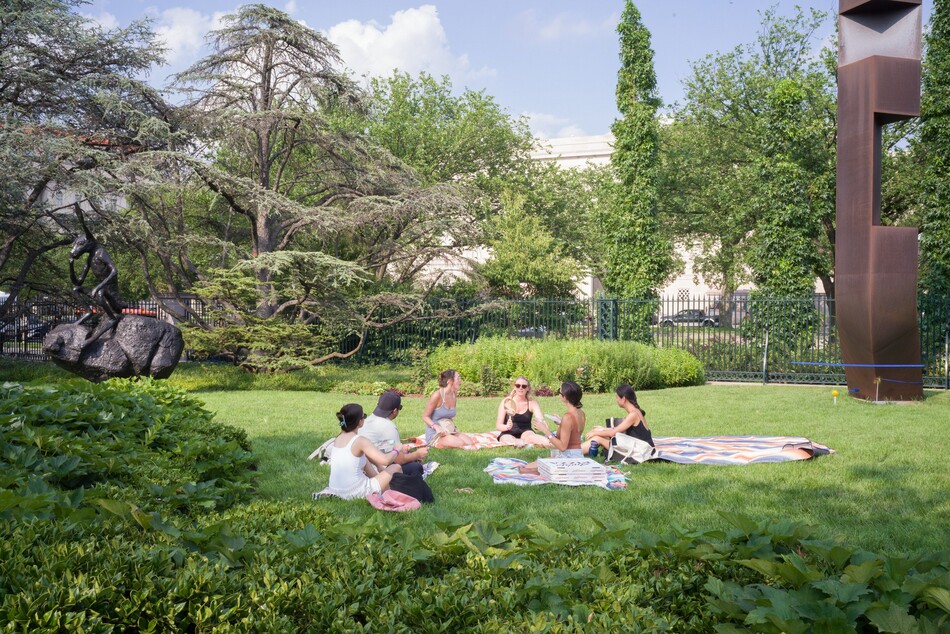
"We are delighted with the selection of Six-Part Seating, which will be made of polished granite. Visitors to our new Sculpture Garden will not only be able to view this striking work but interact with it by touching it and sitting on it," said Earl A. Powell III, director, National Gallery of Art.
This will be the second work by Scott Burton (American, 1939-1989) to enter the National Gallery's collection, joining Rock Settees (1988), a unique and popular piece near the East Building entrance. Six-Part Seating draws on the work of minimalist sculptors such as Donald Judd and Tony Smith, whose basic forms and austere structures were employed by Burton as the elements of a functional style. This work also owes a significant debt to Constantin Brancusi, the great twentieth-century sculptor who challenged strict distinctions between sculpture and the utilitarian object. In this context, Six-Part Seating clearly derives from the monumental Table of Silence (1937-1939), which Brancusi created for a park in Romania. Like Brancusi's circle of seating, Burton's group remains a powerful sculptural presence despite the functional role it serves.
Burton conceived and designed Six-Part Seating in 1985, anticipating an edition of two. The first example was produced for the Mellon Bank in Pittsburgh. As identically fabricated elements, Burton's seats may be arranged in various ways, such as in a circle (suggesting a gathering), or side-by-side in the form of a long bench. The Gallery edition will be made from polished granite (Radiant Red).
Burton emerged as a performance and installation artist during the early 1970s. Furniture--as prop, utilitarian object, and sculptural form--was his model and his preoccupying theme. He was deeply committed to art in public settings, believing that such work should be fully accessible to a broad, non-art audience.
The Collectors Committee also made possible the acquisition of seven photographs. Three are by the renowned Transylvanian born, French photographer Brassaï (Gyula Halász, 1899-1984) including two of his signature studies of Parisian night life, Couple at the Four Seasons Ball, Lappe Street, Paris (c. 1932), Magic City Dance Hall, Cognacq-Jay Street, Paris (c. 1932), and his 1948 portrait of the sculptor Alberto Giacometti. They are among the first photographs by Brassaï to enter the Gallery's collection and join ten others acquired through other donations.
Four photographs by Richard Misrach (American, born 1949) are also the first of a group of twenty-three works by him to be acquired for the Gallery's collection. These large, color photographs including Comfort Stations, Edwards Air Force Base, California (1983), Bomb, Destroyed Vehicles, and Lone Rock, Bravo 20 Bombing Range, Nevada (1987), Dead Animals #327, Nevada (1987), and Desert Croquet #1 (Deflated World), Black Rock Desert, Nevada (1987) dramatically contrast the often devastating impact of man on the sublime beauty of the American West.
Other works on paper include Burgoyne Diller's Shop Tanks (c. 1932-1933), an early lithograph revealing his interest in geometric abstraction deriving from urban subjects; Josef Albers' early drypoint, Variants (1942); six elegant Untitled pen and ink drawings by William Baziotes from the 1950s, which reveal the subtlety and range of his compositional exploration; three early 1950s etchings by Louise Nevelson, two of The Ancient Garden and one of Magic Garden; and William T. Wiley's ink and wax on paper, Untitled (1962) that reflects his early roots in abstract expressionism. Martin Puryear's 1977 chalk drawing, Untitled, evokes a mysterious sense of weight and volume and provides an intriguing counterpoint to his sculpture, Lever No. 3, which was acquired previously by the Collectors Committee.
Since 1975 the Collectors Committee has made possible the acquisition of one hundred eighty-seven works of art. Approximately half of the committee's acquisitions have been works by living artists. The committee was formed in 1975 under the leadership of Ruth Carter Stevenson, chairman of the Gallery's Board of Trustees from 1993-1997. It is currently chaired by Barney A. Ebsworth and Doris Fisher, both major collectors of twentieth-century art. Ebsworth, from St. Louis, is the owner of INTRAV, a travel company, and Clipper Cruise Lines. Fisher, who lives in San Francisco, is co-founder with her husband, Donald, of The Gap.
General Information
The National Gallery of Art and its Sculpture Garden are at all times free to the public. They are located on the National Mall between 3rd and 9th Streets at Constitution Avenue NW, and are open Monday through Saturday from 10:00 a.m. to 5:00 p.m. and Sunday from 11:00 a.m. to 6:00 p.m. The Gallery is closed on December 25 and January 1. For information call (202) 737-4215 or the Telecommunications Device for the Deaf (TDD) at (202) 842-6176, or visit the Gallery's Web site at www.nga.gov. The Gallery is now on Facebook—become a fan at www.facebook.com/NationalGalleryofArt.
Visitors will be asked to present all carried items for inspection upon entering the East and West Buildings. Checkrooms are free of charge and located at each entrance. Luggage and other oversized bags must be presented at the 4th Street entrances to the East or West Building to permit x-ray screening and must be deposited in the checkrooms at those entrances. For the safety of visitors and the works of art, nothing may be carried into the Gallery on a visitor's back. Any bag or other items that cannot be carried reasonably and safely in some other manner must be left in the checkrooms. Items larger than 17 x 26 inches cannot be accepted by the Gallery or its checkrooms.
For additional press information please call or send inquiries to:
Press Office
National Gallery of Art
2000B South Club Drive
Landover, MD 20785
phone: (202) 842-6353 e-mail: pressinfo@nga.gov
Deborah Ziska
Chief of Press and Public Information
(202) 842-6353
ds-ziska@nga.gov
If you are a member of the press and would like to be added to our press list, click here.