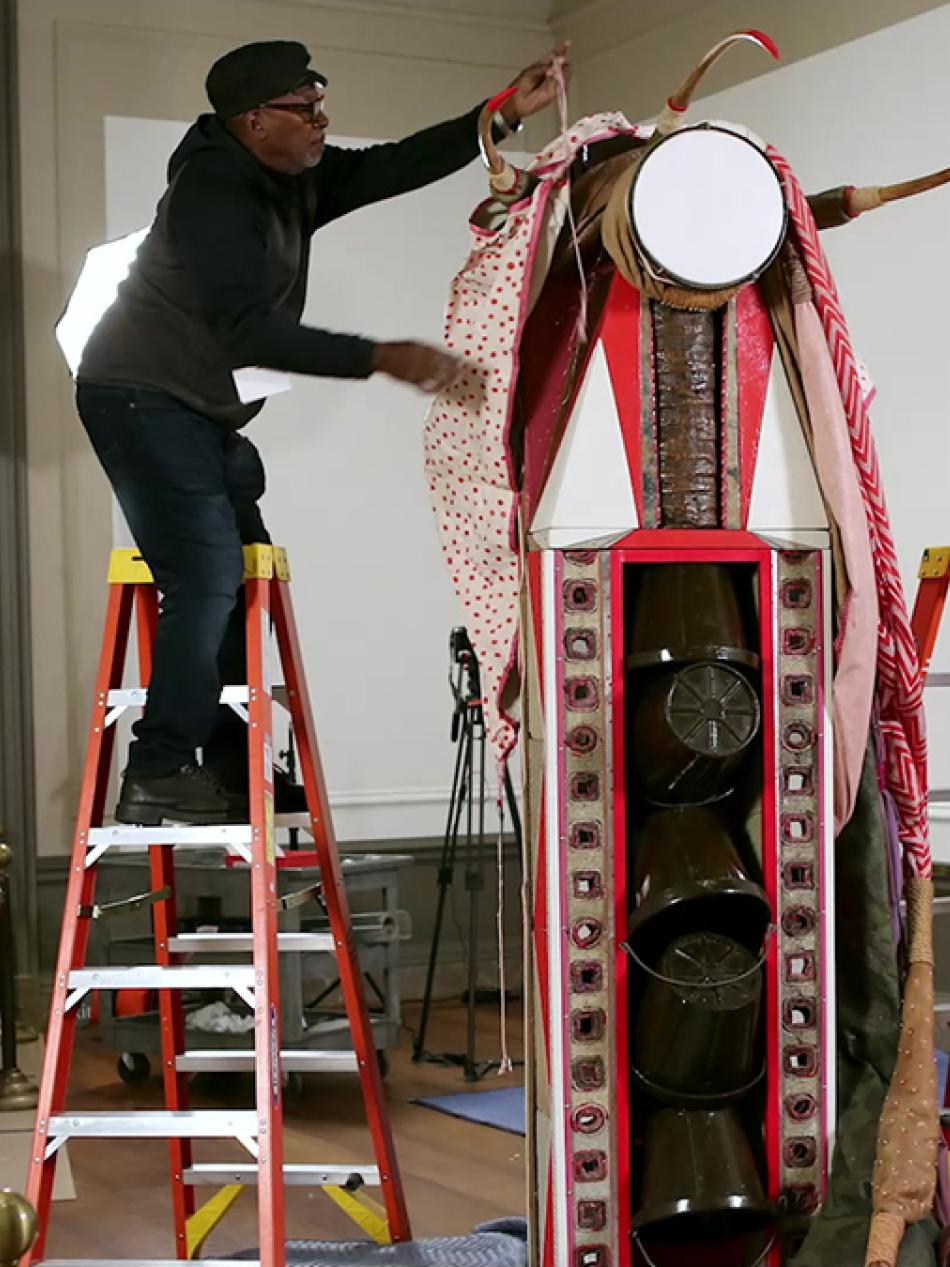
Kerry James Marshall in conversation with James Meyer, associate curator of modern art, National Gallery of Art. Kerry James Marshall has exhibited widely in both the United States and abroad and is the recipient of a MacArthur Fellowship, among other honors. His work often explores the experiences of African Americans and narratives of American history that have historically excluded black people. Drawing upon the artist’s prodigious knowledge of art history and African diasporic culture, his paintings combine figurative and abstract styles and multiple allusions. In Marshall’s art, the past is never truly past: history exerts a constant, often unconscious pressure on the living. In this program recorded on June 26, 2013, Marshall discusses the works and themes of his exhibition In the Tower: Kerry James Marshall, on view at the Gallery from June 28 to December 7, 2013.
Artists
Glenn Ligon, artist, with Molly Donovan and James Meyer, associate curators of modern art, National Gallery of Art. Glenn Ligon’s intertextual works examine cultural and social identity—often through found sources such as literature, Afro-centric coloring books, and photographs—to reveal the ways in which slavery, the civil rights movement, and identity politics inform our understanding of American society. In 2012, the Gallery acquired its first painting by Ligon, Untitled (I Am a Man) (1988). In honor of this acquisition, Ligon presented the 20th annual Elson Lecture on March 14, 2013. Untitled (I Am a Man) is a reinterpretation of the signs carried by 1,300 striking African American sanitation workers in Memphis in 1968 and made famous in Ernest Withers' photographs of the march. Proclaiming "I Am a Man," the signs evoke Ralph Ellison's famous line—"I am an invisible man." Approximating the size of these signs, Ligon’s roughly made painting combines layers of history, meaning, and physical material in a dense, resonant object. As the first painting in which the artist appropriated text, itis a breakthrough. In subsequent works he would transform texts into fields of semilegible and masked meanings. The Gallery owns sixteen works by Ligon, including a suite of etchings and a print portfolio.
Tania Bruguera, artist; Tom Finkelpearl, executive director, Queens Museum of Art; and Mierle Laderman Ukeles, artist. Socially cooperative art is a field not well understood by many, indeed even in the art world. Why is it art? Where does art end and social action begin? Who is the author of a cooperative project? In this lecture recorded on February 3, 2013, at the National Gallery of Art, Tom Finkelpearl celebrates his latest publication, What We Made: Conversations on Art and Social Cooperation, by providing an overview of socially cooperative art—where it comes from, what its artistic roots are, and why it can be considered valuable. Tania Bruguera and Mierle Laderman Ukeles, two of the most important artists working in America today in this field, then describe their work, focusing on a single project. Bruguera, Finkelpearl, and Ukeles take a careful look at how art can intersect with life and how artists are reimagining this intersection in the new avant-garde of participatory, activist, community-inclusive art.
David C. Driskell, artist, curator, and professor of art, University of Maryland, College Park. On January 11, 1990, the National Gallery of Art announced an initiative to address the underrepresentation of minorities—particularly African Americans, Hispanic Americans, and Native Americans—in the museum profession. In response, David Driskell presented a lecture at the Gallery on February 11, 1990, on multi-cultural representation in art museum collections and exhibitions and among staff and visitors. Unresolved issues in our cultural history raise questions about why the arts have been divided along racial lines—if, as Driskell observes, all art emanates from the salient desire to express the inner urges of the human spirit. This quality we all possess is colorless, classless, and uncluttered by feelings of racial superiority. The insistence on dividing art in the United States along racial lines demonstrates a response different in both thought and action than that seen in older cultures and ancient societies. Driskell hopes that these impending initiatives allow us to enter the 21st century with a more holistic view of our history and the cultural pluralism that is the privilege of this nation.
Kerry James Marshall, artist. Kerry James Marshall is a master of the human figure. His imposing, radiant paintings and installations draw equally upon African American history and the history of Western art. Born in 1955 in Birmingham, Alabama, he moved with his family to the town of Watts in 1963, shortly before the race riots began. At Otis Art Institute in Los Angeles he studied with social realist painter Charles White. Marshall's mature career can be dated to 1980, when, inspired by Ralph Ellison's Invisible Man, he developed his signature motif of a dark, near-silhouetted figure. This figure of "extreme blackness," as he puts it, has been important for younger artists including Glenn Ligon and Kara Walker. In honor of the Gallery's acquisition of its first painting, Great America (1994), by the artist last year, Marshall presented the 19th annual Elson Lecture, titled The Importance of Being Figurative, on March 22, 2012.
Terry Winters, artist. A prodigious painter, draftsman, and printmaker, Terry Winters has pushed the boundaries of modern art while he has maintained a keen sense of its history and craft. In this podcast recorded on April 14, 2011, for the Elson Lecture Series at the National Gallery of Art, Winters explains his use of the "low-tech, shape-shifting capabilities" of paint, as he puts it, to engage the complex experience of a high-tech world. The Gallery owns two important paintings by Winters: Bitumen (1986) and Composition (1991).
Claes Oldenburg and Coosje van Bruggen, artists. Working in collaboration since 1976, husband and wife artists Claes Oldenburg and Coosje van Bruggen (1942-2009) redefined the nature of outdoor sculpture in public spaces. In this podcast recorded on October 12, 1995, at the National Gallery of Art, Oldenburg and Van Bruggen discuss the design and installation of their larger-than-life sculptures. These works have been installed all over the world and have become iconic images of large-scale public art. This program was presented in conjunction with the traveling exhibition Claes Oldenburg: An Anthology, which was on view at the Gallery from February 12 to May 7, 1995.
Robert Gober, artist, in conversation with Harry Cooper, curator and head of modern and contemporary art, National Gallery of Art. For 25 years the sculptural and pictorial installations of American artist Robert Gober have proved difficult to ignore, assimilate, or forget. In this podcast, recorded on March 27, 2008, at the National Gallery of Art, Gober speaks with Harry Cooper. They discuss Gober's life as an artist and the consistently unpredictable and affecting nature of his oeuvre, which has had singular importance for contemporary art.
Leo Villareal, artist, in conversation with Molly Donovan, associate curator of modern and contemporary art, National Gallery of Art. In this podcast recorded on September 7, 2008, at the National Gallery of Art, American artist Leo Villareal and curator Molly Donovan discuss Villareal's Multiverse installation, which occupies the Concourse walkway between the East and West Buildings of the National Gallery of Art. Installed between September and December of 2008, Multiverse is one of the largest and most complex light sculptures created by the artist, featuring approximately 41,000 computer-programmed LED (light-emitting diode) nodes that run through channels along the 200-foot-long space.
Subscribe to our feeds in iTunes