Abraham Mignon

German, 1640 - 1679

The son of shopkeepers, Abraham Mignon was born in Frankfurt and baptized in the Calvinist church on June 21, 1640. When his parents moved to Wetzlar in 1649, Mignon was placed under the care and artistic apprenticeship of Jacob Marrel (1614–1681), a still-life painter and art dealer. Marrell was undoubtedly impressed with Mignon’s abilities, for he entrusted his affairs to him whenever he was away in Holland on business. Furthermore, Marrell asked Mignon to instruct his stepdaughter, Maria Sibylla Merian (1647–1717), in still-life painting. By 1664 Marrell and Mignon had left Frankfurt for Utrecht, and in 1669 both were registered in the Saint Luke’s Guild there. While in Utrecht, Mignon maintained the strong religious beliefs of his upbringing. In 1672 he was elected deacon of the Waalse Kerk of Utrecht, a position he held for five years. He married Maria Willaerts, the cousin of the seascape painter Willaerts, Cornelis, in 1675. He died just a few years later, and was buried in Utrecht on March 27, 1679.

Throughout his short career Mignon painted a variety of still-life subjects, but he is best known for his lush compositions of flowers and fruits placed on stone ledges and in niches, or set within ruins and grottos. He developed a distinct style marked by precise detail and drawing. His oeuvre clearly reflects the influence of a number of painters, including Marrell and, most notably, Heem, Jan Davidsz de. Mignon entered the Utrecht painters’ guild in 1669, the same year that De Heem rejoined the guild after his return from Antwerp. De Heem’s influence is best seen in Mignon’s use of bright colors, assurance of drawing, and increasingly elaborate compositions, making it likely that he studied with the older artist.

Considering that Mignon died before his fortieth birthday, many of the approximately four hundred still-life paintings that have been attributed to him were undoubtedly executed by workshop assistants or followers. Nevertheless, this enormous following attests to the popularity of Mignon’s compositions, which were eagerly sought by collectors in the seventeenth and eighteenth centuries, including the Elector of Saxony and Louis XIV of France.

Explore selected works
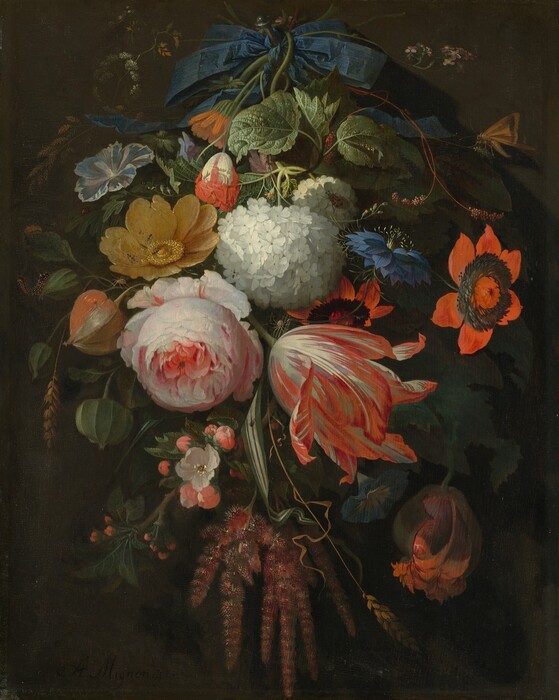
A bouquet of flowers against a dark brown background hangs from a sapphire-blue bow to fill this vertical still life painting. The three largest blooms make a pyramid at the center. A pale pink, flat-leaved carnation is to the lower right of this trio. A red and white striped tulip with flame-shaped petals is next to it, to our right, and a white viburnum bloom, which is made of dozens of smaller clusters, is above. A tan-colored spider builds a web at the center of these three blossoms. Using the face of a clock to work around this trio, we find a spotted bug on a smaller viburnum and some frosty green leaves at noon. A muted orange moth rests on a stalk nearby. Down the right side, the layered vivid blue petals of a love-in-the-mist explode like a starburst. Two coral-red peonies, a mostly closed peony, a topaz-blue morning glory, and the fuzzy fingers of amaranth bring us to six o’clock. Up the left side are delicate pink crab apple blossoms, a spray of Chinese lanterns, a yellow rose with ants crawling across its splayed petals, a striped morning glory, and a few blue, orange, and red buds. A caterpillar rears up on a Chinese lantern bud and a ladybug sits on a leaf nearby. A few stalks of wheat are scattered throughout. Stems weave through the blue ribbon at the top, which is tied around a protruding nail. The artist signed the lower left corner, “AB Mignon f,” with the AB conjoined in a monogram.
Abraham Mignon, A Hanging Bouquet of Flowers, probably 1665/1670, oil on panel, Collection of Mrs. Paul Mellon, 1992.51.5

A Hanging Bouquet of Flowers

Abraham Mignon · probably 1665/1670 · oil on panel ·  Accession ID  1992.51.5
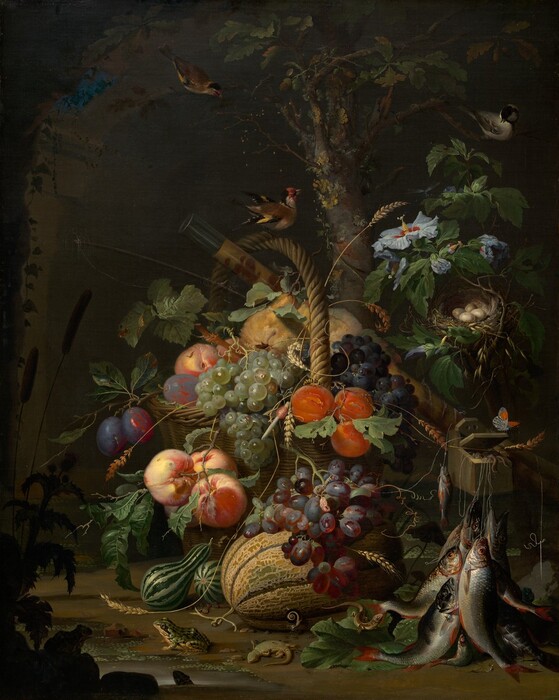
Fruit, flowers, birds, small animals, insects, and fish are piled in and set around a woven basket in woodland setting in this vertical still life painting. The color palette is dominated by rich colors of emerald and pine green, plum purple, butter yellow, and pumpkin orange, with touches of silver and robin’s egg blue. The scene is lit strongly from our left, and the background is swallowed in shadow. The wicker basket with its tall, arched handle has been set before a rough-hewn, stone archway. Birds perch in the tree branches above the basket and on the handle. The fruit in the basket includes green, red, and purple grapes, peaches, plums, oranges, and yellow pears. Tendrils of wheat wind through the fruit and leaves, and around the handle. Green, striped gourds sit to our left next to a cantaloupe at the foot of the basket. Green frogs, a living and a dead lizard, a caterpillar, snail, and insects sit, lie, or move on the dirt ground around the gourds and melon. To our right, about a third of the way up the composition, worms spill out of a wooden box from which hang several fishing lines holding silvery fish. A small, ivory-white butterfly with black markings and a patch of vivid orange on each wing sits on the lid of the box. Above the box of bait, a nest with four cream-white eggs is tucked among the branches of a hibiscus plant with pale blue, flaring blossoms. A mossy, narrow oak tree trunk bearing acorns rises behind the basket, in front of the stone arch, and off the top edge of the painting. A fishing rod and a cylindrical wooden case painted golden yellow with rust-red designs are propped at the back of the basket. Dark silhouettes of cattails, rocks, and frogs are shown around a pool of water in the lower left corner.
Abraham Mignon, Still Life with Fruit, Fish, and a Nest, c. 1675, oil on canvas, Gift of Mr. and Mrs. H. John Heinz III, 1989.23.1

Still Life with Fruit, Fish, and a Nest

Abraham Mignon · c. 1675 · oil on canvas ·  Accession ID  1989.23.1

Bibliography

1753

  • Houbraken, Arnold. De Groote Schouburgh der Nederlantsche Konstschilders en Schilderessen. 3 vols. in 1. The Hague, 1753 (Reprint: Amsterdam, 1976): 3:82-83.

1969

  • Bol, Laurens J. Holländische Maler des 17. Jahrhunderts nahe den Grossen Meister. Landschaft und Stilleben. Braunschweig, 1969: 320-323.

1973

  • Kraemer-Noble, Magdalena. Abraham Mignon 1640-1679. Leigh-on-Sea, 1973.

1995

  • Wheelock, Arthur K., Jr. Dutch Paintings of the Seventeenth Century. The Collections of the National Gallery of Art Systematic Catalogue. Washington, D.C., 1995: 172.

2003

  • Willigen, Adriaan van der, and Fred G. Meijer. A dictionary of Dutch and Flemish still-life painters working in oils, 1525-1725. Leiden, 2003: 143.

2007

  • Kraemer-Noble, Magdalena. Abraham Mignon, 1640-1679: catalogue raisonné. Studien zur internationalen Architektur- und Kunstgeschichte, vol. 44. Petersberg, 2007.