


David W. Penney
Indigenous Land/American Landscape
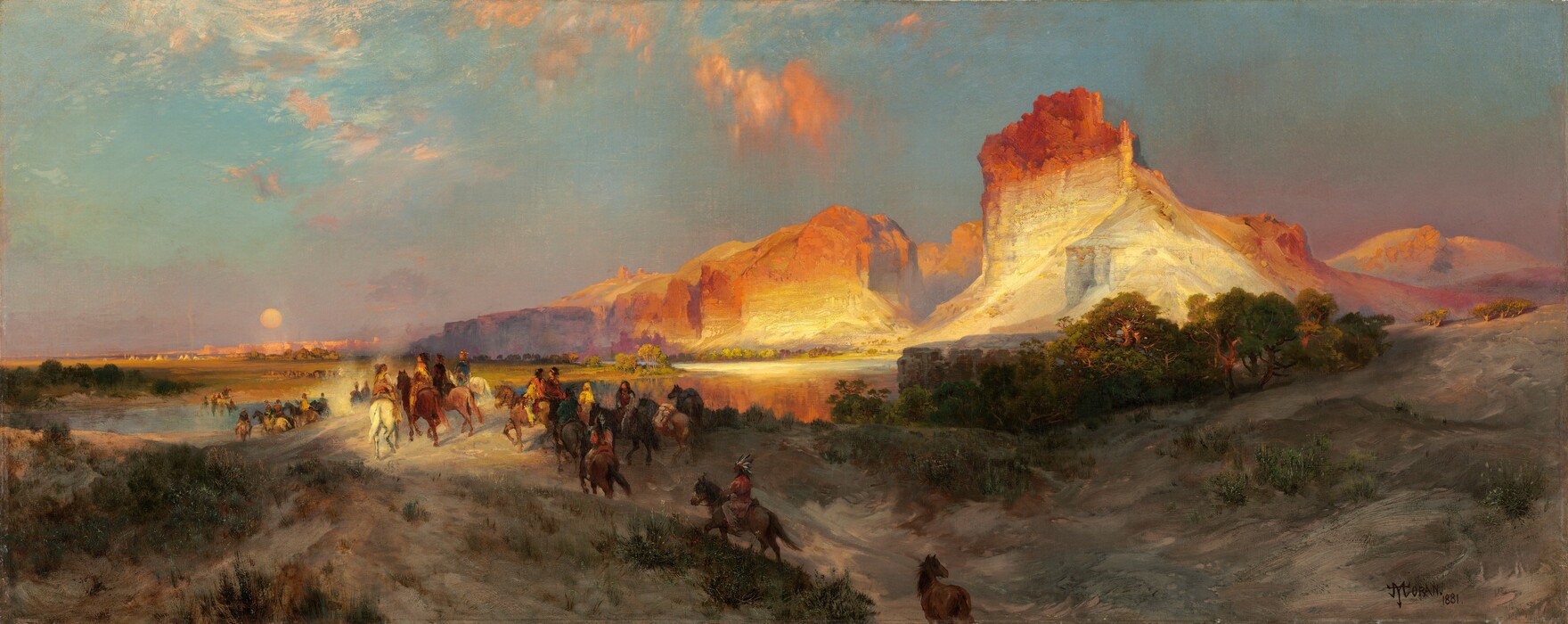
Foundational historians of 19th-century American art have long identified landscape painting, spanning the generations from Thomas Cole and Albert Bierstadt, as expressions of the United States’ earliest fine arts tradition. They scarcely acknowledge Indigenous inhabitants of that land, however, and when they do, American Indians appear most often as a foil or protagonist in nationalist narratives. When art historians have explored the role of Native American images in nationalist themes, they have failed to address how Native people, as subjects or as artists, contested or corrected such narratives. My concerns parallel those raised by settler colonialism, a “structure” of modernity that describes a kind of political control premised explicitly on the erasure of an Indigenous presence by invading and occupying settlers who themselves, through policy, law, violence, and (not least) culture, establish their own claims as “natives” of the land. Art historians have advocated for “a new kind of art history that will actively grapple with the impact of settler colonialism on both artistic practice and art historical narratives,” as proposed by New Zealand art historian Damian Skinner. The core issue at hand in the United States, I argue, is the Anglo-American legal, rhetorical, and visual construct of wilderness and “savagery” (an early 19th-century scientific term referring to the most primitive stage of human social development) that US civilization would measure itself against. In the face of Anglo-American insistence on the obsolescence of so-called savagery and the consumption of wilderness in the name of progress, Indigenous peoples and their artistic productions assert modernity, adaptability, environmental accountability, and ongoing advocacy for cultural and political sovereignty.
My book manuscript is organized geographically in three sections: the Hudson River and Niagara Falls, Saint Louis and the Missouri River, and the far West of Yellowstone and Yosemite. I combine consideration of mid-19th-century Anglo-American paintings depicting those locations with Indigenous productions from the same time and place. Painters of the Hudson River School, such as Cole along with his peers and followers, are largely responsible for the visualization of “wilderness” as a distinctively US legacy. Their landscapes responded in part to emerging tourism of Northeastern scenic places such as the Catskills and Niagara Falls. The scant Native communities remaining in the Northeast of that time offered “souvenir arts,” basketry and beadwork, to those same touristic consumers seeking out authentic American experiences. They thereby refashioned popular perceptions of “Indians” while asserting presence and survivance.
Proto-ethnographic portraits and scenes of Native life produced by artists circulating out of Saint Louis gave form to a visualization of American “savagery” stemming from firsthand observations and depictions of Indigenous people and lifeways. While formal and decorated Native dress signified “savagery” when rendered by Euro-American painters, Native makers created new forms of formal garments with innovative materials and techniques while embracing the materiality of both modernity and tradition. Decorated regalia and the occasions to wear it remain significant expressions of Indigenous cultural sovereignty up through today.

Siyosapa (Hunkpapa/Yanktonai), O’zan o’-wa-pi (“Painted lodge curtain”), 1880/1881, paint on cotton muslin, National Museum of Natural History, EL81-0
Whereas Euro-American painters sought out the “natural wonders” of the West at Yellowstone and the Green River Valley, Native artists in contrast represented the region with narrative drawings and paintings that illustrated conflict and environmental crises as resident tribes contested dwindling buffalo herds and the encroachments of the railroad. When Yosemite became the centerpiece of a wilderness preservation movement, popularized by monumental paintings and emerging photography, European Americans failed to understand that Indigenous residents had created a nurturing, anthropogenic environment that was mistaken for wilderness. While traditions of tending, harvesting, and weaving basketry materials were converted successfully to the marketplace of popular souvenir arts, California basketmaking was threatened at the same time by relentless environmental degradation, on one hand, and restrictive environmental preservation practices, on the other.
A short introduction to my book will look at the engagement of painter Kay WalkingStick (Cherokee Nation of Oklahoma) with American landscape and Indigenous place, and an afterword will conclude with the meditations of artist Shelley Niro (Turtle Clan of the Kanyen’kehà:ka [Mohawk] Nation) on themes of place and memory. These interventions by living artists stress how legacies concerning understandings of wilderness, the racist construct of “savagery,” and the dispossession of Native land remain open and ongoing issues of contention today.
I arrived at the Center with first drafts of my book’s introduction and the section on the Hudson River and Niagara Falls. My research and writing during the past academic year focused on artists and issues in the orbit of Saint Louis. An initial draft for this second section should be complete this spring. I expect to complete drafts for the entire volume by the close of 2026.
Washington, DC
Paul Mellon Senior Fellow, 2025–2026
David W. Penney will continue writing his book manuscript and is currently in discussions with a publisher.