


Programs
During the academic year, the Center organizes scholarly programs that range in size and duration from multiday gatherings to small roundtable discussions. The Center’s programs encourage and support innovative research in the visual arts.

Public Programs
The Center supports lectures, symposia, and discussions that are free and open to the public. These programs are often organized in collaboration with departments across the National Gallery of Art, or with partnering institutions.
January 22, 2026
West Building Lecture Hall and live streamed
The act of repair, too often overlooked as a nuisance with the aim of achieving invisibility, is a complex process and reveals our intricate relationship with the material world around us. As one of the earliest cultural techniques in human history, the modality of repair not only provides critical insight into the value, status, and function of objects. It also reflects on diverse societal belief systems, traditions, and emotions in a world of growth and decay, fragmentation and breakdown.
This public lecture was delivered by Christian Scheidemann, senior conservator and president at Contemporary Conservation, in conjunction with the Edmond J. Safra Colloquy.
January 31, 2026
Politics and Prose Bookstore
Contributors Lisa Gail Collins and Glexis Novoa discussed Art & Histories with Kaira M. Cabañas, series editor and Center associate dean for academic programs and publications. Art & Histories is the first volume in the Center’s new book series, Art &.
March 1, 2026
East Building Auditorium and live streamed
Dante looks at Beatrice and is starstruck. Petrarch spirals into a labyrinth at the sight of Laura. Tasso’s knights, on encountering Armida, lose not only their composure but their sanity.
In these accounts, love does not grow; it takes. This talk considered the way early modern Italy lingered in that instant of disorientation—what had already been called “love at first sight”—and explored how it offered a framework for thinking about attraction, emotions, the divine, and the mysterious pull of art itself.
March 6–7, 2026
University of Maryland / West Building Lecture Hall and live streamed
Since 1971 the Center has partnered with the University of Maryland to present this annual symposium. The event brought together museum and academic communities and provided a platform for the latest research from graduate students in our region.
March 6
George Levitine Lecture in Art History
“On the Past and Future of Indian Ocean Art History”
Nancy Um, Getty Research Institute
March 7
Morning Session
Welcome by Peter M. Lukehart, The Center
Moderated by Tess Korobkin, University of Maryland
“Cupid’s Palace: Giulio Romano’s Sala di Psiche Frescoes and the Palazzo Te as Courtly Sensorium”
Chase Helein, American University
Introduced by Kim Butler Wingfield
“The Primacy of Disegno and the Commodification of Drawings in 16th-Century Italy”
Flavia Barbarini, Temple University
Introduced by Tracy Cooper
“Longing for the Ghulāmān-e Farangī: European Youths in 17th-Century Safavid Painting”
Ryan Foley, George Washington University
Introduced by Mika Natif
“Mis-Understanding the Anatomy of the Part: How One Image Rewrote the Mastectomy Procedure”
Zoe Copeman, University of Maryland
Introduced by Anthony Colantuono
Afternoon Session
Welcome and moderated by Kaira M. Cabañas, The Center
“A Victory in Silver: Architectural Representation and Imperial Symbolism Under Abdülhamid II (r. 1876–1909)”
Christine Kim Korkmaz, Johns Hopkins University
Introduced by Ünver Rüstem
“Rebuilding the City, Building Alternatives: Ideals, Tensions, and Politics in André Lurçat’s Reconstruction of Maubeuge”
Weixin Zhou, University of North Carolina at Chapel Hill
Introduced by Eduardo de Jesús Douglas
“Exceptions and Expectations: Pictorial Carpets and the Question of Authenticity in Southern Iranian Weaving”
Elnaz Latifpour, University of Virginia
Introduced by Amanda Phillips
“Isabel Katjavivi’s They Tried to Bury Us (2018) and the Environmental Impacts of German Colonialism in Namibia”
Emily Shoyer, Bryn Mawr College
Introduced by Lisa Saltzman
March 16, 2026
Virtual
This virtual workshop explored the new resources website for the Early History of the Accademia di San Luca research project. Attendees learned how to navigate hundreds of early modern notarial documents, as well as historical maps and guidebooks, with the project’s team.
March 21, 2026
West Building Lecture Hall and live streamed
What can photographs tell us about violence, mourning, advocacy, and inequity? Images of the deadliest war in American history shaped public understanding of the conflict, giving form to battlefield sacrifice. This lecture considered some of the most canonical photographs to emerge from the Civil War by Mathew B. Brady, Alexander Gardner, and Timothy H. O’Sullivan before turning to photographs that reveal different histories—about who can be a soldier, how martyrdom is imagined, and what kinds of photographs might stand as evidence for war crimes.
April 17, 2026
West Building Lecture Hall
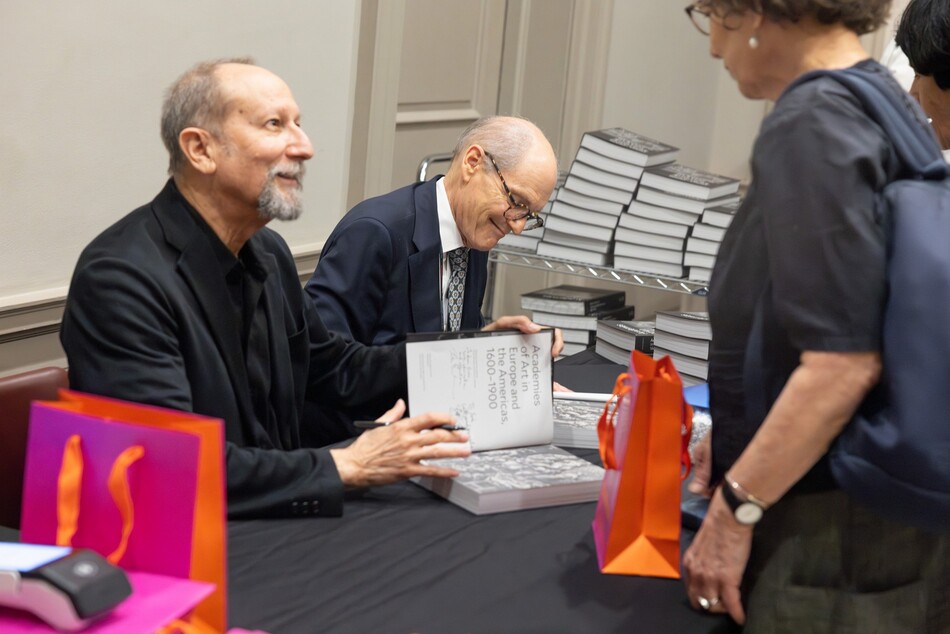
This presentation and discussion was organized in honor of the publication of Academies of Art in Europe and the Americas, 1600–1900.
Elizabeth Fuentes Rojas, professor of art history at the Universidad Nacional Autónoma de México, delivered her lecture, “Women in the Mexican Academia de San Carlos and Their Different Roles: A Long Struggle.” Fuentes’s research into the women—models, amateurs, students, teachers, and artists—throughout the institution’s history brings to light their lives, work, and prolonged challenges.
A discussion followed the lecture with volume editors Peter M. Lukehart, Center interim dean, and Oscar E. Vázquez, professor of art history at the University of Illinois Urbana-Champaign.
May 3–24, 2026
East Building Auditorium and live streamed
Over four lectures, Aden Kumler focused on difficulty as an aesthetic strategy, value, and theme in medieval European art. The lectures expanded upon one of the central topics of Kumler’s scholarly research: how the material conditions of life shape people’s thought, imagination, and actions.
Art made for and by European medieval Christians has often been associated with religious and aesthetic values of certainty, clarity, and transcendence. Kumler argued that, instead, a long tradition of medieval art offers viewers perceptual and conceptual encounters with ambiguity, obscurity, and contingency. Attending to this neglected tradition of difficult, often self-reflexive images, Kumler’s lectures explored how medieval works of art position difficulty as a virtue, asking what was at stake and reflecting on its implications for our understanding of medieval art today.
May 3: “Regio dissimilitudinis: Art and Ars in a Fallen World”
May 10: “Opus/Onus: Art’s Burden in Medieval Europe”
May 17: “Obscuritas: Ambiguity and Disorientation”
May 24: “Passio—Patientia—Potentia: Tribulation, Tension, Transformation”





By-Invitation Programs
The Center organizes small gatherings focused on particular topics throughout the year, ranging from study days to thematic seminars, that bring together scholars from around the world to the National Gallery.
June 3–6, 2025
Each year, a Center postdoctoral fellow in residence designs and directs an intensive weeklong seminar for the predoctoral fellows in residence, including readings, discussions, and visits to local institutions.
Participants
David P. Bardeen, David E. Finley Fellow, 2022–2025
Robyn A. Barrow, Paul Mellon Fellow, 2022–2025
Chaeri Lee, Twenty-Four-Month Ittleson Fellow, 2023–2025
James H. Miller, Twenty-Four-Month Chester Dale Fellow, 2023–2025
Celia Rodríguez Tejuca, Andrew W. Mellon Fellow, 2023–2025
Julia Silverman, Wyeth Fellow, 2023–2025
Wenjie Su, Samuel H. Kress Fellow, 2023–2025
January 23, 2026
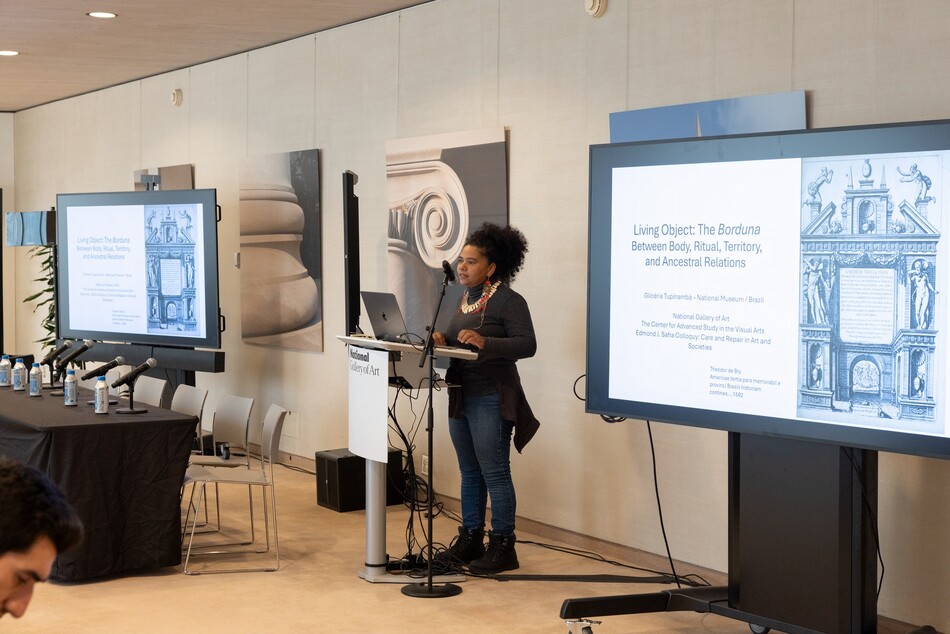
The aim of this colloquy was to explore the notion of “care and repair” as a complex system of relations with the material world around us—and with our past. While repair as a noun may be seen as a nuisance with the aim of invisibility, the act of repairing, according to psychoanalyst Hanna Segal, is a curative practice, and implies the wish to “restore and recreate the loved object…through the active process of successful mourning accompanied by symbol formation.”
Repair, often a crucial element of maintenance, involves fixing, reusing, or repurposing broken or damaged objects, systems, or traditions. By looking at the notion of care and repair in contemporary art and across various cultures, such as Japanese kintsugi or African bricolage, we examine different relationships toward objects and their histories—and ultimately to our own histories.
Session I: The Cultures of Repair
“Visible Versus Invisible Repair: Healers and Emulators”
Lena Stringari, Conservation, National Gallery of Art
“Mended Bodies: Ceramics Restored with Lacquer”
Yayoi Shinoda, Nelson-Atkins Museum of Art
“Repairing Community Through Caring for Cultural Heritage”
Glenn Wharton, University of California, Los Angeles
Discussion moderated by Peter M. Lukehart, The Center
Session II: Theories of Care
“Art and Psyche: Repair and Reparations”
Alfred Margulies, Harvard University
“The Origin of a Work of Art”
Bill Brown, University of Chicago
“On the Art of Caring for Architecture”
Jorge Otero-Pailos, Columbia University
Discussion moderated by Christian Scheidemann, The Center
Session III: Institutional Repair
“Living Object: The Borduna Between Body, Ritual, Territory, and Ancestral Relations”
Glicéria Tupinambá, Bahia, Brazil
“Caring for Territory and Heritage: Restitution Processes Led by the Tupinambá in Brazil”
Daniela Alarcon, Museu Nacional, Rio de Janeiro
“Caring for the Immaterial”
Julien Bismuth, New York
“Theseus’s Ship at the Pit Stop”
José Falconi, University of Connecticut
Discussion moderated by Kaira M. Cabañas, The Center
March 2, 2026
A discussion with Sydney J. Freedberg Lecturer Emanuele Lugli with Center fellows, National Gallery staff, and invited guests.
March 23, 2026
A discussion with Wyeth Lecturer in American Art Jennifer Raab with Center fellows, National Gallery staff, and invited guests.
May 4, 2026
A discussion with Mellon Lecturer Aden Kumler with Center fellows, National Gallery staff, and invited guests.
Fellows’ Presentations
Colloquia, presented by Center professors and senior fellows, and shoptalks, given by the postdoctoral and predoctoral fellows, occur throughout the academic year.
September 25, 2025
Evelyn Lincoln, “Wood Work: The Parasole Woodblock Carvers in Early Modern Rome”
December 4, 2025
Megan E. O’Neil, “Palmas from Texolo: Collective Biographies of Mesoamerican Ballgame Sculptures”
December 11, 2025
Dario Donetti, “Architecture, Hybridity, and the Codex Mellon: Collaborative Design at St. Peter’s”
January 29, 2026
Sarah Gould, “Painting with Steam: Pollution and Paint in 19th-Century British Art”
February 12, 2026
Ünver Rüstem, “Turbans, Tombstones, and the Terms of Ottoman Sartorial Identity”
February 26, 2026
Sinclair Bell, “In Living Color? Aethiopians in Roman Sculpture and the Problem of ‘Ethnic’ Portraiture”
March 19, 2026
David W. Penney, “Indigenous Land/American Landscape: Memory and Place in the Work of Kay WalkingStick and Shelley Niro”
April 16, 2026
Suzanne Preston Blier, “From Igbo Ukwu to Igbo Landing: How Medieval African Objects Speak”
April 23, 2026
Roland Betancourt, “The Byzantine in the Modern Imagination”
April 30, 2026
Kristina Kleutghen, “The Art of Optical Entertainment in 18th-Century China”
October 30, 2025
Alice Casalini, “Sacred Visions: The Architecture of Religious Experience in Gandhāra”
November 6, 2025
Hugo Shakeshaft, “Figure, Space, and the Axis of Change in Ancient Greek Art”
January 8, 2026
Rowanne Dean, “The Seeds Sown by Franco-Burgundian Goldsmiths”
January 26, 2026
Isabella Shey Robbins, “‘Needle and Thread, Kill ’em Dead’: Demond Melancon, Big Chief of the Young Seminole Hunters”
March 5, 2026
Ryan Eisenman, “Technologies of the Multiple, c. 1230”
March 26, 2026
Virginia Girard, “Mining Potential: Painting the Prospector’s Gaze in the 16th-Century Netherlands”
April 9, 2026
Nathalie Miraval, “Sacred Subversions: Art, Law, and Truth in the Early Iberian Atlantic”
Staff Programs
The Center organizes programs to support research and spark dialogue within the National Gallery staff community. Works in Progress give staff a platform to present on research and independent initiatives outside their regular duties.
October 1, 2025
“Magpies and Tigers: A Case for Korean Popular Culture”
Gary Calcagno, The Center
February 4, 2026
“Nueva York: Freddy Rodríguez’s Hard Edge Geometry”
E. Carmen Ramos, Curatorial and Conservation Division
April 1, 2026
“Coquettish Cakes”
Astrid Ketcham, Visitor Experience