


Ryan Eisenman
The 13th-Century Limoges Champlevé Enamel Industry
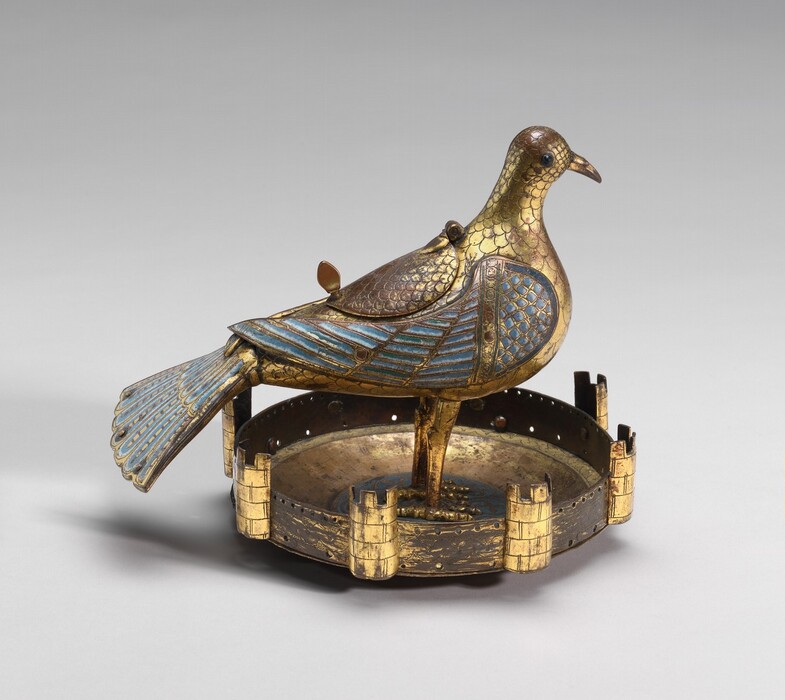
A technique of spreading vitreous material into broad cavities engraved in copper plaques, and subsequently fired to fuse glass and metal, champlevé enameling was so thoroughly associated with the urban center of Limoges during the European Middle Ages that it was referred to as “work of Limoges,” a phrase collapsing process with provenience. For much of the 13th century, Limoges enamelers produced tens of thousands of reliquaries, manuscript covers, bishops’ staffs, crosses, candlesticks, handwashing basins, containers for the consecrated communion wafer, even altar frontals and monumental tomb effigies, made largely on speculation for churches, monasteries, and private residences across Europe, from Orense to Novgorod, Bethlehem to Skálholt. Apart from their shimmering, dark blue glass and glittering, low-relief appliqués, the defining quality of medieval Limoges enamels is their status as multiples. Objects made with intentionally high degrees of visual similarity and with various technologies of copying, replication, and reproduction, multiples were arguably the most important form of artmaking—economically, socially, theologically, politically—in the Middle Ages.
Proceeding from the fact that enamels were made and recognized as multiples, my dissertation addresses a cluster of questions concerning the production and consumption of Limoges enamelwork in the long 13th century. What were the social, economic, and artistic preconditions necessary for the development of the Limoges champlevé enamel industry? To whom were enamel multiples especially appealing? How did the techniques for manufacturing champlevé enamel contribute to the signification of the resultant works? And what role did enamel multiples play in contemporary political conflicts? In addition to confronting these issues, throughout my dissertation I demonstrate that Limoges enamelers strove to produce the effects of exactly replicated images (exemplified by seals, coins, and the Eucharist), though material affordances greatly restricted their use of mechanical reproduction. Likewise, the individuals who purchased these objects hoped their access to technologies of “multiproduction” would confirm or else augment their social standing.

Back Cover of an Evangeliary with a Salvator Mundi, c. 1200–1250, gilded copper with enamel, Rijksmuseum, BK-C-2003-1. Photo: Rijksmuseum, Amsterdam
These arguments unfold over four chapters. In the first, I articulate how the champlevé enamel industry depended on wider mercantile connections and arose out of established crafts already practiced within the city. The import of glass and copper and the export of finished enamels required trade networks extending to Mediterranean ports and Champenois fairs, networks that I propose were first developed to support another industry of multiples in Limoges, luxury textiles. Building on archival and visual evidence that Limoges enamelers also worked as seal matrix carvers and minters, I elaborate how these crafts provided a technical foundation for champlevé as well as a conceptual model for making multiples.
Chapter 2 begins with a critical reevaluation of Pope Innocent III’s supposed patronage of an enameled monument for the shrine of Saint Peter in the Vatican before undertaking a prosopographic study of the owners of Limoges enamels. The popularity of Limoges enamelwork in the 13th century cannot be conclusively linked to explicit papal promotion. Rather, the principal clients of the champlevé enamel industry were, I show, clerics born into the minor nobility or wealthy bourgeoisie who rose through the ecclesiastical hierarchy and ended their careers with accumulated wealth and power; enamel multiples materialized their elevated social standing.
Modeling a method of “iconology of technique,” Chapter 3 centers on enameled pyxes, cylindrical vessels with conical lids that held the consecrated Eucharistic host. Outlining parallel processes of production—engraving an intaglio image, grinding primary materials, filling the engraving with those materials, firing, and consecrating—I argue that the analogous modes of manufacture for both champlevé enamel and the Eucharist made the work of Limoges “suitable” for containing Christ’s body.
In the final chapter, I chart how Limoges enamels facilitated a multiplication of royal power. The patronage of Blanche of Castile, coruler of France, demanded that Limoges goldsmiths produce objects that pushed their skills in making multiples to new heights. In the aftermath of the Albigensian Crusade and the incorporation of the Midi into the kingdom of France, enamels with heraldic iconography offered royal subjects and allies a means of demonstrating their loyalty to the Capetian dynasty as well as a lesson in how to understand multiples.
Based on examinations of hundreds of extant enamels, archival records, and two years of research abroad facilitated by a predoctoral fellowship from the Center, “The 13th-Century Limoges Champlevé Enamel Industry” offers the first comprehensive study of this corpus in more than three decades. While broadly concerned with how this prolific form of the medieval multiple was produced, circulated, understood, and used, it ultimately presents Limoges enamelwork as a materialization of artistic ambitions and audience aspirations.
University of Pennsylvania
David E. Finley Fellow, 2023–2026
Upon receiving his PhD, Ryan Eisenman will take up the position of visiting assistant professor in the Department of Art History, New York University.