Constantijn van Renesse

Renesse, Constantijn Daniel van
Dutch, 1626 - 1680

Constantijn van Renesse was born in Maarsen, near Utrecht, on September 10, 1626. His father, Lodewijk Geradus van Renesse, a theologian and minister in Maarsen, was a learned man who spoke a number of languages. In 1634 he was appointed military chaplain for Prince Hendrik of Nassau, stadtholder of Friesland, in 1634. In 1638, the year of his wife’s death, Lodewijk moved his three sons and daughter to Breda so he could be with the troops during the siege of Breda and help institute the Reformed Church in that area. Shortly after his father’s second marriage in 1639, Constantijn enrolled in the University of Leiden, where he studied languages and mathematics. 

Constantijn seems to have been skilled as a draughtsman, and apparently began his artistic career in Leiden simultaneously with his studies at the University. Although the nature of his early artistic training is not known, he did study with Rembrandt in Amsterdam in the late 1640s and early 1650s. A number of drawings of religious subjects from this period survive, some of which Rembrandt appears to have corrected, that demonstrate Van Renesse’s ability to assimilate Rembrandt’s style. Van Renesse probably assisted Rembrandt in the execution of a number of large-scale religious paintings in the early 1650s (see The Descent from the Cross). Van Renesse also learned to make etchings with pronounced chiaroscuro during his apprenticeship with Rembrandt. Among the genre scenes and portraits Van Renesse etched in the early 1650s is a self-portrait dated 1651.

Van Renesse probably had become an independent artist by 1651, when he depicted his father, his siblings, and himself in Family Concert Party (Salzburg, Residenzgallery). His artistic career, however, soon was eclipsed by civic responsibilities. In 1653 he was named town clerk of Eindhoven, probably as a result of the good contacts his father had with the States General, which was intent on placing protestants in important posts in this region of the Netherlands. In the following year he married Christina Drabbe, with whom he had an unknown number of children. Although Constantijn’s official position, which he kept throughout his life, must have hindered his artistic career, he continued to produce drawings and paintings into the 1660s.

Explore selected works

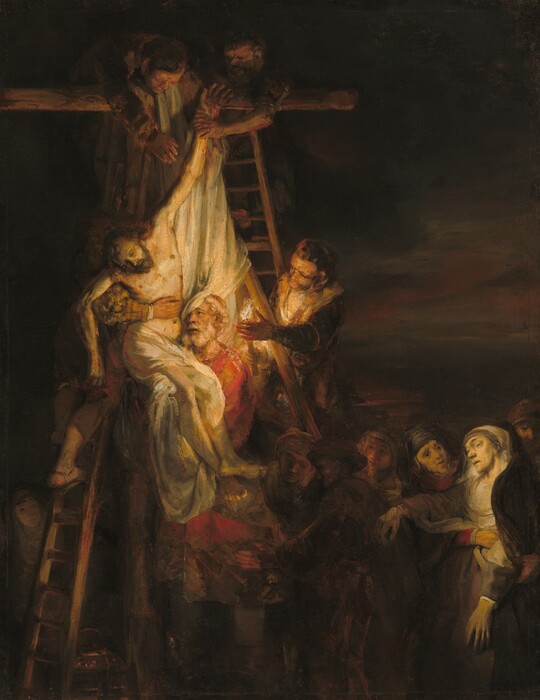
The lifeless body of a bearded young man partly wrapped in an ivory cloth is being lowered from a cross to a group of people at its foot in this vertical painting. All the people have peachy or pale skin, and most are dressed in cream white and shades of brown. The body and head of the dead man, Jesus, slump to our left, eyes closed and mouth hanging open. His arms and hands are streaked with red, and drips of blood dot his head. Two men on ladders propped against the back of the cross reach over the top crossbar, and one man on our right holds Jesus’s left wrist. A long white cloth is draped over the crossbar and falls to wrap around Jesus’s hips. Two more men stand on the ladders on either side of the cross, one with his arm around Jesus’s torso while the other reaches forward to hold a torch that dramatically lights the cluster of bodies. An older man with white hair and beard, wearing a scarlet-red tunic, stands in front and cradles the hips and legs of Jesus as he is lowered. Six people stand to the right of the old man and the cross. A strong light falls on the face of a pale, older woman. Her eyes are closed, her mouth open, and her arms limp as she is caught by the people around her. The men in the group wear hats and the women’s heads are covered with scarves. From the shadows to the left of the cross, near the edge of the painting, the pale face of a woman peers onto the scene. The landscape behind the cross and group is deep in shadow, but rust-red streaks line the horizon in the distance.
Dutch 17th Century, Constantijn van Renesse, The Descent from the Cross, 1650/1652, oil on canvas, Widener Collection, 1942.9.61

The Descent from the Cross

Dutch 17th Century, Constantijn van Renesse · 1650/1652 · oil on canvas ·  Accession ID  1942.9.61
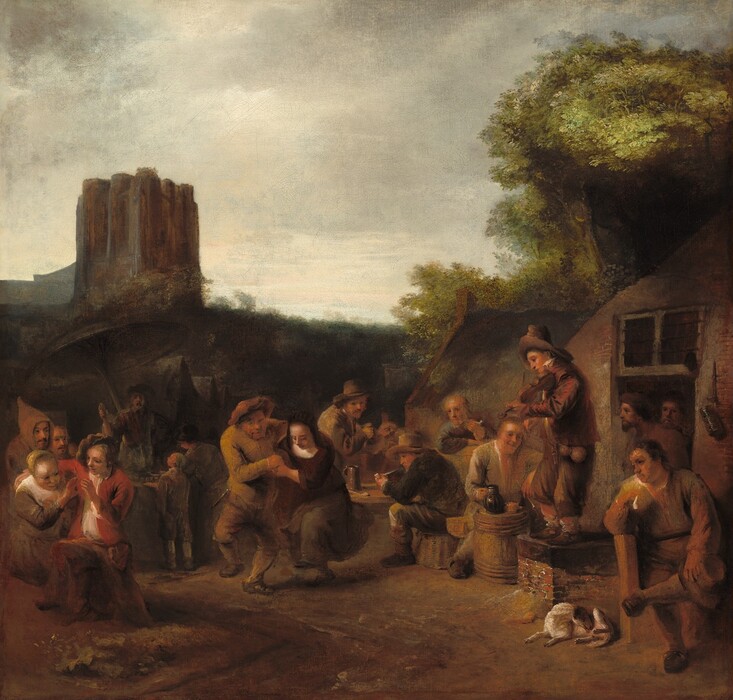
This is a painting of an outdoor scene with numerous people engaged in various activities; some are sitting by low tables, some are dancing, and some are conversing. One person on the right stands on a surface and plays a stringed instrument like a fiddle or violin. The people wear clothes in earth shades of brown, tan, black, and dark red. The background includes a rustic building with a thatched roof, leafy green trees, and what may be a tall castle or church on the left. The cloudy sky above is in shades of gray.
Constantijn van Renesse, Conviviality Near the Inn, early 1650s, oil on canvas, Corcoran Collection (William A. Clark Collection, 1926), 2014.136.42

Conviviality Near the Inn

Constantijn van Renesse · early 1650s · oil on canvas ·  Accession ID  2014.136.42

Bibliography

1907

  • Edited by Ulrich Thieme and Felix Becker. Allgemeines Lexikon der bildenden Künstler von der Antike bis zur Gegenwart 1907-1950, 26:160

1978

  • Vermeeren, Karel. “Constantijn Daniël van Renesse, zijn leven en zijn werken (I).” De kroniek van het Rembrandhuis 30 (1978): 3–23; 31 (1979): 27–32.

1983

  • Sumowski, Werner. Gemälde der Rembrandt-Schüler. 6 vols. Landau, 1983: 4: 2469–2478.