Cornelis Verbeeck

Verbeeck, Cornelius
Verbeecq, Cornelis
Dutch, 1590/1591 - 1637

Originally from Amsterdam, Cornelis Verbeeck spent the majority of his life in and around the city of Haarlem. The earliest documentation pertaining to Verbeeck appears in a statement the artist gave to a Haarlem notary on April 2, 1609, in regard to his involvement in a tavern brawl. The statement provides his place of residence as just outside of the city walls and his age as eighteen.[1] In December of the same year, Verbeeck married Haarlem native Anna Pieters.[2] The couple had two daughters, Elgen, born on October 20, 1613, and Janneke, born on April 7, 1619.[3]

In 1628 Haarlem chronicler Samuel Ampzing described Verbeeck as “very fine and exquisite in ship painting.”[4] The artist had, however, already been active for many years in Haarlem, where he first appeared in the records of the Saint Luke’s Guild in 1610, and again in 1634 as a master painter.[5] Verbeeck’s name also frequently appears in the archives in Haarlem, mostly in connection with tavern brawls. Only two weeks after his marriage, Verbeeck inflicted a “simple flesh wound under the diaphragm, or midriff” on a bleacher named Pieter Bossu.[6] The Bossu matter continued in the courts until 1611, with another incident occurring on May 8, 1610, when Verbeeck threatened Bossu with a knife.[7] On October 31, 1612, Verbeeck was sentenced on two charges for inflicting serious injuries, stab wounds, and lacerations on the brothers Huybert and Jan Huybertsz.[8] And again, in 1628, the artist was banished from a tavern with a warning not to “offend, injure or molest” the proprietor.[9]

Despite his many run-ins with the law, Verbeeck enjoyed success as a painter in Haarlem. He primarily created small-scale scenes of naval battles, ships floundering off rocky coasts, and beach scenes, as well as a few large-scale paintings of historical events.[10] Although there is no evidence that Verbeeck studied with the Haarlem marine painter Hendrick Cornelis Vroom (Dutch, c. 1563–1640), he was clearly influenced by him, especially in his treatment of choppy waves with white, hairlike spray and deep troughs. Verbeeck’s later paintings move away from Vroom’s influence and include more complex compositions and a naturalistic rendering of waves. Verbeeck’s seascapes fetched some of the highest prices among that genre and his paintings appear in multiple inventories of middle- and upper-class patrons in Haarlem.  


[1] Laurens Johannes Bol, Die holländische Marinemalerei des 17. Jahrhunderts (Braunschweig, 1973), 47. There was another Cornelis Verbeeck living in Haarlem at the time who was the father of the horse painter Pieter Verbeeck. See also A. Bredius Archive, Netherlands Institute for Art History (RKD), The Hague.

[2] Laurens Johannes Bol, Die holländische Marinemalerei des 17. Jahrhunderts (Braunschweig, 1973), 47. The Haarlem marriage register lists Verbeeck as “a bachelor from Amsterdam.”

[3] Laurens Johannes Bol, Die holländische Marinemalerei des 17. Jahrhunderts (Braunschweig, 1973), 48.

[4] Samuel Ampzing, Beschryvinge ende lof der stad Haerlem in Holland (Haarlem, 1628), 372.

[5] Adriaan van der Willigen, Les artistes de Harlem; notices historiques avec un précis sur la Gilde de St Luc (Haarlem and The Hague, 1870), 20; Hessel Miedema, De archiefbescheiden van het St. Lukasgilde te Haarlem: 1497–1798, 2 vols. (Alphen aan den Rijn, 1980), 2:419.

[6] Jeroen Giltaij and Jan Kelch, Praise of Ships and the Sea (Rotterdam, 1996), 137. See note 3 in Giltaij and Kelch, which cites the A. Bredius Archive, Netherlands Institute for Art History (RKD), The Hague: “Een aantal Chirurgyns moeten de wond onderzoeken. Het is een simpele vleyswonde onder de diaphragma ofte middelriff.” 

[7] Jeroen Giltaij and Jan Kelch, Praise of Ships and the Sea (Rotterdam, 1996), 137.

[8] Jeroen Giltaij and Jan Kelch, Praise of Ships and the Sea (Rotterdam, 1996), 137.

[9] Laurens Johannes Bol, Die holländische Marinemalerei des 17. Jahrhunderts (Braunschweig, 1973), 48; Jeroen Giltaij and Jan Kelch, Praise of Ships and the Sea (Rotterdam, 1996), 137.  

[10] One of these paintings, Cornelis Houghtman’s Fleet Setting Sail for the East Indies, 1623, Cheltenham Art Gallery, is his only dated work. Verbeeck signed his paintings in various ways, including: “CVB,” usually located on a ship’s flag; “Kornelio,” which Giltaij (Jeroen Giltaij and Jan Kelch, Praise of Ships and the Sea [Rotterdam, 1996], 138) suggests is the Italian version of the artist’s name; “Cornelis VB H,” the H presumably standing for Haarlem; and “CVB H.”


Explore selected works
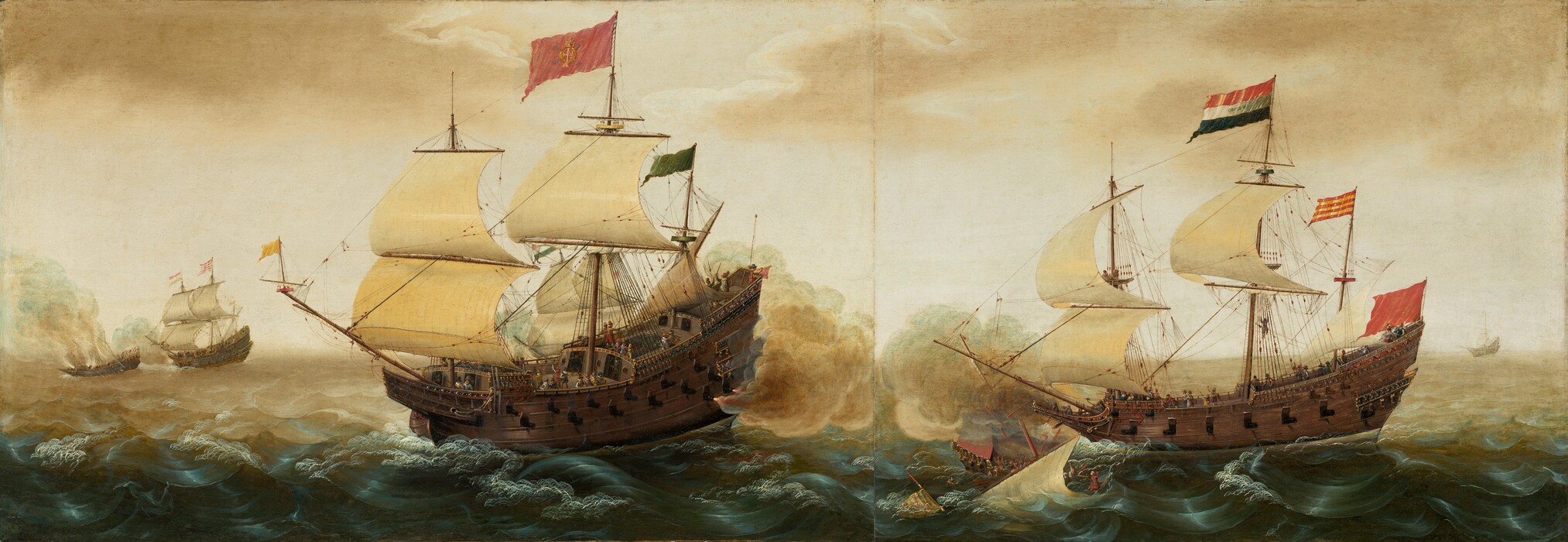
Two large wooden warships firing on each other on a choppy sea almost fill the width of this long horizontal painting. The water closest to us is ocean blue and becomes tan with crests of parchment white in the distance. The tall sides of the warships are pierced with rows of black cannons poking through portholes. Each ship has three tall masts with flax-colored sails billowing in the wind. Tiny men dressed in gold, red, and blue line the decks firing rifles, climbing rigging, or watching the action. The ship to our left is angled toward us, the long arm of the bowsprit on its bow extending to our left. A pink flag bearing a gold and blue crest flies from its tallest mast. A green flag flies from its rear mast and a smaller gold one from the prow. Bright flashes of yellow and rose-pink erupt from two of its cannons, and the stern is wrapped in tawny-brown and light blue smoke. Close to that warship, we look onto the long side of the second warship, to our right. A flag with bands of red, white, and blue flies from its tallest mast and a smaller one with orange and gold stripes flutters from its rear mast. A third red flag flies from the stern. Armored men stand in its prow, firing rifles at a sinking ship directly in front of us. This smaller ship is almost completely submerged with just part of its sail and keel above the choppy surface of the water. Tiny people jump in the water or remain in place while shrapnel from its blasted wooden mast flies out in every direction. One man kneels on the sinking deck with his hands together, facing the attacking crew. In the distance to the left of the left-hand warship, two smaller ships also seem locked in battle. The larger of that distant pair chases the smaller, whose masts collapse with smoke rising from its deck. A sixth ship, tiny in scale, sails near the horizon near the right edge of the composition. Camel-brown clouds floating against a parchment-colored sky in the top two-thirds of the painting. The artist signed the painting as if his name were written on the flag with the red, white, and blue bands: “CORNELIS VB,” with the V and B joined to create a monogram.
Cornelis Verbeeck, A Naval Encounter between Dutch and Spanish Warships, c. 1618/1620, oil on panel, Gift of Dorothea V. Hammond, 1995.21.1-2

A Naval Encounter between Dutch and Spanish Warships

Cornelis Verbeeck · c. 1618/1620 · oil on panel ·  Accession ID  1995.21.1-2

Bibliography

1628

  • Ampzing, Samuel. Beschrijvinge ende lof der stad Haerlem in Holland. Haarlem, 1628: 372.

1648

  • Schrevelius, Theodorus. Harlemias, ofte, De eerst stichtinghe der stad Haarlem. Reprinted in 1754. Haarlem, 1648: 445.

1753

  • Houbraken, Arnold. De Groote Schouburgh der Nederlantsche Konstschilders en Schilderessen. 3 vols. in 1. The Hague, 1753 (Reprint: Amsterdam, 1976): 2:123.

1870

  • Willigen, Adriaan van der. Les Artistes de Harlem: Notices historiques avec un précis sur la Gilde de St. Luc. Revised and enlarged ed. Haarlem and The Hague, 1870: 20.

1895

  • Rooses, Max. "Een veiling van schilderijen in 1616." Oud Holland 13 (1895): 178.

1907

  • Ref Number: XXXIV.224 (born Ha
    T.-B.XXXIV.224 (born Haarlem 1590 - died Haarlem 1631/1635)

1973

  • Bol, Laurens J. Die holländische Marinemalerei des 17. Jahrhunderts. Braunschweig, 1973: 45-48.

1974

  • Preston, Colonel Rupert. Seventeenth-Century Marine Painters of the Netherlands. Leigh-on-Sea, 1974: 15.

1979

  • Dutch and Flemish 16th and 17th Century Paintings from the Shipley Collection. Exh cat. 6 venues, organized by Alan Jacobs Gallery, London, 1979-1980. London, 1979 (cat. compiled by Christopher Wright).

1980

  • Miedema, Hessel. De Archiefbescheiden van het St. Lukasgilde te Haarlem: 1497-1798. 2 vols. Alphen aan den Rijn, 1980: 2:419.

1990

  • Keyes, George S. Mirror of Empire: Dutch Marine Art of the Seventeenth Century. Exh. cat. Minneapolis Institute of Arts; Toledo (Ohio) Museum of Art; Los Angeles County Museum of Art, 1990-1991. Cambridge, England, 1990: 422.