Emanuel de Witte

Dutch, c. 1616 - 1691/1692

Emanuel de Witte was born in Alkmaar in about 1616, the son of Pieter de Wit, a local schoolteacher, and his wife, Jacomijntge van der Beck. According to Arnold Houbraken, De Witte studied with Evert van Aelst (1602–1657), a still-life painter in Delft.[1] In 1636 De Witte joined the Saint Luke’s Guild in Alkmaar but he soon moved to Rotterdam before returning to Delft in 1641. In October of that year a daughter of his was baptized in Delft; one year later, on October 4, 1642, he married the child’s mother, Geertgen Arents. De Witte joined Delft’s Guild on June 23, 1642, and was regularly documented in the city during the next several years; in March 1650 he rented an inexpensive house on the Nieuwe Langendijk for a year.

De Witte probably moved to Amsterdam in 1651, although he was first recorded there in January 1652. Geertgen died soon after, and De Witte married Lysbeth Lodewyck van de Plass in 1655; the couple had a daughter, born in February 1656. In 1658, however, Lysbeth was banished from Amsterdam for robbery, and she took their daughter with her. In addition to his personal troubles, De Witte suffered financial difficulties during the latter years of his life and was forced to indenture himself on numerous occasions. He was known to experience severe bouts of depression, and it is believed that he committed suicide in the winter of 1691–1692 in Amsterdam.[2]

Although De Witte started out as a painter of biblical and mythological scenes, after 1650 he turned increasingly toward the depiction of church interiors. He often incorporated the pulpit or other church furniture in his views of Delft or Amsterdam churches. Along with his Delft contemporaries Gerard Houckgeest (1600–1661) and Vliet, Hendrik Cornelisz van, De Witte was an influential painter of architectural settings. Unlike Houckgeest and Van Vliet, however, who concentrated on the accurate rendering of space and perspective, De Witte rendered fanciful church interiors. He also demonstrated a greater interest in the contrasts of light and shadow and emphasized figures and animals in his interior spaces. In addition, he painted market scenes and several portraits.  


[1] Arnold Houbraken, De groote schouburgh der Nederlantsche konstschilders en schilderessen, 3 vols. (The Hague, 1753; reprint, Amsterdam, 1976), 1:283.

[2] Arnold Houbraken, De groote schouburgh der Nederlantsche konstschilders en schilderessen, 3 vols. (The Hague, 1753; reprint, Amsterdam, 1976), 1:286–287.


Explore selected works
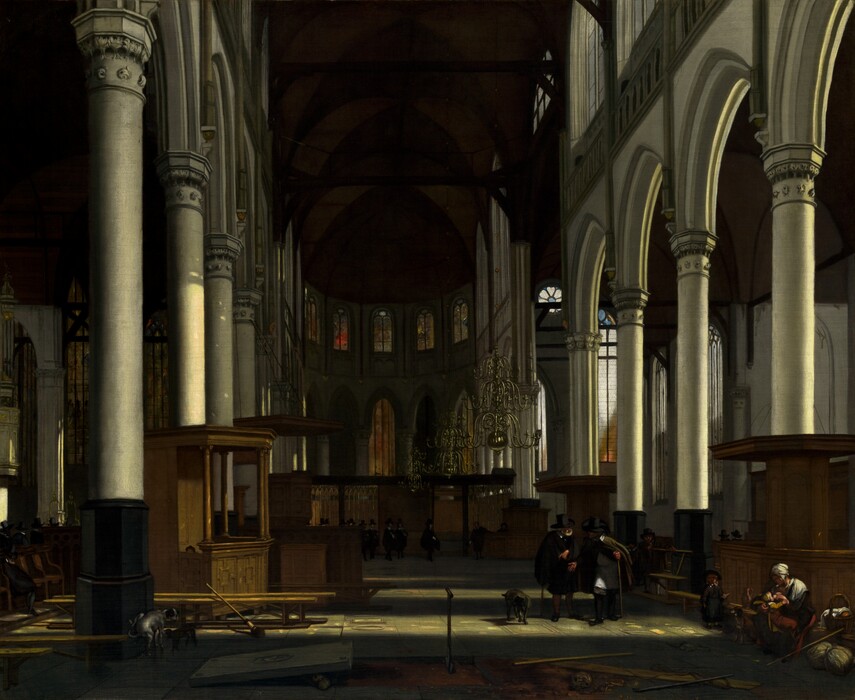
We stand in the central nave of a deeply shadowed church looking down toward the altar in this horizontal painting. Sunlight streams in from our right to bathe white pillars lining the nave with light, and it illuminates a wooden stall, like a private seating box, situated in front of the columns to our left. The forehead, eyes, and one hand of a young child peeks over the top edge of one of the panels, perhaps peering at us. Touches of pale red and yellow suggest stained glass over the dimly lit altar at the far end of the church, across from us. Gold chandeliers with curling, scrolling arms hang along the length of the nave, well below the dark, vaulted ceiling. About a dozen of men wearing black enter the church in a line from the left, near the altar. Closer to us, to our right, two men lean together in conversation with a dog nearby. One man gestures to a rectangular stone slab that has been lifted from the church floor to reveal dirt underneath, to our left. Two shovels, a broom, and a skull lay nearby. In front of the men, in the lower right corner of the canvas, a woman sits and nurses a swaddled infant. A young boy and another dog near the pair looks toward or at us. Two dogs stand in the shadows around the column closest to us on the left, and one raises its leg to relieve itself on the base.
Emanuel de Witte, The Interior of the Oude Kerk, Amsterdam, c. 1660, oil on canvas, Patrons' Permanent Fund, 2004.127.1

The Interior of the Oude Kerk, Amsterdam

Emanuel de Witte · c. 1660 · oil on canvas ·  Accession ID  2004.127.1

Bibliography

1753

  • Houbraken, Arnold. De Groote Schouburgh der Nederlantsche Konstschilders en Schilderessen. 3 vols. in 1. The Hague, 1753 (Reprint: Amsterdam, 1976): 1:282-287.

1963

  • Manke, Ilse. Emanuel de Witte, 1617-1692. Amsterdam, 1963:1-71.

1982

  • Liedtke, Walter A. Architectural painting in Delft: Gerard Houckgeest, Hendrick van Vliet, Emanuel de Witte. Doornspijk, 1982: 76-96.

1991

  • Giltaij, Jeroen, and Guido Jansen. Perspectives: Saenredam and the Architectural Painters of the 17th Century. Trans. Yvette Rosenberg. Exh. cat. Museum Boymans-van Beuningen, Rotterdam, 1991: 183-209.

2000

  • Liedtke, Walter A. A View of Delft: Vermeer and His Contemporaries. Zwolle, 2000: 121-127.

2001

  • Liedtke, Walter A., Michiel Plomp, and Axel Rüger. Vermeer and the Delft school. Exh. cat. Metropolitan Museum of Art, New York; National Gallery, London. New Haven, 2001: 432.