Master of the Catholic Kings

Master of the Retable of the Reyes Catolicos
Spanish, active c. 1485/1500

Explore selected works

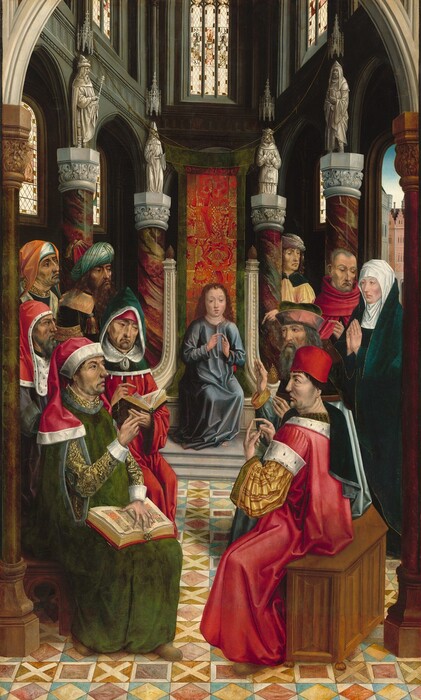
Set in a church, nine men and one woman gather around a throne, on which sits a young boy in this vertical painting. All the people have pale or olive-toned skin. The boy has long, wavy brown hair framing an oval face with delicate features. He looks down in front of him as he holds the tips of his two pointer fingers to touch. His gold-edged, ocean-blue robe falls loosely to the floor over one bare foot. The throne is carved from parchment-white stone and it sits on a low platform set on three shallow steps. Behind the boy, a crimson-red cloth patterned with gold and edged with a moss-green border is held up with four ropes tied into a four-point canopy. Five bearded and cleanshaven men stand and sit in a close group to our left, in front of the throne. They all wear hats, including a turban, hoods, and caps, and long robes in red, green, and white. Two hold open books and each man looks in a different direction, either toward the child or toward the group of four men and one woman clustered to our right. At the center of that second group, the woman wears a white cloth covering her head and a teal-blue robe, and she holds her hands together in prayer. Upon closer inspection, one finds that the woman and child’s heads are surrounded by lines radiating out to create haloes. The other four men in the group to our right also wear jewel-toned robes, and all wear caps except for one man, who is bareheaded. The man closest to us holds his hands with fingertips touching, like the child. The floor between the groups, leading up to the throne, is inlaid with square and X-patterns in sky blue, rose pink, golden yellow, and off white. To either side of the throne and behind the groups of men, six columns support statues carved from white stone. The polished columns are marbled with brick red, pine green, and fawn brown. Two taller columns along the left and right edges of the painting support a pale gray stone arch, which is cut off by the top edge. The apse beyond the throne is decorated on the second level with stained glass set within gray stone walls. An arched opening in the wall to our right, above the woman, leads to a view of buildings with stepped rooflines.
Master of the Catholic Kings, Christ among the Doctors, c. 1495/1497, oil on panel, Samuel H. Kress Collection, 1952.5.43

Christ among the Doctors

Master of the Catholic Kings · c. 1495/1497 · oil on panel ·  Accession ID  1952.5.43
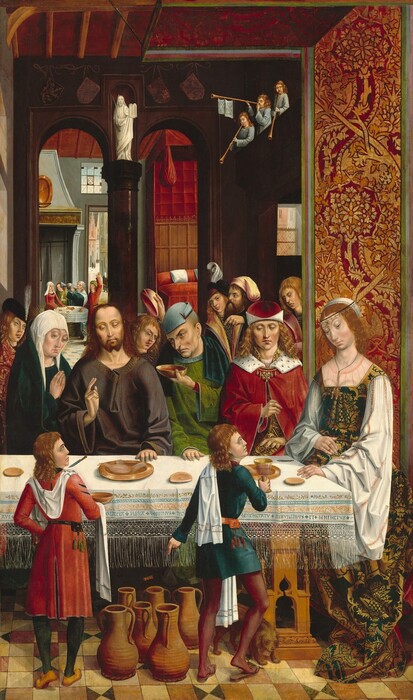
Three men and two women sit or stand along the far side of a long table, with more people looking on or gathered in other rooms behind them in this tall, vertical painting. All the people have pale skin. The long table stretches nearly the width of the painting. Near the left edge of the painting, a woman wearing a teal-blue robe over a white head scarf holds her hands together in front of her chest in prayer, and she looks down and to our right toward the tabletop. Next to her, a bearded man wearing a loose, eggplant-purple robe, Jesus, holds his right hand, to our left, up in front of his chest with his first two fingers raised, and the other hand rests on the table. His long, wavy brown hair hangs by his face, and he looks down toward the table with hooded eyes, his head tilted slightly to our left. Gold lines radiate out from the woman and Jesus’s heads. At his left shoulder, to our right, a man wearing a sky-blue cap and an emerald-green robe holds an oval-shaped bowl filled with a red liquid toward Jesus with one hand, and the other rests on the table. He looks to our left with light brown eyes under arched brows, and he has deep wrinkles across his forehead, at the corners of his eyes, along his chin line, and around his mouth. To our right and at the end of the table, a young, cleanshaven man sits next to a woman. Both have wavy blond hair, and they look down at the table. The man wears a crimson-red cap and a white fur-lined red cloak with a gold, jeweled clasp lined with teardrop pearls. His right hand, to our left, is lifted toward the woman sitting next to him. The woman wears a pearl-and-jewel headband around a white cloth that drapes down the back of her head. Her pine-green dress is patterned with shimmering gold, stylized leaf designs and has full, loose, white sleeves. She wears three gold rings on the hand resting on the table and two jeweled, gold bands on the other, which rests on her belly. Two younger people, both with brown, shoulder-length hair, stand on our side of the table, facing away from us as they look toward the woman to our right. The one to our left wears a brick-red tunic, and he holds a shallow, round bowl. The one to our right wears teal blue and holds a gold goblet on the table. With his other hand, he points down at six tall jugs on the geometrically patterned floor, and a brown dog stands at his feet. The table is covered with a white cloth, which is decorated with bands of stylized leaves and borders on the side facing us. Along the bottom of the cloth, above long fringe, a Latin inscription reads, “AVE GRACIA PLENA DOMINVS TECV BENEDICTATV INMVILEDIDVS ET BENEDICTVS.” Two gold plates, a few pieces of round, flat bread, and two knives are spaced along the tabletop. Behind the group at the table, one person stands to our left, another at the center, and a trio of men stand to our right. The far wall of the room is peirced with two tall, narrow arches of wood or dark stone to our left. At the top of the column separating the arches, there is white statue of a man holding up two round-topped tablets. The archway to our right opens onto a room with a bed covered with a ruby-red cover and a white pillow. Under the other arch, to our left, one woman and three men sit or stand around a round table in front of a tall fireplace mantle. One of the men holds a large, pewter-silver pitcher up to his lips, and the other three look on. The round table is covered with a white cloth and set with a few dishes. A door on the far wall of that room opens onto a street view lined with buildings.
Master of the Catholic Kings, The Marriage at Cana, c. 1495/1497, oil on panel, Samuel H. Kress Collection, 1952.5.42

The Marriage at Cana

Master of the Catholic Kings · c. 1495/1497 · oil on panel ·  Accession ID  1952.5.42

Bibliography

1913

  • Mayer, August L. Geschichte der spanischen Malerei. Leipzig, 1922: 144-145. (also Spanish ed., Madrid, 1942: 165-166).

1930

  • Post, Chandler R. A History of Spanish Painting. 14 vols. Cambridge, Massachusetts, 1930-1966: 4, part 2:418-428; 5, part 1:182, 194.

1939

  • Mayer, August L. "Late XVth Century Castilian Painting." Apollo 29 (1939): 281.

1943

  • Post, Chandler R. "The Pacully Master." Gazette des Beaux-Arts 23 (1943): 328.

1990

  • Brown, Jonathan, and Richard G. Mann. Spanish Paintings of the Fifteenth through Nineteenth Centuries. The Collections of the National Gallery of Art Systematic Catalogue. Washington, D.C., 1990: 92-93.