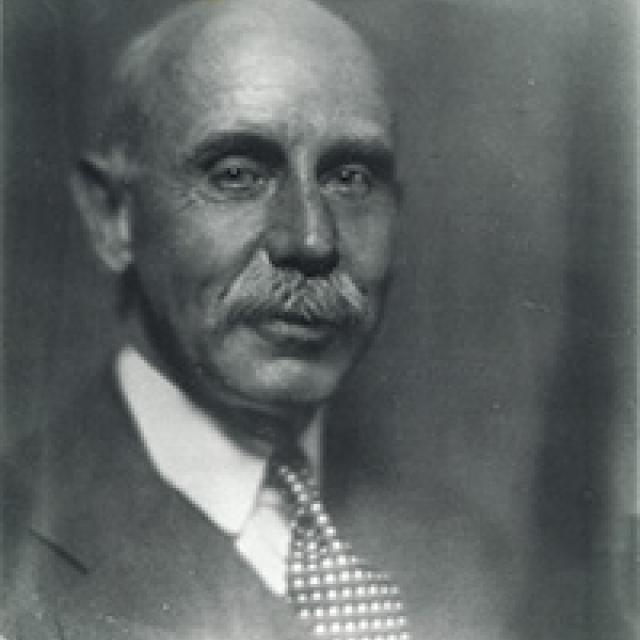
Allen Tucker

American, 1866 - 1939

Allen Tucker, born in Brooklyn, New York, in 1866, began his career as an architect. He earned an architecture degree from the School of Mines at Columbia University in 1888 and worked for the architecture firm of McIlvaine and Tucker from 1895 to 1904. Throughout the 1890s he studied at the Art Students League in New York, where one of his instructors was the American impressionist John Twachtman, a significant influence on Tucker’s early style. By 1904 Tucker had decided to leave the field of architecture and devote himself to painting full time.

In 1910 Tucker was included in the New York Exhibition of Independent Artists, organized as an alternative to the conservative practices of the National Academy of Design. The following year Tucker became a founding member of the American Association of Painters and Sculptors, which sought to create new spaces for young artists to exhibit their work. This association organized the Armory Show in 1913. Tucker produced the catalog for the exhibition, and five of his paintings were included in the show. The Armory Show, which was the first opportunity for many Americans to view modern European art, prompted Tucker’s shift to a post-impressionist style influenced by Vincent van Gogh.

In 1914, in his late forties, Tucker volunteered to serve in the American Ambulance Field Service in France, and then worked in a Red Cross hospital once the United States entered World War I. He wrote about his war experience in a book of poems, There and Here (1919).

Tucker helped organize and was included in the first exhibition of the Society of Independent Artists in 1917, and he had his first solo exhibition at the Whitney Studio Club in 1918. In the 1920s Tucker taught at the Art Students League. He continued to write, publishing Design and the Idea in 1930 and a monograph on Twachtman in 1931. Tucker died in New York in 1939.

Explore selected works
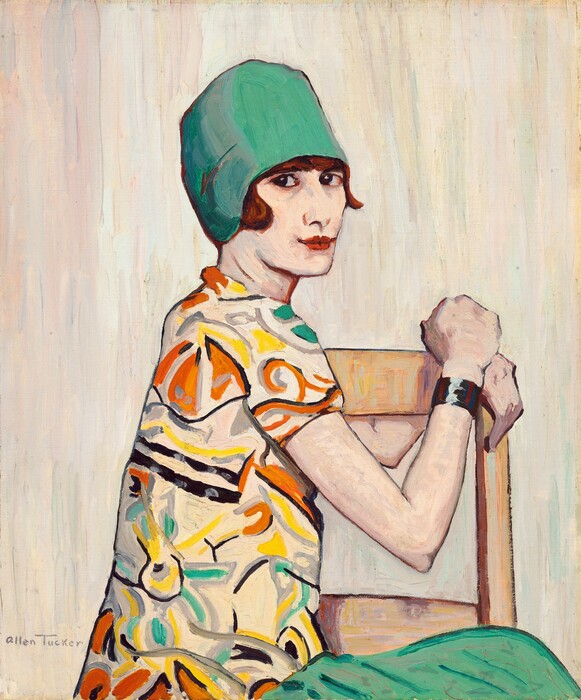
This painting depicts a woman from the waist up, seated sideways on a wooden chair. She is turned to the right, with her hands on the back of the chair, and looks over her shoulder towards us. She has pale skin and short reddish-brown hair visible beneath a green cap. Her red lips are slightly turned up at the edges, and her eyes are dark. She is wearing a brightly colored top with abstract shapes in orange, yellow, gray, and green against a cream background, and a green skirt that is the same shade as her hat. A bracelet adorns her wrist with vertical stripes of white, dark blue, and dark red. The chair she sits on is light yellow wood, and the background is made of vertical lines of white, cream, and gray, with hints of pastel pink, minty green, and pale blue. The brushstrokes in the painting are visible.
Allen Tucker, Bizarre, 1928, oil on canvas, Gift of the Allen Tucker Memorial, 1971.13.1

Bizarre

Allen Tucker · 1928 · oil on canvas ·  Accession ID  1971.13.1
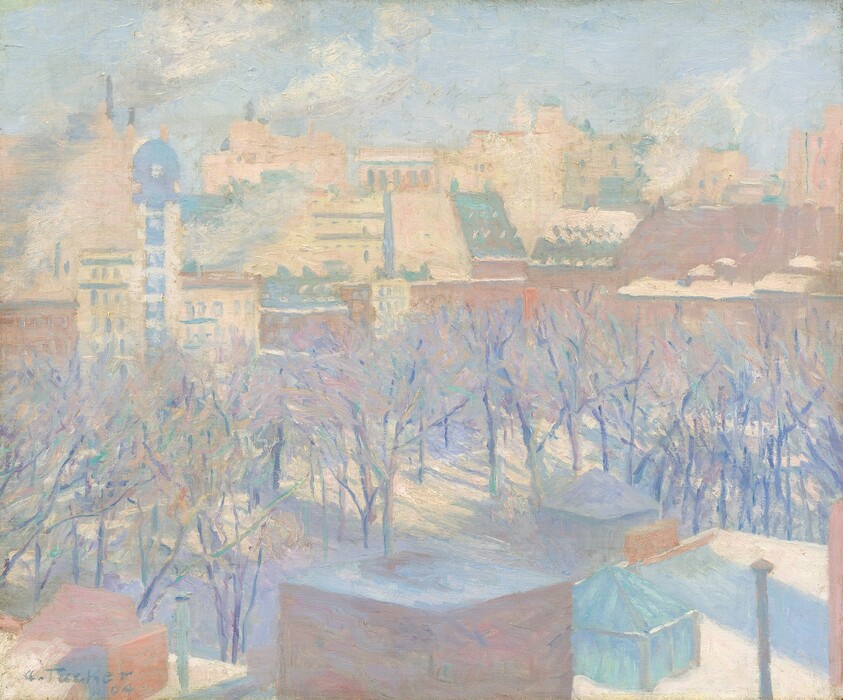
This painting shows an elevated view of a snowy city scene. Our view overlooks rooftops and bare, leafless trees surrounded by snow-covered ground. The section of trees is in the center of the image, and behind them are distant buildings of various styles. Light brushwork creates a soft, filtered light across the cityscape. The buildings are in shades of pale red, light yellow, cream, and peach, with some teal and gray. Some of the buildings cast long shadows, and these are shown in light blue. The trees are painted with thin lines of purple, pink, yellow, and teal. The sky above the scene is light blue, and soft white clouds drift across it.
Allen Tucker, Madison Square, Snow, 1904, oil on canvas, Gift of the Allen Tucker Memorial, 1971.13.2

Madison Square, Snow

Allen Tucker · 1904 · oil on canvas ·  Accession ID  1971.13.2

Bibliography

1932

  • Watson, Forbes. Allen Tucker. New York, 1932.