Jacob van Walscapelle

van Walscapelle, Jacob
Dutch, 1644 - 1727

Little is known about the still-life painter Jacob van Walscapelle. He was born in 1644 in Dordrecht, where he was baptized under the surname of his father, Elias Cruydenier. For unknown reasons, however, Jacob, along with his sister Antonia, later changed their name to Van Walscapelle after their paternal grandmother.[1] In 1660 Antonia moved to Amsterdam to marry Ottmar Elliger (1633–1679), a painter of flower still lifes and portraits. Jacob probably followed his sister not long thereafter, becoming a pupil of the still-life painter Cornelis Kick (1635–1681).[2]

Van Walscapelle’s abundant still lifes, however, reflect the influence of Heem, Jan Davidsz de more than that of his Amsterdam master. His flower and fruit pieces, as well as several breakfast and vanitas scenes, display the same monumentality and vibrant color evident in De Heem’s works. Van Walscapelle’s still lifes fetched high prices on the market, but relatively early in his career the artist decided to pursue public affairs in addition to painting. Beginning in 1673, he held various public offices in Amsterdam, and in 1682 received a municipal appointment in the Saaihal.[3] His last known painting, a vanitas still life, is dated 1685. He died in Amsterdam on August 16, 1727.

[1] Jan Knoef, “Jacob van Walscapelle,” Oud-Holland 56 (1939): 262.

[2] Arnold Houbraken, De Groote Schouburgh der Nederlantsche Konstschilders en Schilderessen. 3 vols. (The Hague, 1753; reprint: Amsterdam, 1976), 2:334.

[3] Jan Knoef, “Jacob van Walscapelle,” Oud-Holland 56 (1939): 262.


Explore selected works

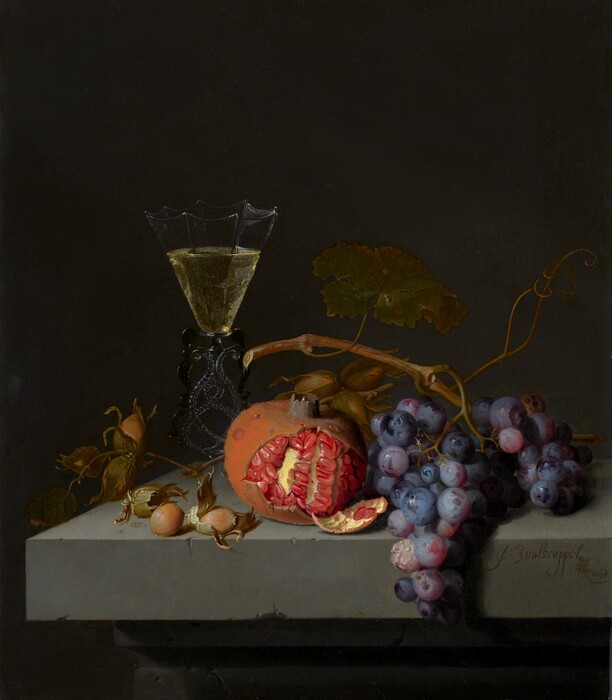
A half-peeled pomegranate, a few nuts, a bunch of purple grapes, and a glass of pale yellow wine sit on the corner of a stone ledge against a dark background in this vertical still life painting. The corner of the chipped gray ledge is close to and lines up with the lower left corner of the painting. Two hazelnuts sit near the front of the ledge, and a twig with three more nuts in papery husks are attached to a twig. Behind that, the flaring cup of the wineglass is made up of flat panels, which are inwardly scalloped along the upper edge, like an upside-down badminton shuttlecock. The stem is made of intertwining ropes of clear and black glass. At the lower center of the composition, the glistening, scarlet-red seeds of the pomegranate contrast with the rust-orange rind. Another twig of hazelnuts is between the pomegranate and the bunch of frosty purple grapes. The vine and a broad, dark green leaf arches over the grapes and pomegranate. The objects are brightly lit from our left against a charcoal-gray background. Molding under the ledge can be made out in the shadows across the bottom edge of the painting. Closer inspection reveals tiny water droplets on the stone ledge and the pomegranate. The artist signed and dated the painting in cursive text on the front face of the ledge, near the lower right corner: “J: Walscappel 1675.”
Jacob van Walscapelle, Still Life with Fruit, 1675, oil on panel, Juliet and Lee Folger/The Folger Fund, 2001.71.1

Still Life with Fruit

Jacob van Walscapelle · 1675 · oil on panel ·  Accession ID  2001.71.1

Bibliography

1753

  • Houbraken, Arnold. De Groote Schouburgh der Nederlantsche Konstschilders en Schilderessen. 3 vols. in 1. The Hague, 1753 (Reprint: Amsterdam, 1976): 2:334.

1980

  • Vroom, Nicolaas R.A. A Modest Message as Intimated by the Painters of the "Monochrome Banketje." 2 vols. Schiedam, 1980: 1:236.