Jan Weenix

Dutch, 1642 - 1719

Jan Weenix was born in Amsterdam in 1642, the son of the Italianate painter Jan Baptist Weenix (1621–1660/1661) and Josina de Hondecoeter.[1] He spent his early childhood in Amsterdam without his father, who left for an artistic sojourn in Italy just fourteen months after Jan’s birth. Jan Baptist returned to Amsterdam in 1647, and shortly thereafter the family moved to Utrecht. By 1657 they had settled in a large house outside of the city, the “Huis ter Mey,” where the younger Jan became a pupil in his father’s studio.

After Weenix joined the Utrecht painter’s guild in 1664, he painted Italianate genre scenes in the manner of his father.[2] He probably moved to Amsterdam in the early 1670s, although the first official record of him in that city was not until October 1679, when he married.[3] In Amsterdam Weenix abandoned the painting of Italianate scenes in favor of extravagant game pieces, a genre that had gained popularity since the 1650s, thanks in part to Weenix the elder's success in painting such scenes.[4] Jan Weenix had only one known pupil, Dirk Valkenburg (1675–1721), who closely imitated his master’s style.

Weenix’s paintings, which were sought after by wealthy Amsterdam burghers, typically depict dead game set against lush landscapes with dramatic views into the distance. He often combined these scenes with classical elements, including antique urns and statues. At the turn of the century, his reputation attracted the attention of Johann Wilhelm von der Pflaz, the German Elector Palatine in Düsseldorf, for whom he produced numerous game pieces and large still lifes from 1702 until about 1714.[5]


[1] Arnold Houbraken, De Groote Schouburgh der Nederlantsche Konstschilders en Schilderessen. 3 vols. (The Hague, 1753; reprint: Amsterdam, 1976), 2:78.

[2] Christine Skeeles Schloss, “The Early Italianate Genre Paintings by Jan Weenix,” Oud-Holland 97 (1983): 71, as cited in S. Muller, De Utrechtsche Archieven, I. Schilders-Vereenigingen te Utrecht, Bescheiden uit het Gemeente-Archief (Utrecht, 1880), 33.

[3] Adrianus Daniel de Vries “Biografische Aanteekeningen betreffende Voornamelijk Amsterdamsche Schilders,” Oud-Holland 4 (1886): 300. “Ondertr. 7 Oct. 1679. Johan Weenix, van ouders doot, geass. Abram Hondecoeter, syn oom, en Pieternelle Backer, van A., out 2- jaren, op de Fluwelen Burghwal, geass. Haer vader Jan Pietersz Backer.” Christine Skeeles Schloss, “The Early Italianate Genre Paintings by Jan Weenix,” Oud-Holland 97 (1983): 71, states that the Gemeentelijke Archiefdienst van Amsterdam lists the date as October 13. Weenix became a burgher of Amsterdam on March 23, 1688.

[4] Scott A. Sullivan, The Dutch Gamepiece (Montclair, NJ, 1984), 62. The genre had also gained popularity as a result of the works of Elias Vonck (1605–1652), Aelst, Willem van, and Melchior d’Hondecoeter (1636–1695).

[5] Peter Eikemeier, “Der Jagdzyklus des Jan Weenix aus Schloss Bensberg,” Weltkunst 48 (1978): 296–298.


Explore selected works
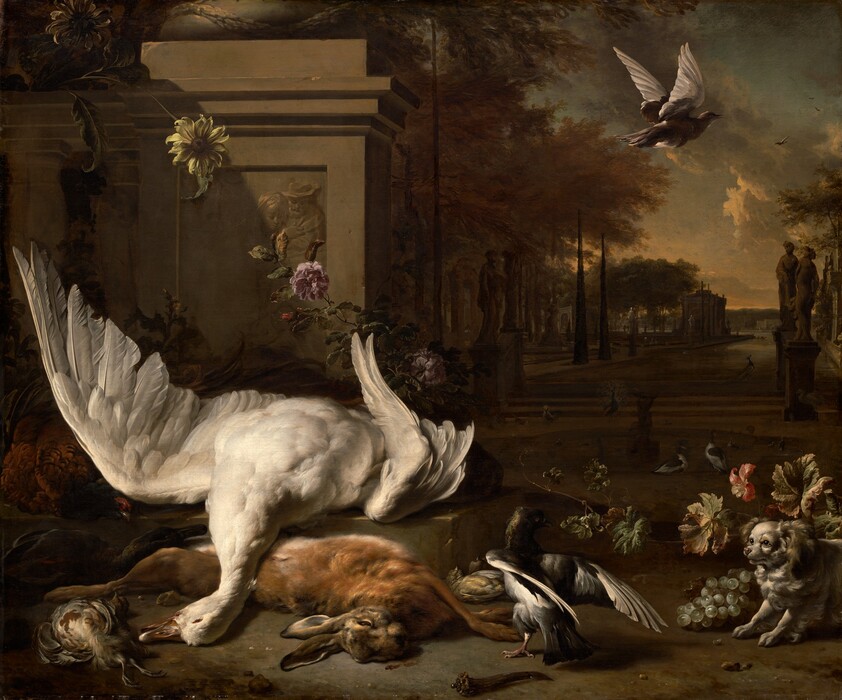
The limp, dead bodies of a swan, rabbit, and three birds along with a live bird and a small dog are arranged on and near a low stone step in the bottom left corner of this horizontal painting. To our left and close to us, the white swan lies on its back on the step with its wings partly extended. Its long neck drapes toward us over the rabbit’s body, the bird’s head turned to our left. The rabbit has tawny-brown fur and lies stretched out on its side, its belly facing away from us. Tucked in the lower left corner of the painting, a fowl has a round body with cream-white and chestnut-brown feathers. The beaks of two more dead birds peek out from the shadows beyond the rabbit’s body. Behind the dead animals and taking up the left third of the painting, the square base of a fawn-brown stone column nearly reaches the top edge of the canvas. The front face is carved with a relief showing a woman and man huddled together as they look down in front of them, seemingly toward the swan. A yellow flower with narrow, tapered petals hangs over the upper left corner of the base and lavender-purple flowers, perhaps roses, peek around the base from our right. To our right of the dead animals, a bird with black, smoke-gray, and white feathers stands facing away from us with its wings flared back. Its emerald-green and gold head gleams in the stark light illuminating the scene from the lower left. It turns its head toward a small dog in the lower right corner. The dog has white and pale, honey-brown fur, a round face, blunt nose, and sable-brown floppy ears. The dog’s back half is cut off by the edge of the painting, and it seems to lean back as it looks toward the bird. A grapevine with broad, curling leaves winds into the painting behind and above the dog, ending with scrolling tendrils at the center of the composition. The leaves are fern green, some fading to a pale sage green or tan, and edged in brown. One leaf over the dog’s head is crimson red and tan, and a glistening cluster of green grapes lies on the ground near the dog’s front paws, to our left. Beyond the live bird and dog, a deep landscape opens up with statues lining a stepped walkway that leads to a rectangular reflecting pool. Several black and white birds the size of ducks stand in the shadowed background near the pool and more birds fly overhead. Backlit by the amber-gold sunset, tall trees with thin black trunks and caramel-brown leaves line the path leading to a tall narrow structure at the water’s edge. The golden sunset fades to a pale blue sky with drifting clouds over low mountains in the deep distance.
Jan Weenix, Still Life with Goose and Game before a Country Estate, c. 1685, oil on canvas, Patrons' Permanent Fund, 2004.39.1

Bibliography

1753

  • Houbraken, Arnold. De Groote Schouburgh der Nederlantsche Konstschilders en Schilderessen. 3 vols. in 1. The Hague, 1753 (Reprint: Amsterdam, 1976): 2:77-83.

1886

  • De Vries, Adrianus Daniel. "Biografische aanteekeningen betreffende voornamelijk Amsterdamsche schilders…" Oud Holland 4 (1886): 295-304.

1970

  • Ginnings, Rebecca Jean. "The Art of Jan Baptist Weenix and Jan Weenix." Ph.D. dissertation, University of Delaware, 1970.

1978

  • Eikemeier, Peter. "Der Jagdzyklus des Jan Weenix aus Schloss Bensberg." Weltkunst 48 (1978): 296-298.

1983

  • Schloss, Christine Skeeles. "The Early Italianate Genre Paintings by Jan Weenix." Oud Holland 97 (1983): 69-97.

1984

  • Sullivan, Scott A. The Dutch Gamepiece. Montclair, New Jersey, 1984: 61-67.

1999

  • Chong, Alan, and Wouter Th. Kloek. Still-life Paintings from the Netherlands, 1550-1720. Exh. cat. Rijksmuseum, Amsterdam; Cleveland Museum of Art. Zwolle, 1999: 300.