Willem Claesz Heda

Dutch, 1594 - 1680

Documents indicate that Willem Claesz Heda was born in Haarlem on December 14, 1594. This evidence is supported by an inscription designating his age—“aetate 84”—found on a 1678 portrait of Heda by the Haarlem painter Bray, Jan de. Heda spent his entire career in Haarlem. In 1616, at the age of twenty-one, he became a member of the Saint George civic guard, serving as a corporal from 1642 to 1645. He married Cornelia Jacobsdr on June 9, 1619. Heda also took an active role in the Saint Luke’s Guild. His name first appears on the guild rolls of 1631, the year in which he assisted Salomon de Bray (1597–1664) in its reorganization.[1] Heda was elected deken in 1642 and 1652, and was a hoofdman in 1637, 1643, and 1651. In a document dated July 7, 1642, Heda lists one of his sons, Heda, Gerret Willemsz, as an apprentice.

Although he painted some portraits and figural compositions, Heda specialized in still-life painting. He was unquestionably one of the greatest masters of the genre. As is evident from his early vanitas still lifes, Heda was influenced by the Haarlem painter Floris van Schooten (active c. 1617–1655). His breakfast pieces—tabletop still lifes displaying an array of food, including cheese, fruit, and bread—likewise grew out of the Haarlem still-life tradition of the early seventeenth century, as was already noted during his lifetime by Haarlem historian Theodorus Schrevelius, who wrote that Heda painted “fruit and all kinds of knick-knacks” in the manner of Floris van Dyck (1575–1651). Heda’s paintings evolved from additive compositions to monumental, monochrome breakfast and banquet pieces, executed with delicate brushwork that could vividly convey a wide range of materials and textures.

Heda and Claesz, Pieter were the principal still-life artists in Haarlem until well after mid-century. Heda’s great influence spread to painters in other artistic centers as well, among them the Amsterdam artist Jan Jansz den Uyl (c. 1595–1640).

[1] See Ed Taverne, “Salomon de Bray and the Reorganization of the Haarlem Guild of St. Luke in 1631,” Simiolus 6 (1972–1973): 50–69.

Explore selected works
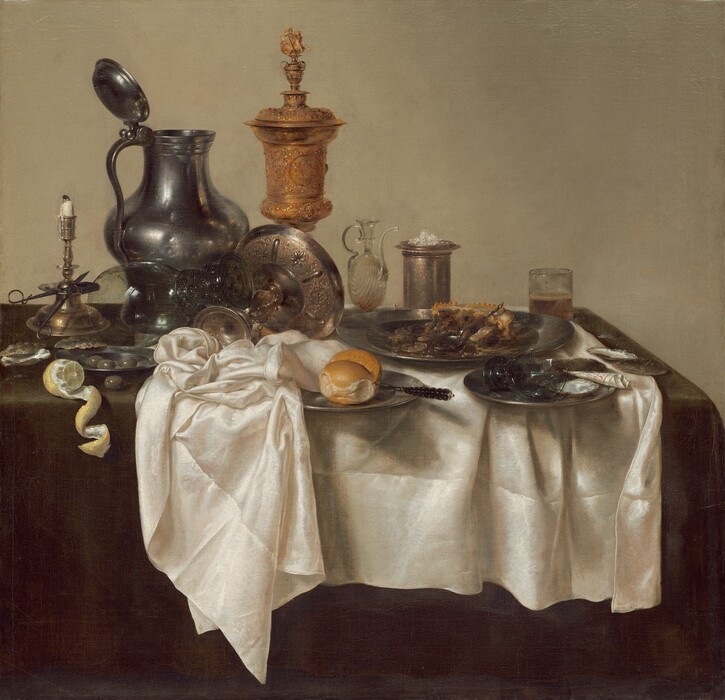
A jumble of pewter plates and a pitcher, glass goblets, a gold chalice, a brass candlestick, and other vessels along with lemons, olives, and the remains of a mince pie are arranged on a cream-white tablecloth bunched on a dark green tabletop in this square still life painting. The scene is painted almost entirely in shades of cool grays, gold, brown, and white against a deep beige background. The objects span width of the canvas across its center. At the left edge of the painting, a vibrant yellow lemon has been cut so its rind curls in a spiral that hangs over the front edge of the table. Behind the lemon, a scissor-like candle snuffer is propped against the wide ledge of the tall brass candlestick, its white candle nearly burned down. A few glistening olives sit in a small pewter plate, and one olive sits on the tabletop near the lemon and candlestick. A glass goblet with a wide stem with textured knubs rests upended on an elaborately chased, gold, footed vessel that has been tipped over so its wide shallow bowl faces away from us. The tall pewter pitcher behind this is dented on its rounded body. The lidded gold chalice next to the jug is the tallest object in the painting. Next to the chalice, along the right half of the painting, is a glass oil cruet with a long, curving spout, a tall, cylindrical vessel holding a small pile of salt, and a straight-sided, low glass holding beer. In front of these objects, an untouched bread roll and knife sit on a pewter plate at the center of the composition. The remains of the mince pie with its pastry crust sit on a large pewter plate to our right. In front of it is a smaller plate holding a broken goblet and a piece of black and white paper rolled into a cone. A few empty oyster shells sit on the table to the left and right, near the lemons and mince pie. The artist signed and dated the painting along the edge of the white cloth near the lower right corner: “HEDA 1635.”
Willem Claesz Heda, Banquet Piece with Mince Pie, 1635, oil on canvas, Patrons' Permanent Fund, 1991.87.1

Banquet Piece with Mince Pie

Willem Claesz Heda · 1635 · oil on canvas ·  Accession ID  1991.87.1

You may also like

Bibliography

1648

  • Schrevelius, Theodorus. Harlemias, ofte, De eerst stichtinghe der stad Haarlem. Reprinted in 1754. Haarlem, 1648: 390.

1870

  • Willigen, Adriaan van der. Les Artistes de Harlem: Notices historiques avec un précis sur la Gilde de St. Luc. Revised and enlarged ed. Haarlem and The Hague, 1870: 156-157.

1941

  • Gelder, Henrik Enno van. W. C. Heda, A. van Beyeren, W. Kalf. (Paletserie) Amsterdam, n.d.[1941].

1956

  • Bergström, Ingvar. Dutch Still-Life Painting in the Seventeenth Century. Translated by Christina Hedström and Gerald Taylor. London, 1956: 123-124.

1980

  • Vroom, Nicolaas R.A. A Modest Message as Intimated by the Painters of the "Monochrome Banketje." 2 vols. Schiedam, 1980: 1: 53-78, 2: 65-80, nos. 324-392.

1988

  • Segal, Sam. A Prosperous Past: The Sumptuous Still Life in the Netherlands, 1600–1700. Edited by William B. Jordan. Translated by P.M. van Tongeren. Exh. cat. Stedelijk Museum Het Prinsenhof, Delft; Fogg Art Museum, Cambridge, MA; Kimbell Art Museum, Fort Worth. The Hague, 1988: 121-140.

1995

  • Wheelock, Arthur K., Jr. Dutch Paintings of the Seventeenth Century. The Collections of the National Gallery of Art Systematic Catalogue. Washington, D.C., 1995: 99.

2003

  • Willigen, Adriaan van der, and Fred G. Meijer. A dictionary of Dutch and Flemish still-life painters working in oils, 1525-1725. Leiden, 2003: 103.

2006

  • Biesboer, Pieter, and Neeltje Köhler, eds. Painting in Haarlem 1500-1850: the collection of the Frans Hals Museum. Translated by Jennifer Kilian and Katy Kist. Ghent, 2006: 189-195.