Biagio d'Antonio

Biagio d'Antonio da Firenze
Tucci, Biagio d'Antonio
Florentine, c. 1446 - 1516

Explore selected works

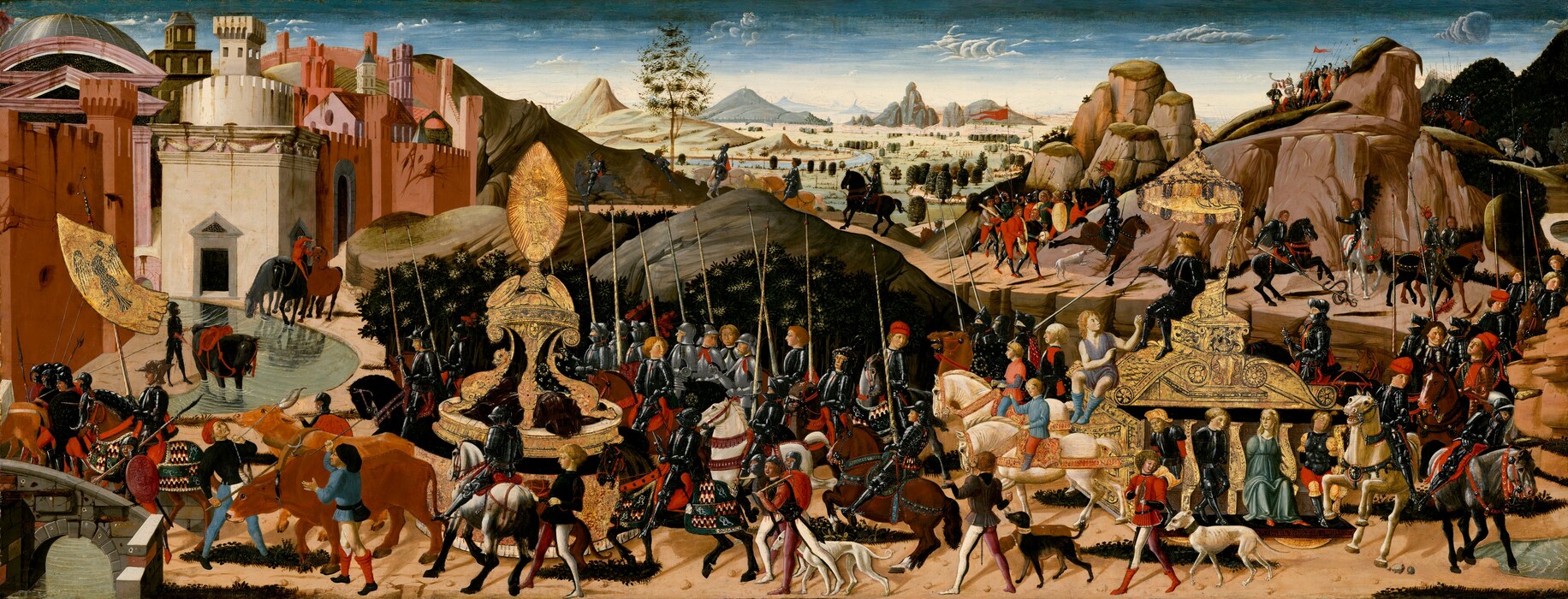
Winding from our right to left, a procession of dozens of people, mostly men and many in black and gray armor on foot and horseback, weaves through rocky hills to the gates of a city in this long, horizontal painting. The people we can see have light skin, and they are small in scale against the landscape. Throughout the procession, dogs nip at the heels of horses that walk, rear, or buck. Many of the armored men carry tall spears. The men not wearing armor mostly wear crimson-red robes over black stockings or short black tunics over stockings with one white leg and one mauve-pink leg. To our right, a man wearing black armor and a black wreath around his blond hair rides a gold throne on a large, gold platform being pulled by two cream-white horses. A gold canopy hangs over his head. Facing our left in profile, he points a scepter down at a person sitting in front of him, lower down on the base. That person wears a simple, lilac-purple tunic and slouching, denim-blue boots as he turns and looks up at the crowned man, hands raised. Three men and one woman sit in alcoves on the side of the base facing us with their hands behind their backs. The men wear black armor while the woman wears a muted sea-green dress. The letters “SPQR” are written in gold across the chest of a rider to our right. The procession in front of the throne passes around a tall golden structure like a fountain. At the top of that structure, a woman surrounded by gold rays to create an ellipse. The soldiers at the front of the procession cross a short, arched bridge leading into the city, and one rider carries a gold banner with a stylized, splayed black bird. Towers and domes in shades of cream, coral, and pink peek above the crenelated city wall. To our right, the landscape beyond the procession is dotted with trees leading to rocky mountains in the deep distance. The horizon line comes four-fifths of the way up the composition. A few wispy white clouds float across a sky that deepens from white along the horizon to lapis blue across the top edge of the panel.
Biagio d'Antonio, Italian 15th Century, The Triumph of Camillus, c. 1470/1475, tempera on panel, Samuel H. Kress Collection, 1939.1.153

The Triumph of Camillus

Biagio d'Antonio, Italian 15th Century · c. 1470/1475 · tempera on panel ·  Accession ID  1939.1.153
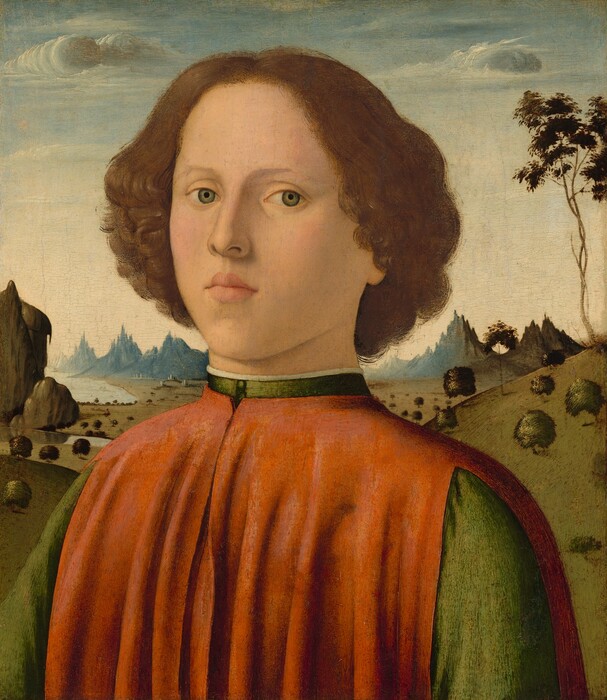
This painting is a portrait of a boy seen from the chest up, facing us with a neutral expression. He has fair skin, light eyebrows, defined, pink lips, and green eyes. His curly hair is brown and falls around his ears. The boy wears a high-collared garment with an olive-green undershirt and a reddish-orange outer vestment. There is a serene landscape in the background with rolling hills, pointed rock formations, scattered trees, bushes, and a blue sky with a few wispy clouds.
Biagio d'Antonio, Portrait of a Boy, c. 1476/1480, oil and tempera on poplar panel, Samuel H. Kress Collection, 1939.1.179

Portrait of a Boy

Biagio d'Antonio · c. 1476/1480 · oil and tempera on poplar panel ·  Accession ID  1939.1.179

Bibliography

1999

  • Bartoli, Roberta. "Biagio d'Antonio." Milan, 1999.

2003

  • Boskovits, Miklós, and David Alan Brown, et al. Italian Paintings of the Fifteenth Century. The Systematic Catalogue of the National Gallery of Art. Washington, D.C., 2003: 130.