


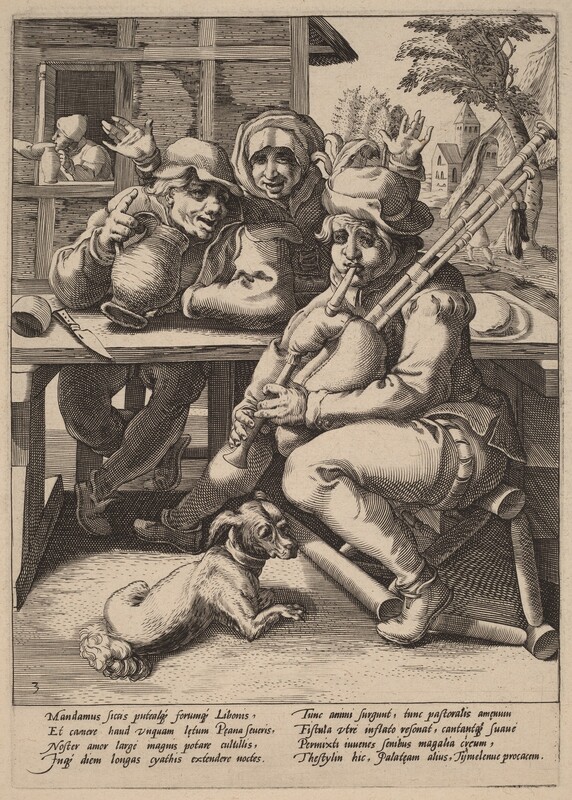
The Bagpipe Must Be Filled
c. 1592
Hendrick Goltzius
Related Artist, Dutch, 1558 - 1617
Artist After, Netherlandish, 1548 - 1606

Artwork overview
-
Medium
engraving and letterpress on laid paper
-
Credit Line
-
Dimensions
plate: 24.4 x 17 cm (9 5/8 x 6 11/16 in.)
sheet: 39.7 x 27.2 cm (15 5/8 x 10 11/16 in.) -
Accession Number
2004.2.3
-
Catalogue Raisonné
New Hollstein, no. 97, State i/iii
-
Series Title
Six Proverbs (plate 3)
Associated Artworks
See all 6 artworks
Do Not Spend Your Savings Too Soon
1590
Six Proverbs
1590
The Scales of Marriage
1590
Artwork history & notes
Provenance
Château de la Roche-Guyon, France (part of an album)1; (Paul Prouté S.A., Paris); purchased by NGA, 2003.
1 The album was bound in vellum, with "Abraham" on the cover and "Ligeoys" on the back cover. The Château de la Roche-Guyon stamp was on some of the pages, which included a variety of northern mannerist prints by Goltzius, Matham, Saenredam, and others. It was apparently dismantled by Prouté for sale of some of the prints to the NGA.
Associated Names
Bibliography
1949
Hollstein, F.W.H. et al. German engravings, etchings and woodcuts ca. 1400-1700. 8 vols. Amsterdam: Menno Hertzberger, 1954-1868. Dutch and Flemish etchings, engravings and woodcuts, ca. 1450-1700. Vols. I-XV, XVIII, XIX. Amsterdam: Menno Hertzberge
1993
The New Hollstein Dutch & Flemish Etchings, Engravings and Woodcuts, 1450-1700. (Karel van Mander, Marjolein Leesberg, author). Rotterdam: Sound & Vision Interactive, 1996-, no. 97, state i/iii.
Inscriptions
lower left, in image, in plate: 3; below image, in plate: Mandamus sicas putealq[ue] formq[ue] Libonis, / Et canere haud vnquam l[a]etum P[a]eana seueris, / Noster amor large magnis potare culullis, / Inq[ue] diem longas cyathis extendere noctes. Tunc animi surgunt, tunc pastoralis am[a]enum / Fistula vtre inflato resonat, cantantq[ue] suaue / Permixti iuuenes senibus magalia circum, / Thestylin hic, Palat[a]eam alius, Thymelenue procacem (We forsake the daggers, the puteal of Libo and the forum and never sing a happy song to the strict people. We enjoy drinking plentifully from large goblets and spending long nights until the break of day with our cups. Our courage is thus restored, and then resounds the sweet shepherd's flute when the bagpipes are played and the young men sing pleasantly together with the old chaps around the huts, the one about Thestylis, and the other about Palatea or the playful Thymele); below plate, in letterpress: Door liefd' van 't vocht, prysen wy de volle kruyck, / 'Thooft op ydel buyck,, kan geen vreughd begrypen: / Al te langhe vasten, is gheen goedt ghebruyck, / Den sack moet vol zijn, sal de lylle pypen. (They yt love wine call men to fill the pot, An empty belly a good head confounds, To fast to long tis' ill I like it not, When ye bags full my pipe most sweetly sounds.)
[translations by Jan Bloemendal in The New Hollstein Dutch & Flemish Etchings, Engravings and Woodcuts, 1450-1700. (Karel van Mander, Marjolein Leesberg, author). Rotterdam: Sound & Vision Interactive, 1999, no. 97, pp. lxxv-lxxvi.]
Wikidata ID
Q76360447