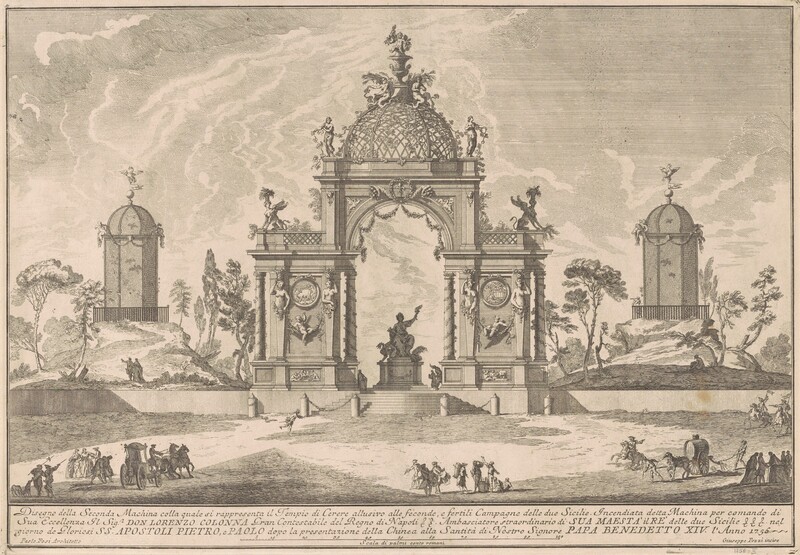
The Seconda Macchina for the Chinea of 1756: The Temple of Ceres

1756

Giuseppe Pozzi, after Paolo Posi

Associated Names
Giuseppe Pozzi

Etcher, Roman, 1723 - 1765

Paolo Posi

Artist After, Italian, 1708 - 1776

The image shows a frontal perspective of a grand architectural structure resembling a monumental archway. The horizon is low, with the structure and landscape stretching across the image. A slightly elevated central area leads up to the arch and statue. The architectural details are highlighted with intricate lines and etching techniques, showcasing a classical style with statues and decorative elements adorning the arch. The color palette is monochromatic, consisting of various shades of sepia or black and white. Closest to us, there is a scene with elegantly dressed figures, horse-drawn carriages, and animals, adding a sense of scale and activity. Beyond this, stairs lead up to the centerpiece where a statue sits prominently within the archway. In the distance on either side of the main structure, small domed pavilions are surrounded by trees and landscaped gardens. The sky is filled with swirling clouds delicately etched above, providing a dramatic backdrop to the architectural focus.

Media Options

This object’s media is free and in the public domain. Read our full Open Access policy for images.

Artwork overview


Artwork history & notes

Bibliography

1994

  • Gori Sassoli, Mario. Della Chinea e di altre "Macchine di gioia". Apparati architettonici per fuochi d'artificio a Roma nel Settecento. Milan, 1994, no. 62.

Inscriptions

Lettered LL: "Paolo Posi Architetto"
Lettered LR: "Giuseppe Pozzi incise"
Lettered LC: "Disegno della Seconda Machina colla quale si rappresente il Tempio di Cerere allusivo alle feconde e fertili Campagne [...] l'Anno 1756"

Wikidata ID

Q77258651

You may be interested in

Loading Results