


Saint Jerome
c. 1477
Francesco di Giorgio Martini
Artist, Sienese, 1439 - 1501
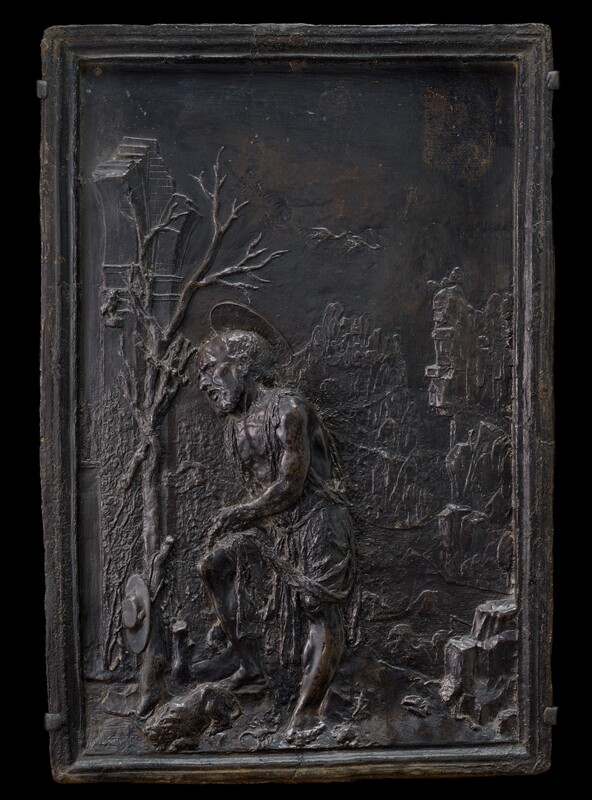

Artwork overview
-
Medium
bronze
-
Credit Line
-
Dimensions
overall: 54.9 × 37.1 × 3.81 cm (21 5/8 × 14 5/8 × 1 1/2 in.)
gross weight: 14934.6 gr (32.925 lb.)
framed: 106.68 × 76.2 × 15.24 cm (42 × 30 × 6 in.)
depth (shoulder): 3.8 cm (1 1/2 in.) -
Accession Number
1957.14.12
Artwork history & notes
Provenance
Probably Agostino Chigi [1563-1639], Siena as by Vecchietta.[1] Eugène Piot [1812-1890]; [2] (his sale, Hôtel des Ventes, Bonnefons de Lavialle, Paris, 14 April 1847, no. 14, as by Donatello, bought-in);[3] (his sale, Hôtel Drouot, Paris, 25-30 April 1864, no. 25, as by Bertoldo);(Charles Mannheim, Paris);[4] purchased March 1877 by Gustave Dreyfus [1837-1914];[5] his estate; purchased 1930 with the entire Dreyfus collection by (Duveen Brothers, Inc., London, New York, and Paris); purchased 1944 as by Bertoldo by the Samuel H. Kress Foundation, New York;[6] gift 1957 to NGA.
[1] As kindly pointed out by Dr. Francesco Petrucci, director of Palazzo Chigi in Ariccia, an entry in the 1644 inventory of Agostino Chigi, Rector of the Hospital of Santa Maria della Scala in Siena preserved at the Bibilioteca Apostolica Vaticana (BAV, AC, n. 411, “Attinenti alla primogenitura del Sig. Agostino Chigi di Siena, 1644”), reads as follows: “[19] Un quadro di bassorilievo in bronzo alto ¾ e largo ½ braccio, con una cornice di noce che rappresenta S. Girolamo opera del Vecchietta senese scudi 20” [A bronze relief panel ¾ braccio high and ½ braccio wide in a walnut frame, representing St. Jerome, a work of the Sienese artist Vecchietta, 20 scudi]. As kindly pointed out by Professor Roberto Bartalini, a Sienese braccio corresponded to 0.78 meters. Consequently, the dimensions of the relief (three-quarters and half a braccio) correspond to approximately 58 × 39 cm, very close to the present one. The inventory is published in Almamaria Mignosi Tantillo, "Le opere d'arte dell'eredità di Agostino Chigi rettore dello Spedale di Santa Maria della Scala a Siena", in Alessandro VII Chigi (1599-1667). Il Papa Senese di Roma Moderna, exhibition catalogue ed. by Alessandro Angelini, Monika Butzek, and Bernardina Sani, Siena, 2000: 343-346. (see email from 3 February 2026 in the NGA curatorial file). The identification of the present relief with the object described in the 1644 inventory was first proposed by Bartalini, who published the hypothesis in Le Occasioni del Sodoma. Dalla Milano di Leonardo alla Roma di Raffaello, Rome, 1996:26. The rationale supporting this identification is further set forth in the correspondence from 5 February 2026 preserved in the NGA curatorial files.
[2] According to Bode, Bertoldo, 1925: 76-78, Piot purchased the sculpture in Florence as attributed to Bertoldo.
[3] Professor Hubert Goldschmidt (see email from 5 January 2026, preserved in the NGA curatorial file) drew attention to the Chigi provenance on the basis of the catalogue of the 1847 Piot sale. The 1847 catalogue records that the plaquette originated from the collection of a Chigi villa in the environs of Siena, reportedly sold two years earlier. It is possible this refers to the Sienese branch of the Chigi Zondadari family, descendants of Cardinal Flavio Chigi [1631-1693] as proposed by Petrucci. This hypothesis appears to be supported by the absence, as Petrucci observes, of any comparable properties or descriptions corresponding to the present relief in the Roman Chigi inventories (see email from 9 January 2026, NGA curatorial file). It is plausible that the villa may be identified with the Villa Chigi alle Volte Alte, also known as Villa Chigi-Farnese or Villa Mieli, which was acquired by Agostino Chigi in 1603. The present state of research, however, does not permit the precise identification of the residence in question, nor has documentation of a public sale in 1845 of a collection housed there yet been located.
[4] As reported in the annotated sale catalogue, Mannheim bought the relief at the 1864 Piot sale for 940 francs.
[5] According to Goldschmidt, Gustave Dreyfus purchased the relief in March 1877 from Mannheim for 1,000 francs.The reference can be found in List C, a Dreyfus document in Gustave Dreyfus's handwriting listing all the objects of the Timbal collection which he retained and some of his additional acquisitions made after 1873 (copies preserved in the in NGA curatorial file). The acquisition of the Saint Jerome relief is also listed in Gustave Dreyfus’s acquisitions ledger, as reported by Goldschmidt (see email from 1 April 2026, preserved in the NGA curatorial file).
[6] See the Kress Digital Archive (https://kress.nga.gov/Detail/objects/1833). The transfer of the sculpture from Piot to Dreyfus to Duveen and finally to Kress is also documented in Luciano Bellosi, Francesco di Giorgio e il Rinascimento a Siena, 1450-1500, exhibition catalogue, Chiesa di Sant' Agostino, Siena, 1993: 202-203.
Associated Names
Exhibition History
1878
L'Art ancien, Exposition Universelle, Paris, 1878, no. 138.
1932
Renaissance Sculpture and Medals from the Collection of Gustave Dreyfus, Fogg Art Museum, Cambridge, Massachusetts, 1932, no catalogue.
1993
Francesco di Giorgio e il Rinascimento a Siena 1450-1500, Chiesa di Sant'Agostino, Siena, Italy, 1993, no. 28, repro., as San Girolamo nel deserto.
2007
Renaissance Siena: Art for a City, National Gallery, London, 2007-2008, no. 26, repro., as Saint Jerome in Penitence.
2016
Unfinished: Thoughts Left Visible, The Met Breuer, New York, 2016, no. 5, repro.
Bibliography
1878
Piot, Eugène. "La sculpture a L'Exposition Rétrospective du Trocadéro." Gazette des Beaux-Arts 2d ser., 18 (October 1878): 588, as by Bertoldo.
1879
Piot, Eugène. L’Exposition universelle de 1878: L’art ancien. Paris, 1879: 143, as by Bertoldo.
1901
Venturi, Adolfo. Storia dell'Arte Italiana. 11 vols. Milan, 1901-1940: 6(1908):518.
1908
Migeon, Gaston. "La collection de M. Gustave Dreyfus, V: Les plaquettes." Les Arts 80 (August 1908): 18, 23, as attributed to Bertoldo.
1923
Venturi, Adolfo. "Francesco di Giorgio Martini scultore." L'Arte 26 (1923): 213-214, as Francesco di Giorgio (earliest current attribution).
1924
Venturi, Adolfo. L'Arte a San Girolamo. Milan, 1924: 168-169.
1925
Bode, Wilhelm von. Bertoldo und Lorenzo dei Medici. Freiburg, 1925: 76-78, as by Bertoldo.
Vaudoyer, Jean-Louis. “La collection Gustave Dreyfus.” L’Amour de l’Art 6, no. 7 (1925): 257, repro. 258, as by Bertoldo.
1928
Bode, Wilhelm von. Florentine Sculptors of the Renaissance. Translated by Jessie Haynes. Rev. 2nd ed. London, 1928: 185, as by Bertoldo.
1931
Ricci, Seymour de. The Gustave Dreyfus Collection: Renaissance Bronzes. Oxford, 1931: 4, no. 2, pl. 2, as by Bertoldo.
1935
Brinton, Selwyn. Francesco di Giorgio Martini of Siena: painter, sculptor, engineer, civil and military architect (1439-1502). 2 vols. London, 1935: 2:46-47.
1943
Weller, Allen Stuart. Francesco di Giorgio 1439-1501. Chicago, 1943: 162-163, 253, fig. 60, as late 1480s.
1949
Rotondi, Pasquale, ed. Studi artistici urbinati. 2 vols. [Urbino], 1949: 1:23, 71, as preceding Deposition and NGA tondi.
Seymour, Charles. Masterpieces of Sculpture from the National Gallery of Art. Washington and New York, 1949: 17-18, 178, note 30, repro. 106.
Brandi, Cesare. Quattrocentisti senesi. Milan, 1949: 234.
1951
Renaissance Bronzes: Statuettes, Reliefs and Plaquettes, Medals and Coins from the Kress Collection. Introduction by Perry B. Cott. National Gallery of Art, Washington, 1951: 142, repro. 61.
1958
Landais, Herbert. Les Bronzes Italiens de la Renaissance. Paris, 1958: 38, 113, pl. 7.
1961
Walker, John, Guy Emerson, and Charles Seymour. Art Treasures for America: An Anthology of Paintings and Sculpture in the Samuel H. Kress Collection. London, 1961: 89, color repro.
1965
Pope-Hennessy, John W. Renaissance Bronzes from the Samuel H. Kress Collection: Reliefs, Plaquettes, Statuettes, Utensils and Mortars. London, 1965: 26-27, no. 74, fig. 15.
Summary Catalogue of European Paintings and Sculpture. National Gallery of Art, Washington, 1965: 156.
1966
Montagu, Jennifer. "Plaquettes Revealed." Apollo 83 (March 1966): 229.
1968
Berenson, Bernard. Italian Pictures of the Renaissance. Central Italian and North Italian Schools. 3 vols. London, 1968: 1:142.
National Gallery of Art. European Paintings and Sculpture, Illustrations. Washington, 1968: 138, repro.
1970
Del Bravo, Carlo. Scultura senese del Quattrocento. Florence, 1970: 100-101.
1975
Walker, John. National Gallery of Art, Washington. New York, 1975: 628, fig. 967.
1980
Carli, Enzo. Gli scultori senesi. Milan, 1980: 45.
Friedmann, Herbert. A Bestiary for Saint Jerome. Washington, D.C., 1980: 164-172, figs. 120, 122-124, 128.
1983
Wilson, Carolyn C. Renaissance Small Bronze Sculpture and Associated Decorative Arts at the National Gallery of Art. Washington, 1983: 36–37, no. 4, repro.
1984
Walker, John. National Gallery of Art, Washington. Rev. ed. New York, 1984: 629, no. 974, repro.
1987
Toledano, Ralph. Francesco di Giorgio Martini. Pittore e scultore. Milan, 1987: 134-135, no. 53, two repros., as c. 1485-1490.
1994
Sculpture: An Illustrated Catalogue. National Gallery of Art, Washington, 1994: 91, repro.
Penny, Nicholas. "Non-Finito in Italian Fifteenth-Century Bronze Sculpture." Antologia di belle arti new series, nos. 48-51 (1994): 13-14, fig. 4.
1996
Bartalini, Roberto. Le Occasioni del Sodoma. Dalla Milano di Leonardo alla Roma di Raffaello. Rome, 1996: 26.
2000
Mignosi Tantillo, Almamaria, "Le opere d'arte dell'eredità di Agostino Chigi rettore dello Spedale di Santa Maria della Scala a Siena", in Alessandro VII Chigi (1599-1667). Il Papa Senese di Roma Moderna, exhibition catalogue ed. by Alessandro Angelini, Monika Butzek, and Bernardina Sani, Siena, 2000: 343-346.
2003
Gregori, Mina, ed. In the Light of Apollo: Italian Renaissance and Greece. 2 vols. Exh. cat. National Gallery and Alexandros Souzos Museum, Athens, 2003-2004: 1:219.
Wikidata ID
Q63809432