


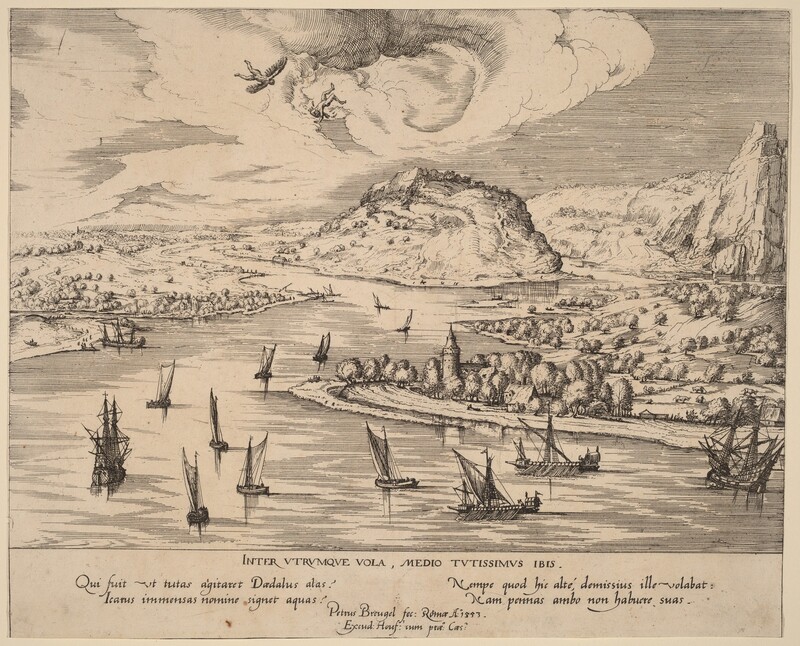
River Landscape with the Fall of Icarus
c. 1595
Simon Novellanus
Artist, German, active c. 1560/1590
Publisher, Flemish, 1542 - 1600
Artist After, Netherlandish, c. 1525/1530 - 1569

Artwork overview
-
Medium
etching and engraving on laid paper
-
Credit Line
-
Dimensions
sheet (trimmed to plate): 27.5 × 33.8 cm (10 13/16 × 13 5/16 in.)
-
Accession Number
1964.8.420
-
Catalogue Raisonné
New Hollstein, no. A5, State i/ii
Artwork history & notes
Bibliography
1908
Bastelaer, Rene van. Les estampes de Peter Bruegel l'ancien. Brussels: G. van Oest et Cie, 1908.
1993
The New Hollstein Dutch & Flemish Etchings, Engravings and Woodcuts, 1450-1700. (Pieter Bruegel, Nadine Orenstein author). Rotterdam: Sound & Vision Interactive, 1996-, no. A5, state i/ii.
1996
Serebrennikov, Nina Eugenia. "Imitating Nature / Imitiating Bruegel," Nederlands Kunsthistorisch Jaarboek, vol. 47, 1996, pp. 223-246.
Inscriptions
in margin below image, in plate: Inter utrumque vola, medio tutissimus ibis. (Fly in between, in the middle you will go most safely) // Qui fuit ut tutas agitaret Daedalus alas? / Icarus immensas nomine signet aquas? // Nempe quod hic alté demissius ille volabat: / Nam pennas ambo non nabuere suas. (How is it possible that Daedalus could safely move his wings back and forth? [How did it happen that] Icarus gave his name to the vast waters? This was of course because he flew high and the other lower; for neither had feathers of his own.) // Petrus Breugel fec: Romae A[nn]o 1553. / Excud: Houf: cum prae: Caes:
Wikidata ID
Q65512051