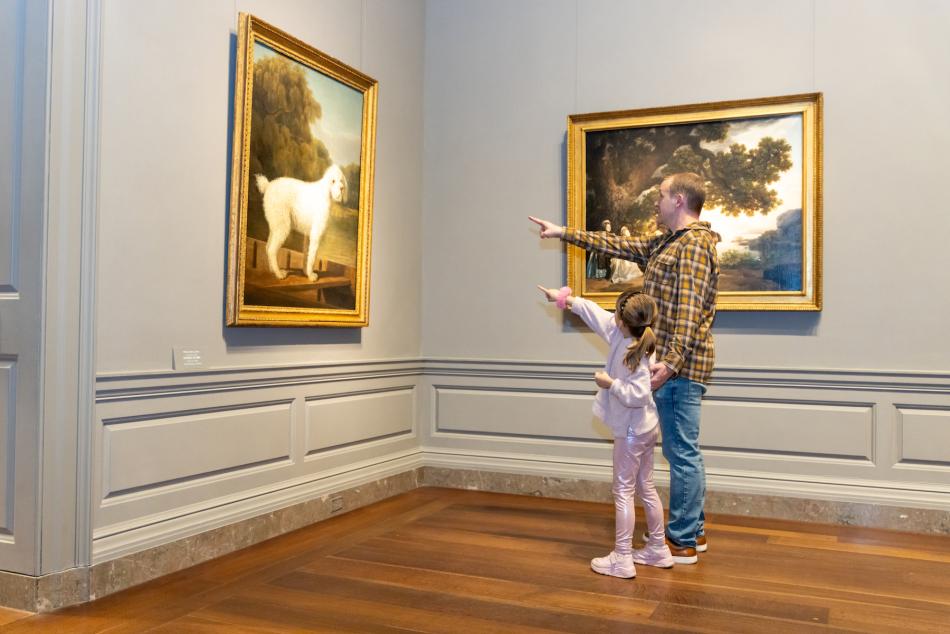
A dog with short, curly, white hair stands in a wooden boat facing our right almost in profile, though it turns its head to look at us in this vertical portrait painting. The dog spans nearly the width of the canvas and is close to us. The dog’s ears hang down the side of its face to its chin. Its eyes are light brown and rimmed in black, and the lower lids are pink. The dog has a thick torso covered with tight curls, and it has a short puff of a tail. Its front legs are straight and the hind legs might be slightly bent. The dog stands on a slat spanning the width of the boat, which is angled away from us to our left. The landscape behind the has a calm, sage-green body of water with a tall, willow-like tree to our left and a lower band of leafy trees to our right. A few smoke-gray clouds float over the treetops in an otherwise pale blue sky.
George Stubbs, White Poodle in a Punt, c. 1780, oil on canvas, Paul Mellon Collection, 1999.80.22

Dogs

Dogs appear in art as everything from faithful companions and symbols of loyalty and protection to working animals and sporting partners. No painter of canines was more famous than Edwin Landseer. His works were so celebrated that a mastiff breed was named after him.
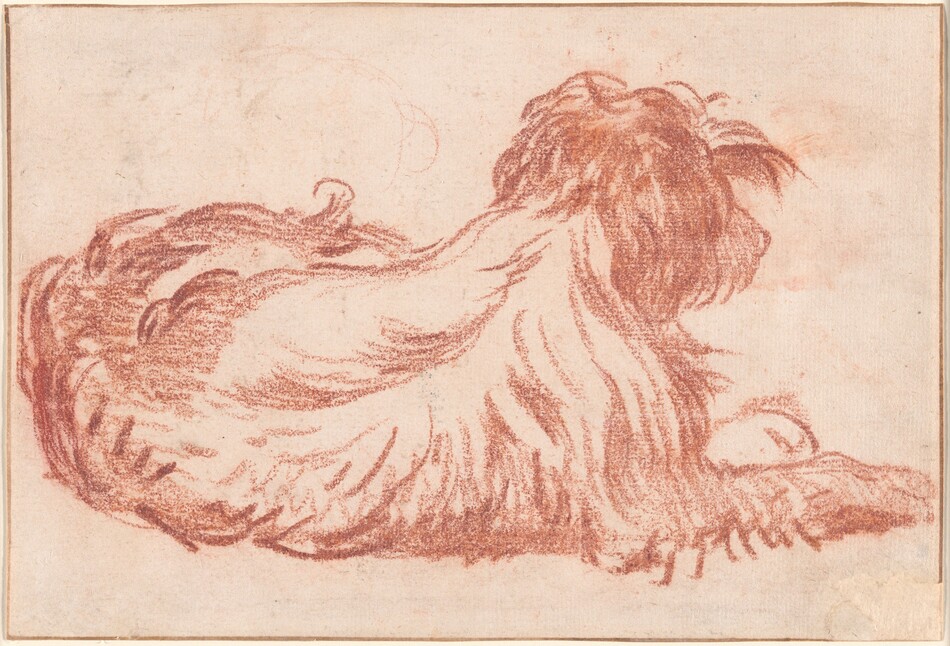
  • This is a drawing of a dog lying down. The drawing is executed with a medium that gives a reddish-brown tone. It depicts the dog in a relaxed pose, lying on its side with its back to the viewer, showing its textured fur. The artist focuses on capturing the texture and volume of the fur with loose, flowing lines. The background is plain, emphasizing the details of the fur. Light and shadow are depicted falling across the folds of fur, suggesting a gentle light source.
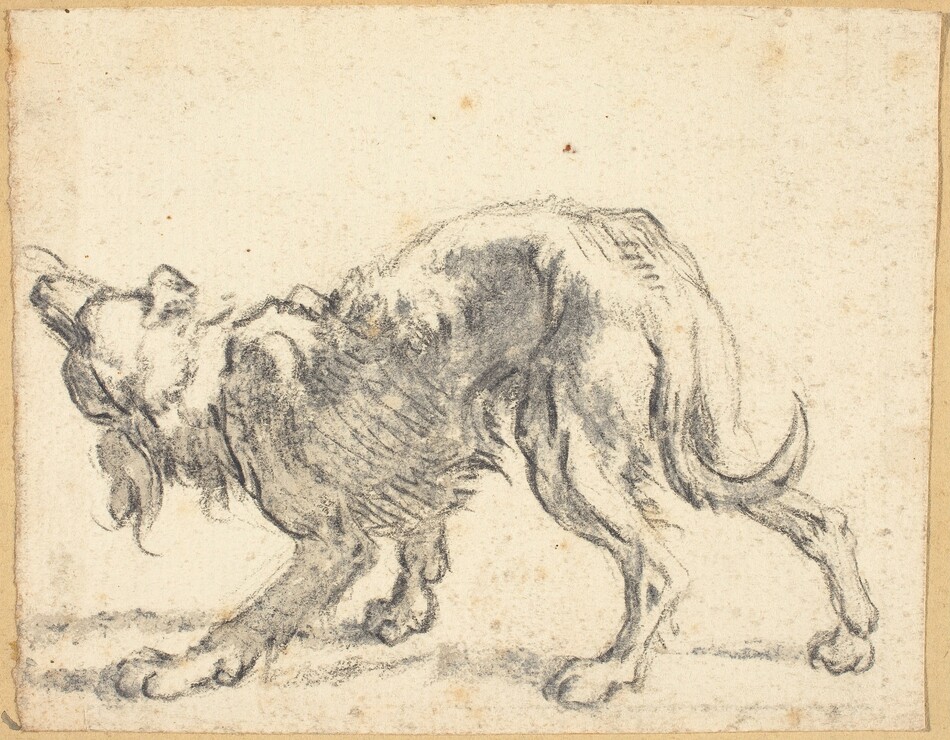
  • This is a drawing of a dog in a dynamic pose. The dog has its head turned upwards and back, as if reacting to a sound or an object above it. The dog is captured in a stance that suggests movement, with one of its front legs stepping forward and its other paws firmly planted. The body of the dog is detailed with pencil strokes emphasizing its fur texture. The background is plain, focusing attention on the dog.
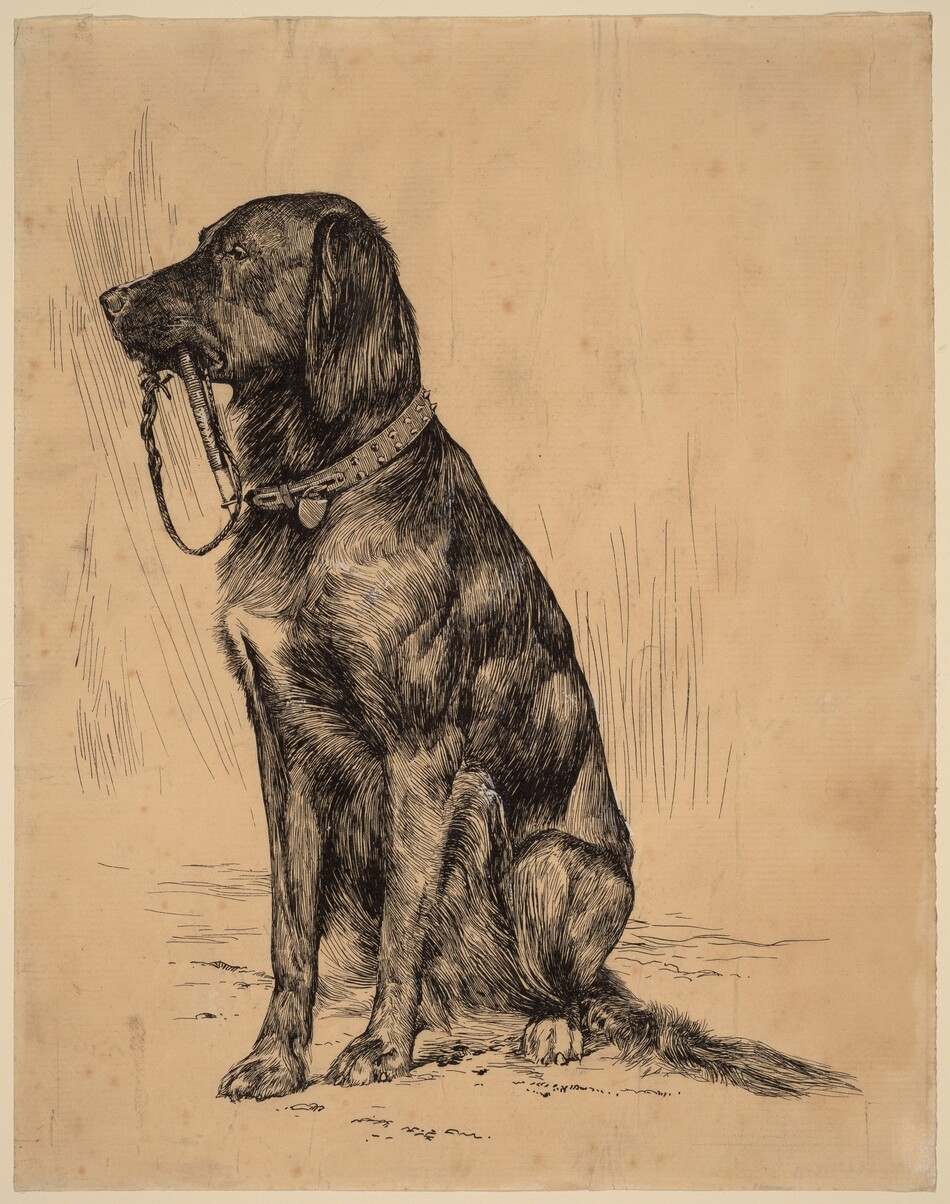
  • This is a drawing of a dog sitting upright, facing left. The dog wears a spiked collar and holds a leash in its mouth. The dog's short fur is drawn in detailed, dark lines, and it has long ears that hang down and a patch of white fur on its chest. The breed could be something similar to a retriever. The background is mostly plain, tan paper with some simple thin lines.
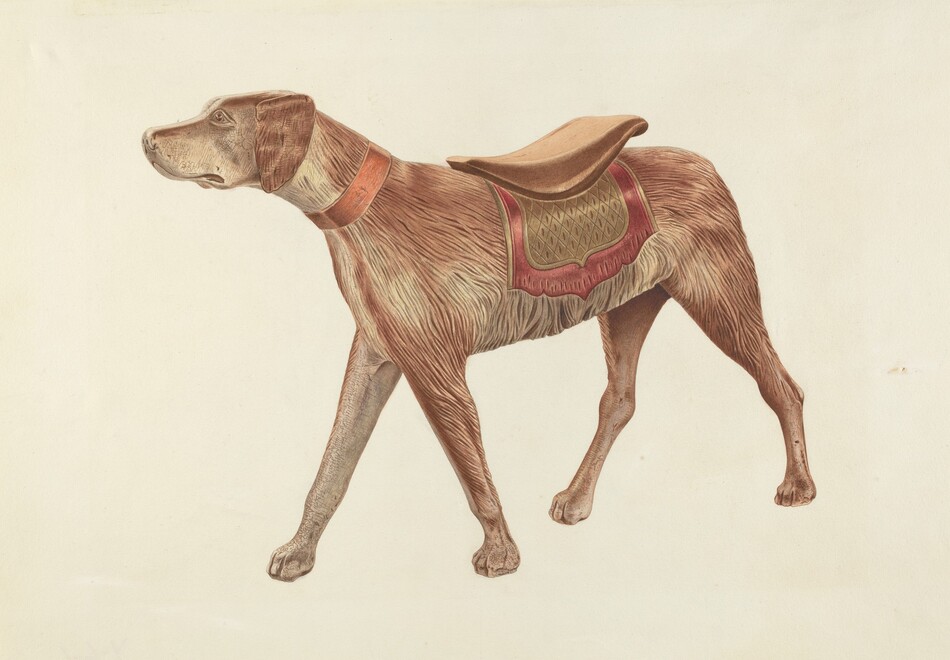
  • This is a painting of a dog with a saddle. The image depicts a dog standing on all four legs, with detailed fur texture created using soft, earthy tones of brown and red. The dog wears a decorative saddle that sits atop its back, featuring intricate patterns and colors. The animal's posture is calm and poised, highlighted on a light background which emphasizes the detailed textures and colors of its fur and saddle. This is in the style of the 19th-century naturalistic animal illustrations.
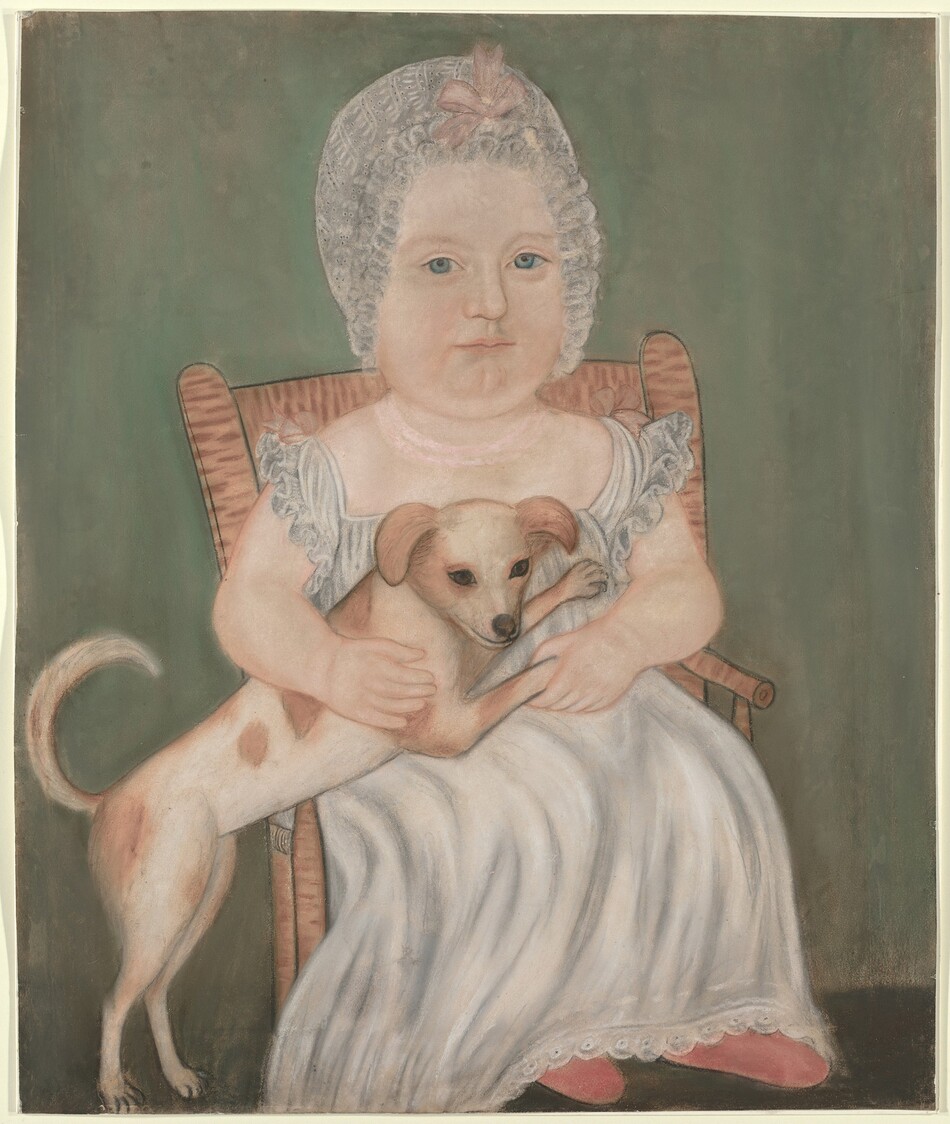
  • The person in the image is seated on a wooden chair facing forward. They have a round face with fair skin, large blue eyes, a small nose, and full lips. They are wearing a lace cap with a bow, a light blue or gray dress with lace trim, and pink slip-on shoes. They are holding a small dog with short beige fur and dark markings, curled tail, in their lap. The background is a simple, muted green color.
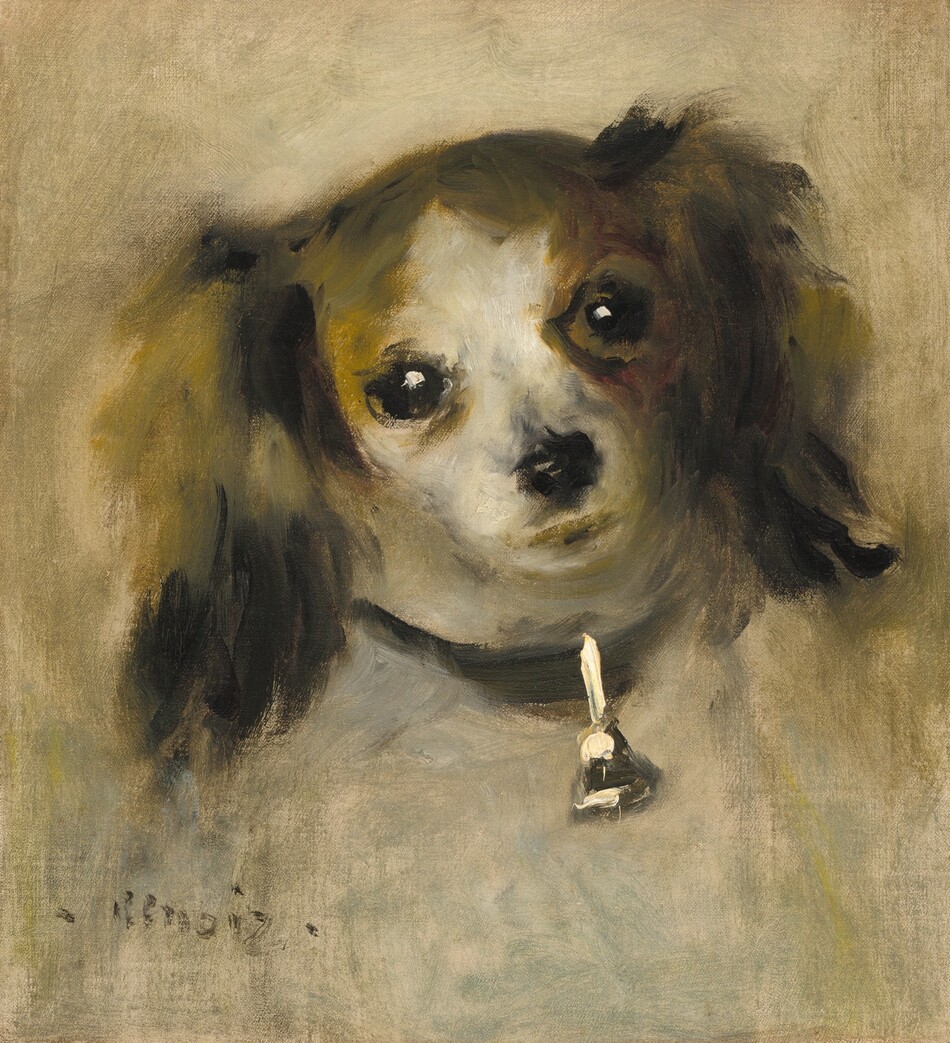
  • The head and floppy ears of a dog with a delicate muzzle are loosely painted in this vertical portrait. The dog’s head is cocked to our left, and it looks at us with large, glistening black eyes. Its fur is mottled caramel brown, black, and dark gray except for a white blaze on its forehead and down around its mouth. A silver bell glints on a black collar. The dog’s body fades out below the collar, and that area and the background are painted with strokes of oyster white and a few areas of shale blue. The artist signed the lower left corner, “Renoir.”
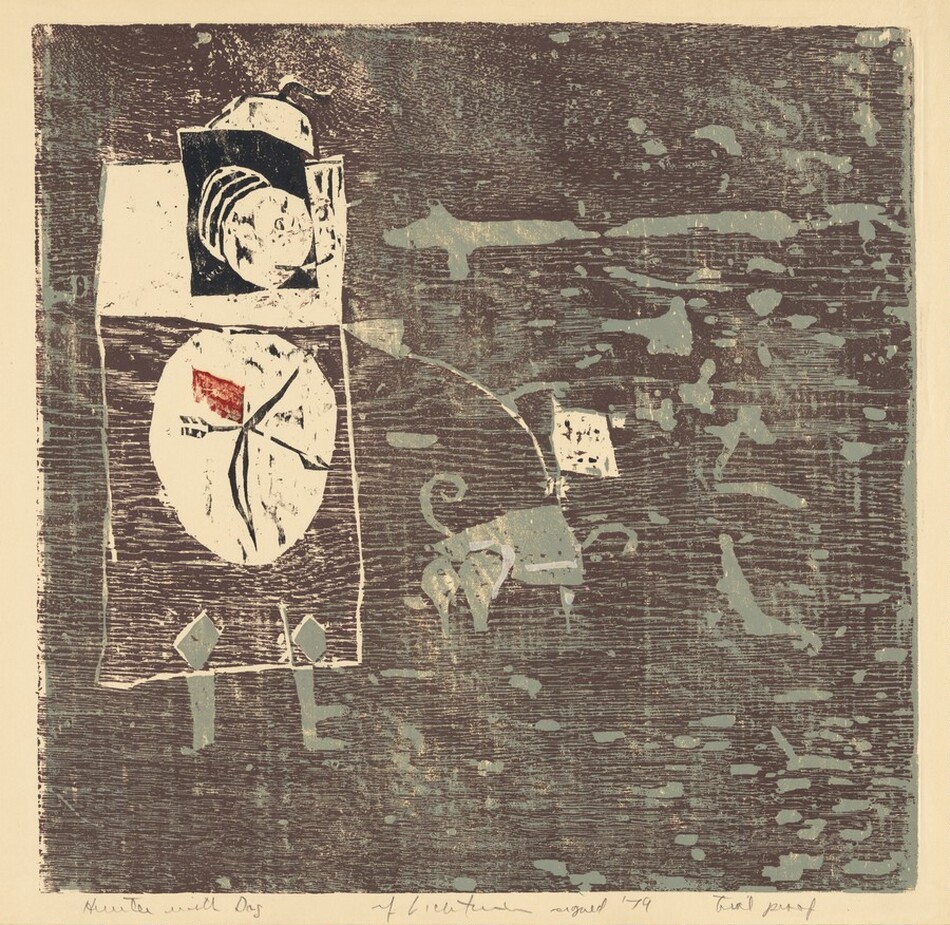
  • The image contains various geometric shapes and lines arranged in an abstract composition. A large rectangular shape with circular patterns inside is on the left, while two smaller diamond shapes are below it. On the right, a curved line connects to an abstract form, with scratchy textures in the background.
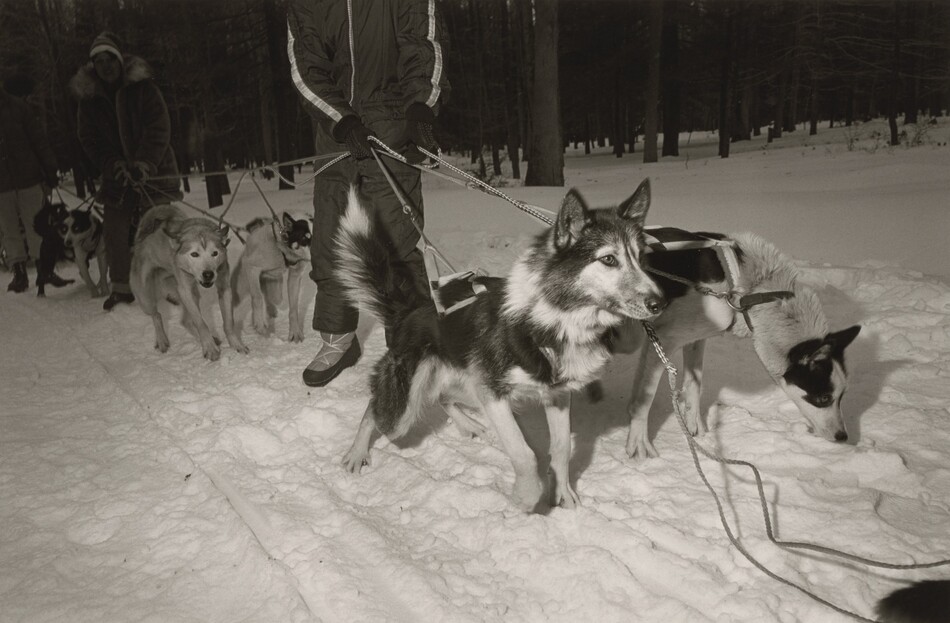
  • This is a photograph of a team of sled dogs in a snowy forest. The image shows a group of Husky-type dogs harnessed and ready for pulling a sled through a wintry landscape. The forest is dense with tall, bare trees, and the ground is covered with a thick layer of snow. The dogs appear attentive and energetic. The black and white tones highlight the contrast between the dogs' thick fur and the snow-covered environment. The presence of sled traces and the positioning of the dogs suggest a moment of preparation or a pause during a sledding expedition.
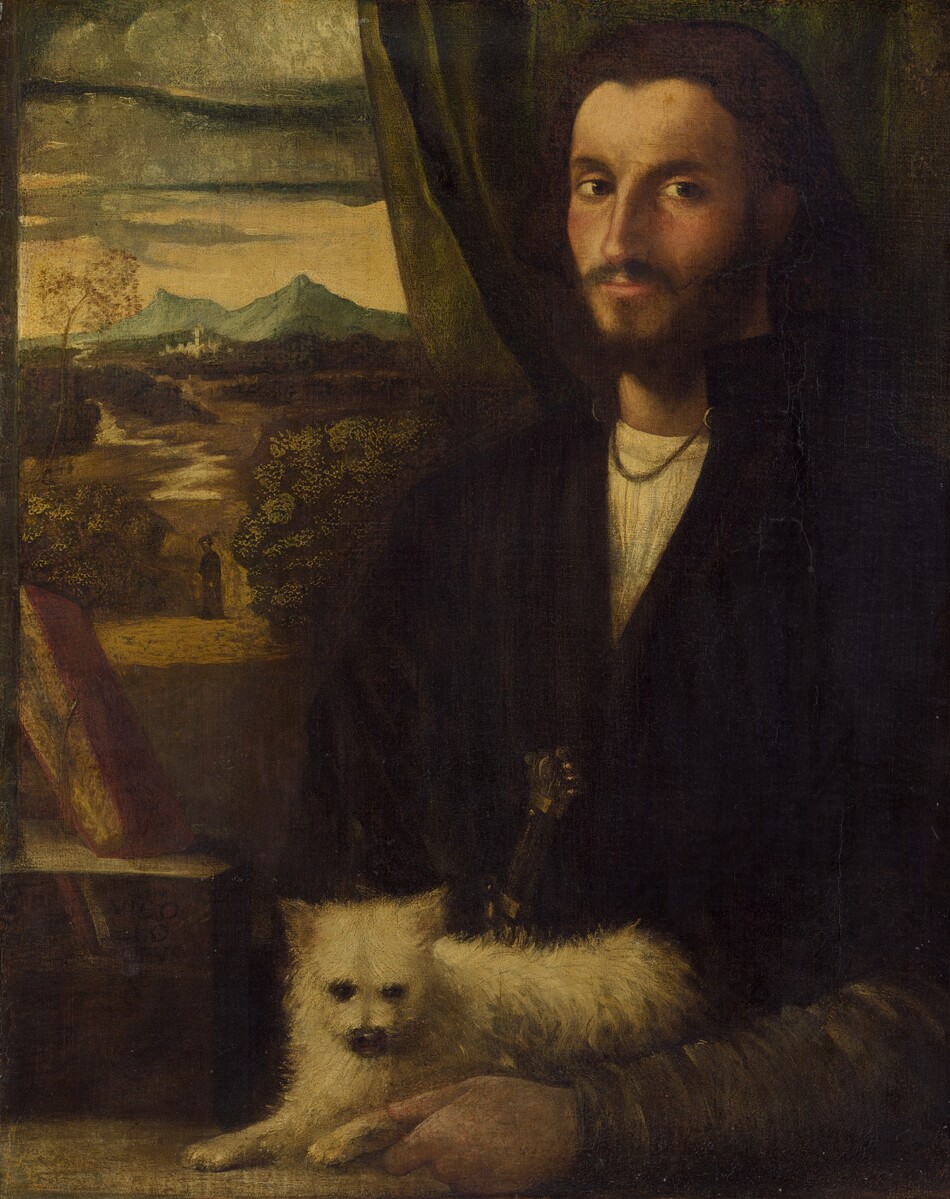
  • Shown from the waist up on the far side of a table or ledge, a man with a pale, olive complexion rests his arm alongside a small white dog lying on the ledge in this vertical portrait painting. The scene has an overall honey-colored hue over a palette dominated by blacks, olive green, and gold-tinged ivory white. To our right in the composition, the man’s body is angled to our left and he looks out at us from the corners of his dark eyes. He has a straight nose and high cheekbones. A mustache and trimmed beard frame his pink lips, which curve slightly up at the corners. His brown hair is brushed back from a pointed widow’s peak on his forehead, and it blends into the dark olive-green curtain hanging behind him. The high corners of his black robe are connected with a gold chain, and the robe comes to a V over a white shirt. His left hand, on our right, rests on the ledge, near the bottom of the composition. A small dog with pointed ears and shaggy, ivory-white fur is tucked behind the man’s arm, its left paw between the man’s thumb and forefinger. A shaft of black and gold indicate the hilt of a sword, presumably hung from the man’s waist. To our left, a dusty rose-pink book stands on a brown box. Upon closer inspection, an inscription has been painted in black on the upper right corner of the box: “VICO LO OPUS AETA.” Beyond the book, a view of a landscape through an open window fills the upper left quadrant of the composition. A person wearing a long brown robe stands on a path that zigzags into the distance, past dark green bushes and trees. Ice-blue, jagged mountains line the horizon. The sky above the mountains is parchment white and bands of slate-blue clouds fill in the top of our view.
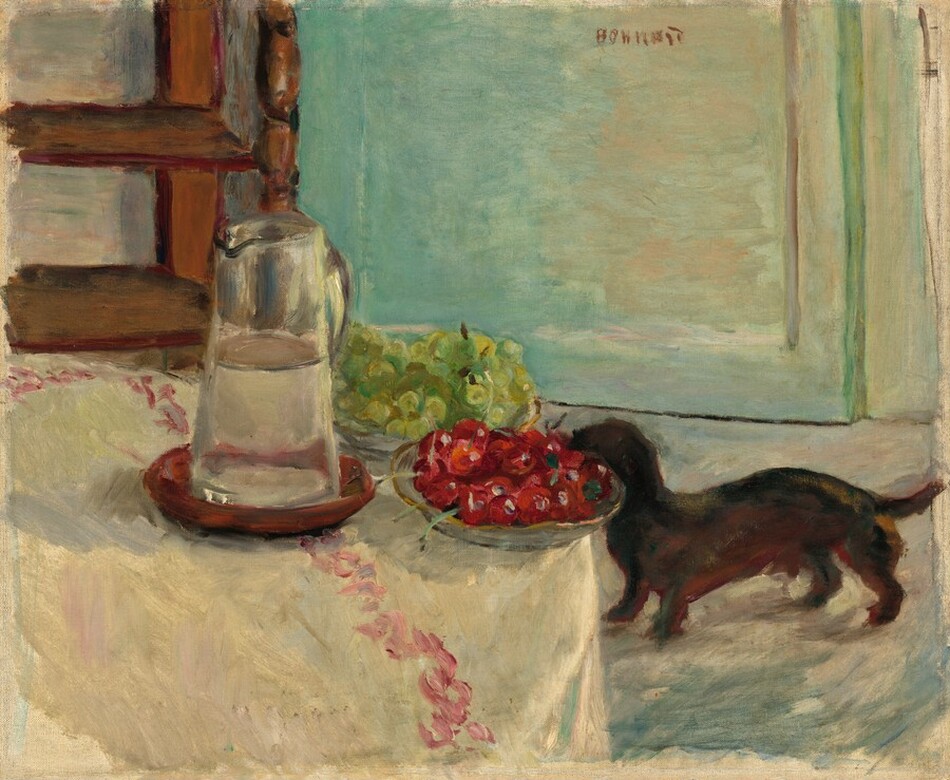
  • A small, long brown dog is partly hidden by a bowl of red cherries perched on the right edge of a table in this loosely painted, horizontal scene. In the light-filled interior, the table fills the lower left half of the composition. It is draped with a sand-colored cloth decorated with a diagonal band of rose-pink strokes that ends near the lower right. In the center of the table, a tall glass pitcher half filled with water rests in a shallow burgundy-red bowl. Next to the pitcher, to our right, one bowl piled with cherries sits in front of clusters of green grapes in another bowl. Beyond the table, a wooden piece of furniture with two open shelves fills the upper left of the composition. The dog stands on the right side facing our left in profile. It is chocolate brown with a short tail and stubby little legs, and its face is hidden by the cherries. The walls and floors of the room are painted in swipes of teal, peach, tan, blues, and grays. The artist has signed the upper center right in red, “Bonnard.”
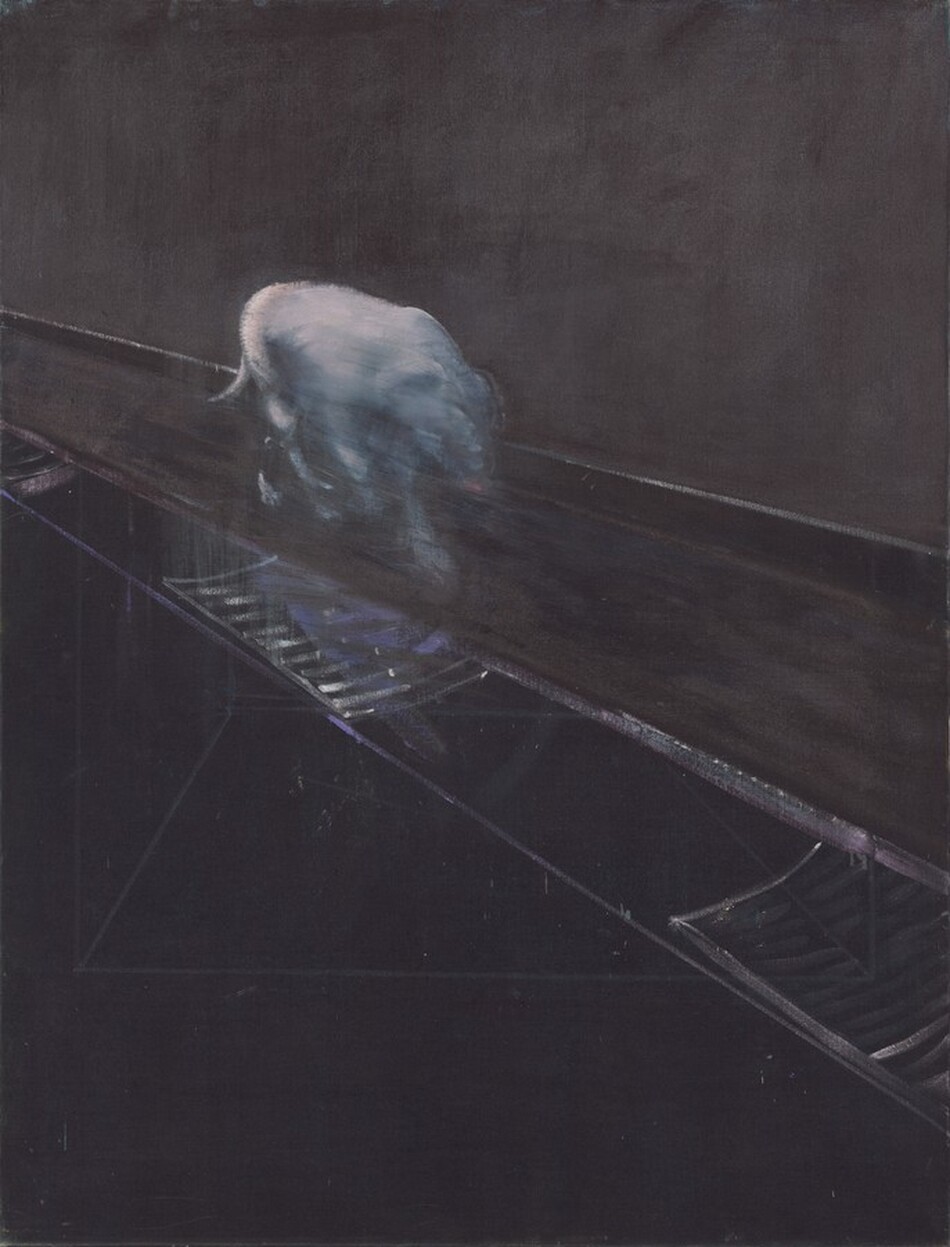
  • Painted entirely in shades of white, charcoal, and steel gray, a slim, white, almost ghostly dog makes its way from our left to right with its snout held low, along a sidewalk or rails in this vertical composition. The dog is thinly painted and blurry, as if shown in action, so the details are difficult to make out. The dark, gray space is defined only by three diagonals running from the center of the left edge down into the lower right corner. Within the band made by the lower two diagonals, two parallel sets of curving, parallel lines suggest grates or gutters over storm drains. Seeming unrelated to the rest of the image, three faint, gray, ruled lines radiate upward from a point near the lower-left corner to intersect the lowermost border defining the gutter.
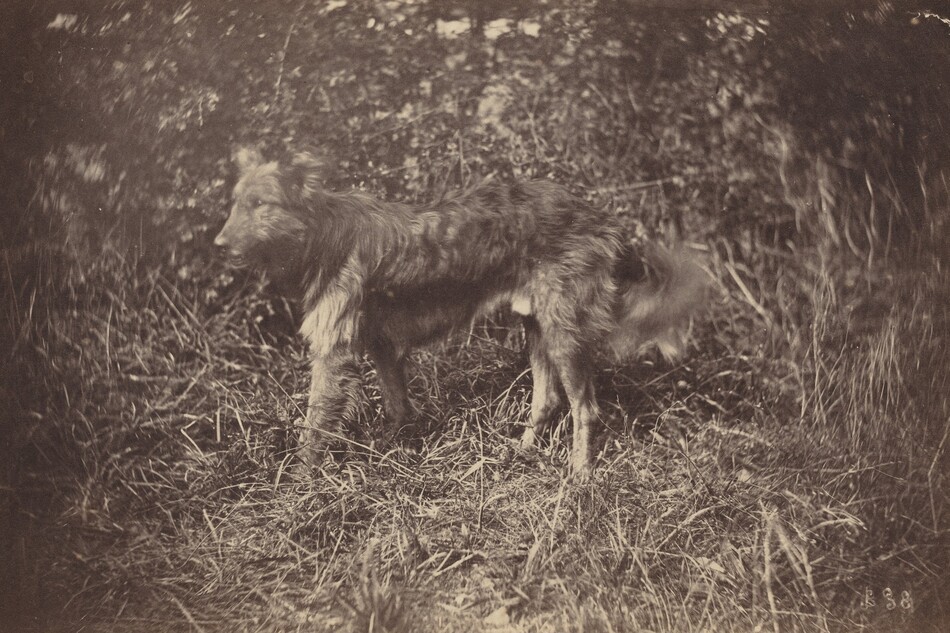
  • This is a photograph of a dog in tall grass. The image shows a medium-sized, long-haired dog in a natural setting with dense vegetation around, including tall grasses and blurred foliage in the background. The dog's fur matches the earthy tones of the surroundings, giving the photo a monochromatic appearance. The dog is positioned slightly to the left, with its body angled and head turned. The atmosphere is calm and contemplative, capturing a peaceful moment in nature.
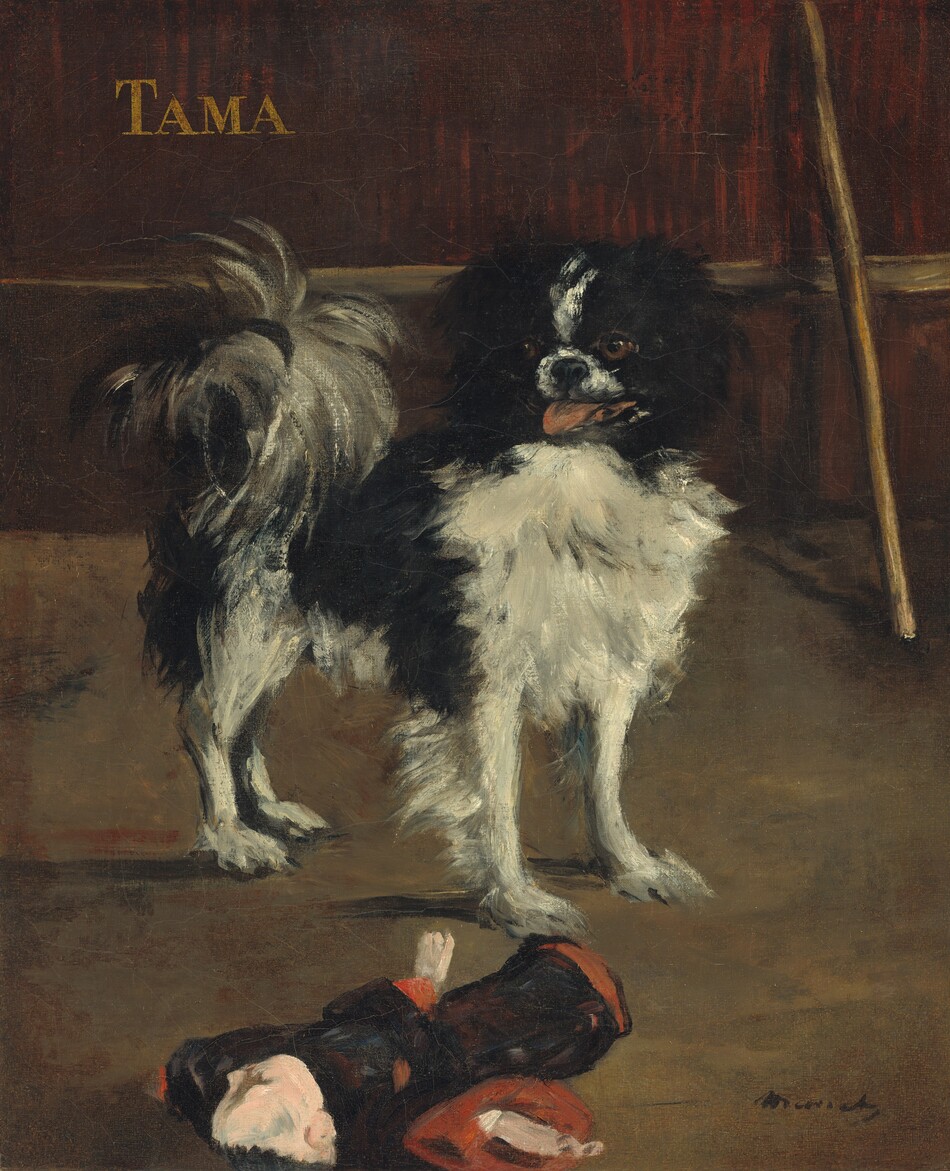
  • A small, shaggy, black and white dog stands in a wood paneled room with its body angled to our right but turning its head, pink tongue out, to our left in this vertical painting. The animal is painted with loose brushstrokes that evoke the dog’s long, feathery fur. The dog peers to our left with golden brown eyes. It is black along its flanks and ears, with a stripe of white down the center of the head, and on the muzzle. The chest, belly, and legs are also white, and the bushy tail, which curls up and out like a fountain, is a mixture of black and white. Leaning on the paneling behind the dog to our right is a light wood walking stick. An object, presumably a stuffed toy in the shape of a person wearing a long black robe lined in crimson, lies on the brownish sage-green floor in front of the dog. The dog’s name, “TAMA,” appears in tan block letters at the upper left. The artist signed the work in the lower right corner, "Manet."
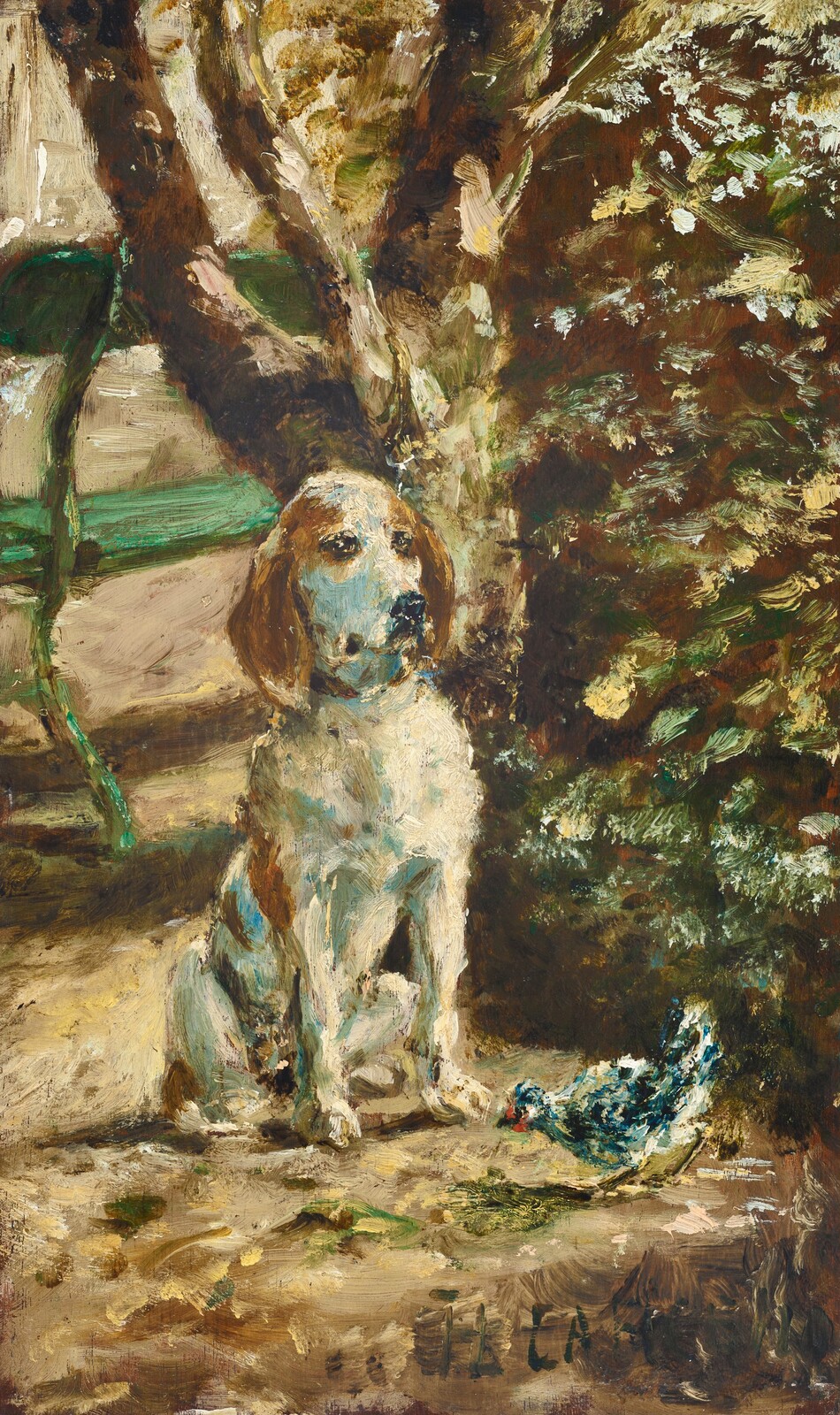
  • A white dog spotted with caramel-brown and with long, floppy ears sits in a garden setting near a green park bench in this loosely painted vertical portrait. The dog leans slightly onto its right paw, to our left, and looks off to the right, its ears relaxed. A blue bird crouches near the ground in front of the dog’s feet. Painted with tones of peanut brown and earthy green, a bush and tree trunk fill the background to the right, and the back of the bench is to the left. The artist inscribed the bottom right with his initials, HTL, conjoined in a monogram and the dog’s name, “LA FLECHE.”

Explore More

Article:  Seeing the National Gallery through the Eyes of a Child

Six year-old Addy and her dad Austin Graff have tips for enjoying the National Gallery as you grow.

Article:  Who Is Sir Edwin Landseer? 10 Things to Know

A look at the prodigy who became so famous for his paintings of animals that a dog breed was named after him.
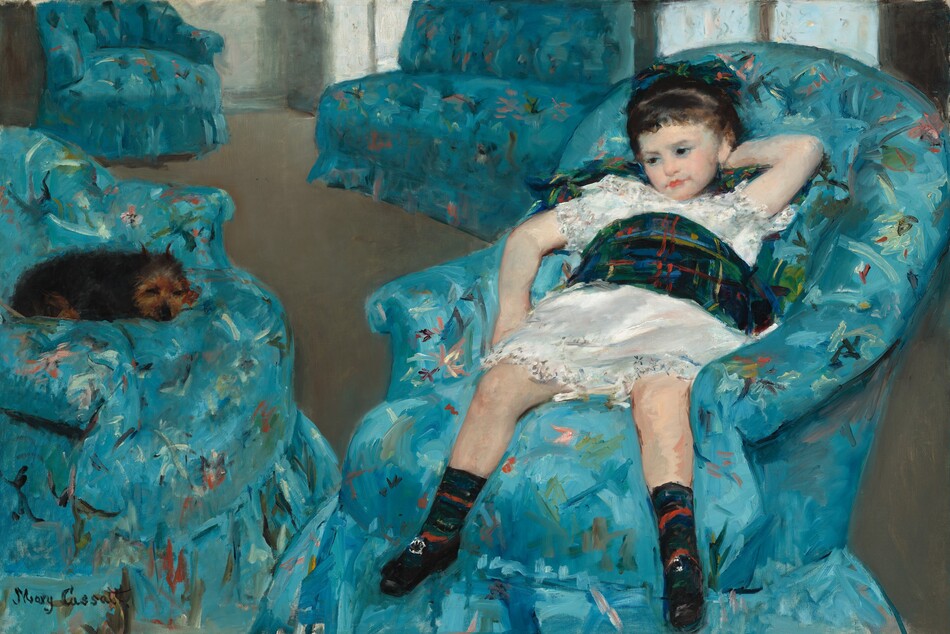
A small brown dog and a pale-skinned little girl wearing a white dress sit in matching celestial-blue armchairs in this horizontal painting. To our right, the girl sits with her legs angled to our left. She slumps back with her legs spread, and her left elbow, on our right, is bent so that hand rests behind her head. Her other elbow is draped over the armrest. Her dark brown hair appears to be pulled back, and tawny brown eyes under faint brows gaze down and to our left. She has a small nose set in a round face and a coral-pink mouth closed in a straight line. Her white dress has touches of gray, soft pink, and powder blue with a wide plaid sash around her waist. The pine-green, black, and sapphire-blue sash is accented with overlapping vertical and horizontal lines of burnt orange, light blue, and mustard yellow. Her socks match her sash and come up to mid-calf, over black shoes with silver buckles. The small dog has scruffy black fur and a russet-brown face. It lies curled in the chair opposite the girl, to our left, with its eyes closed and ears pricked up. The rounded backs of the upholstered chairs curve down to become the low arms. The vivid and light blue fabric of the chairs is scattered with loosely painted strokes of avocado and forest green, peach pink, cherry red, plum purple, and white. Beyond the chairs closest to us is another armchair and an armless loveseat, both covered with the same fabric. They sit at the back of the room, in a corner flooded with silvery light coming through four windows on the right side. The furniture is arranged on a peanut-brown floor. The artist signed in the lower left, “Mary Cassatt.”

Article:  Mary Cassatt Brings Girls and Women into the Museum

Author and art historian Katy Hessel on the impressionist's iconic painting.