Harriet Goodhue Hosmer, Clasped Hands of Robert Browning and Elizabeth Barrett Browning, model 1853, bronze, Gift in honor of Margaret and Raymond Horowitz, 2005.41.1

LGBTQ+ Artists

Explore artists and artworks representing the queer community. 

From Andy Warhol to Zanele Muholi, discover the LGBTQ+ pioneers in our collection who have left their mark on art history.

Selected works
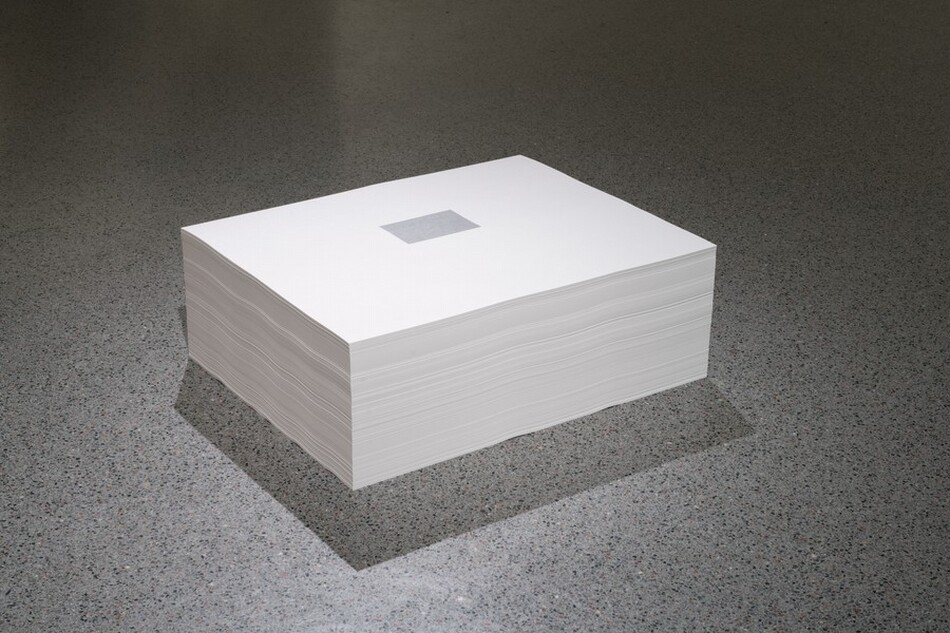
  • We look down onto a tidy stack of hundreds of sheets of white paper, which sits on a gray, speckled floor in this photograph. The top sheet is printed with a small, dove-gray rectangle at the center. A corner of the stack angles toward us, with the short side of the sheets to our left and the long side to our right.
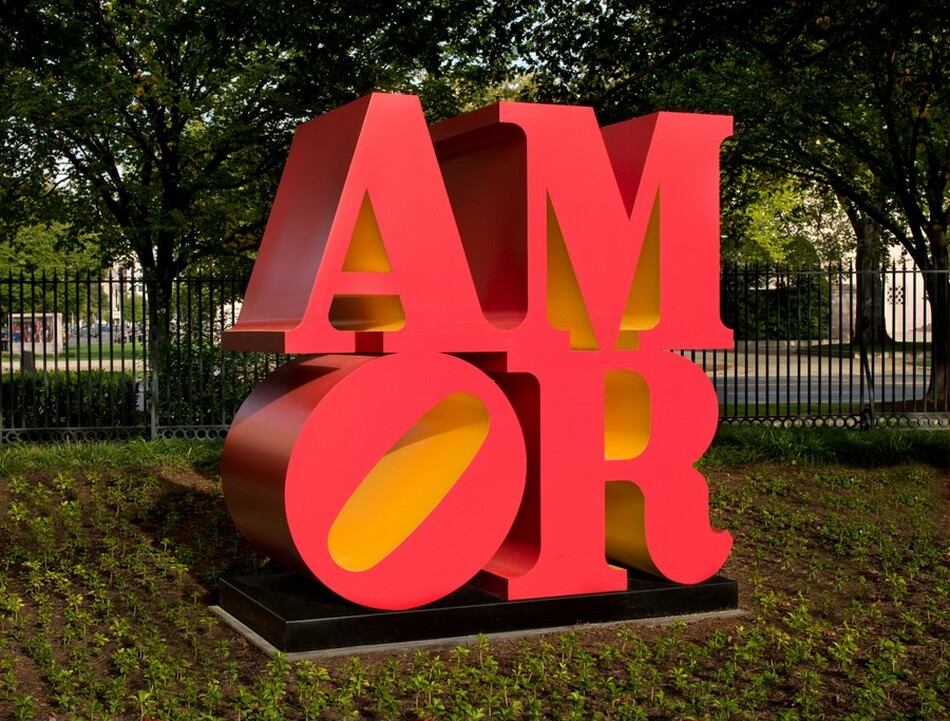
  • Four deep, three-dimensional letters spell out the word AMOR in this free-standing sculpture, with the A and M stacked on top of the O and R to create a square on a low black platform. The letters are coral red with butter-yellow undersides. The elongated, oval-shaped opening within the circular letter O is angled 45 degrees, toward the M at the upper right. We stand slightly to the left in this photograph so we can see the deep sides of the letters. The sculpture is displayed out-of-doors with trees and a tall black fence in the background and plantings around the base.
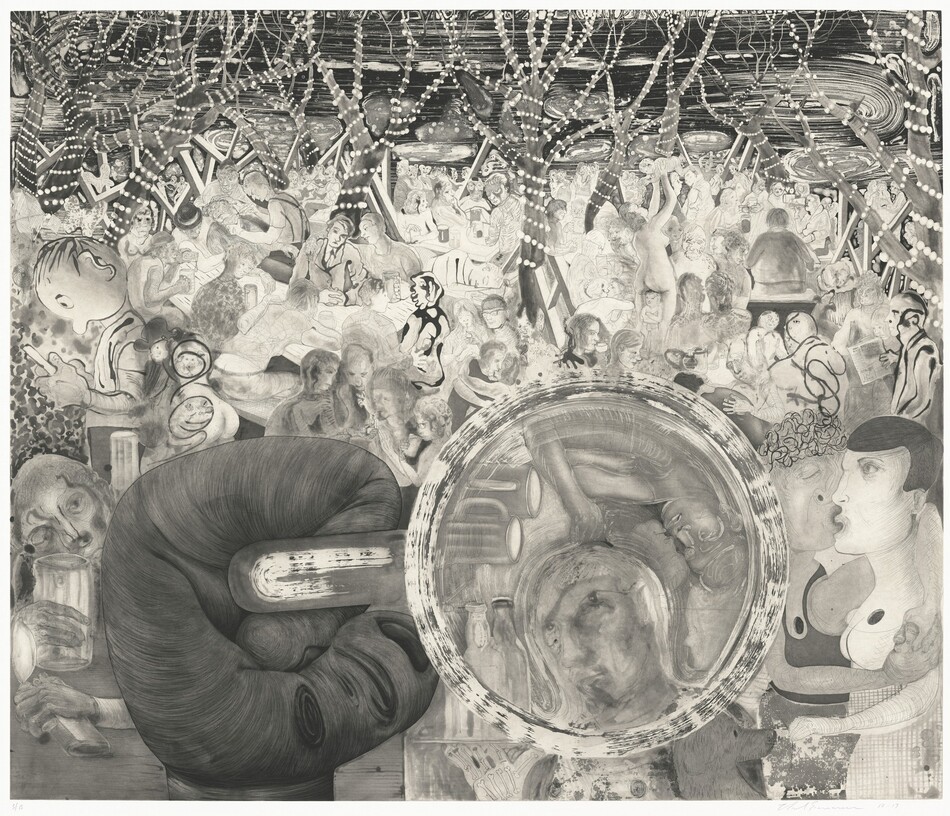
  • In shades of silvery gray and white, a cartoonish fist holds the handle of a beer stein so we look down into the glass. Filling the space around it, people sit, kiss, drink, or talk in a swirling, dream-like haze in this horizontal print.
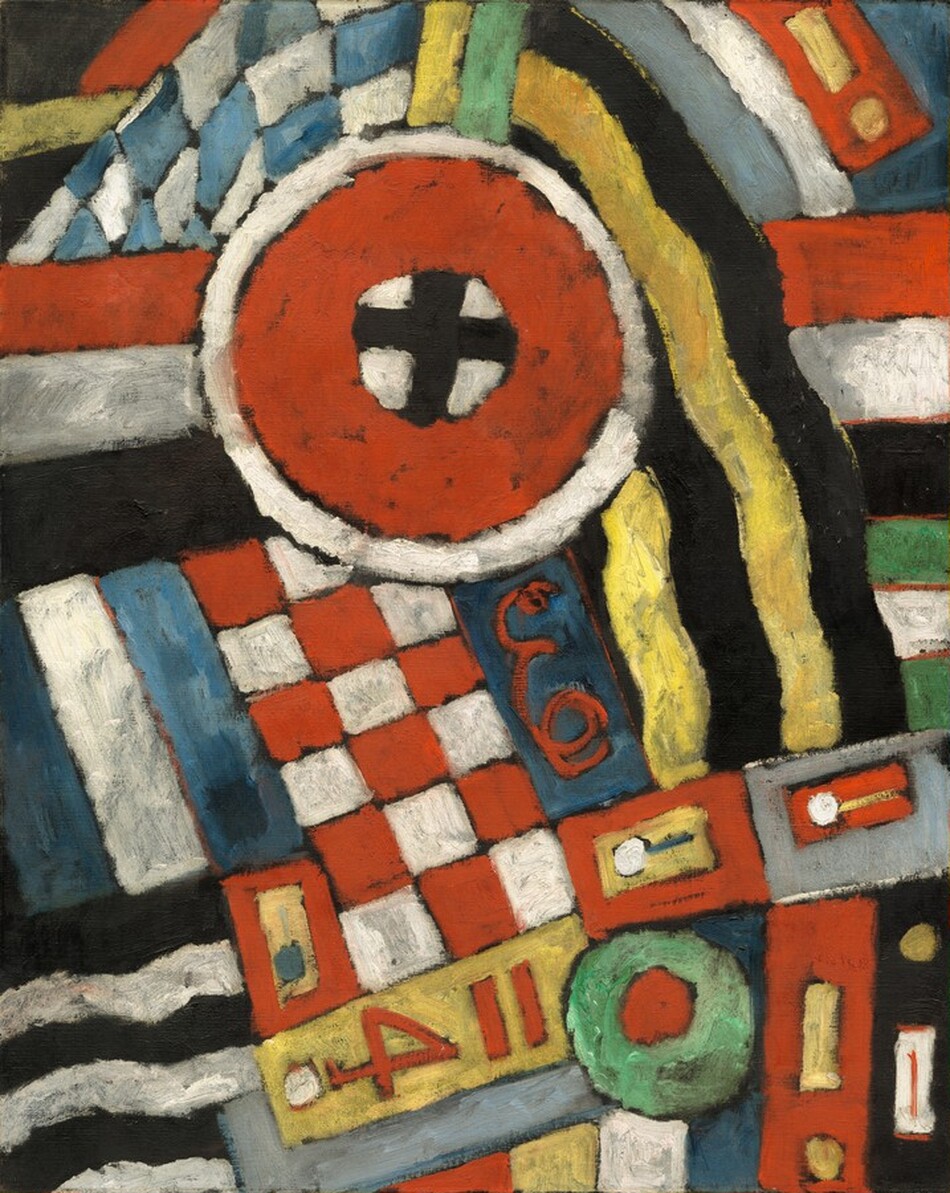
  • This vertical canvas is filled with geometric shapes that create patterns in red, blue, yellow, green, black, and white in this abstract painting. The paint is applied with visible brushstrokes, giving some areas a mottled look. Some of the patterns seem to revolve around a red circle near the top center. The circle has a black cross like a plus sign on a white field at its center, and a white band around its perimeter is outlined in black. A blue and white checkered band curves up over the red circle to our left while a banner-like form of alternating, wavy yellow and black lines cascade down to the right of the circle. Horizontal bands of red, white, and black extend across the canvas behind the circle. Below the circle, a blue panel with a curly, cursive red “E” is flanked to the left with a red and white checkerboard, then alternating, almost vertical lines of blue and white. The red number “4” appears on a yellow field at the bottom center of the work, and is flanked by rectangular forms and alternating bands of color to either side.
  • A man is seated on a wooden chair, his full body visible. He sits with one leg bent and raised onto the seat of the chair while the other leg is stretched out in front of him, touching the floor. His upper body is slightly turned to the side, with his left arm resting on his bent knee. He has short hair and distinct facial features with a profile view facing left. He wears a plain short-sleeved t-shirt and a watch on his left wrist. The background is a plain and seamless light-colored backdrop.
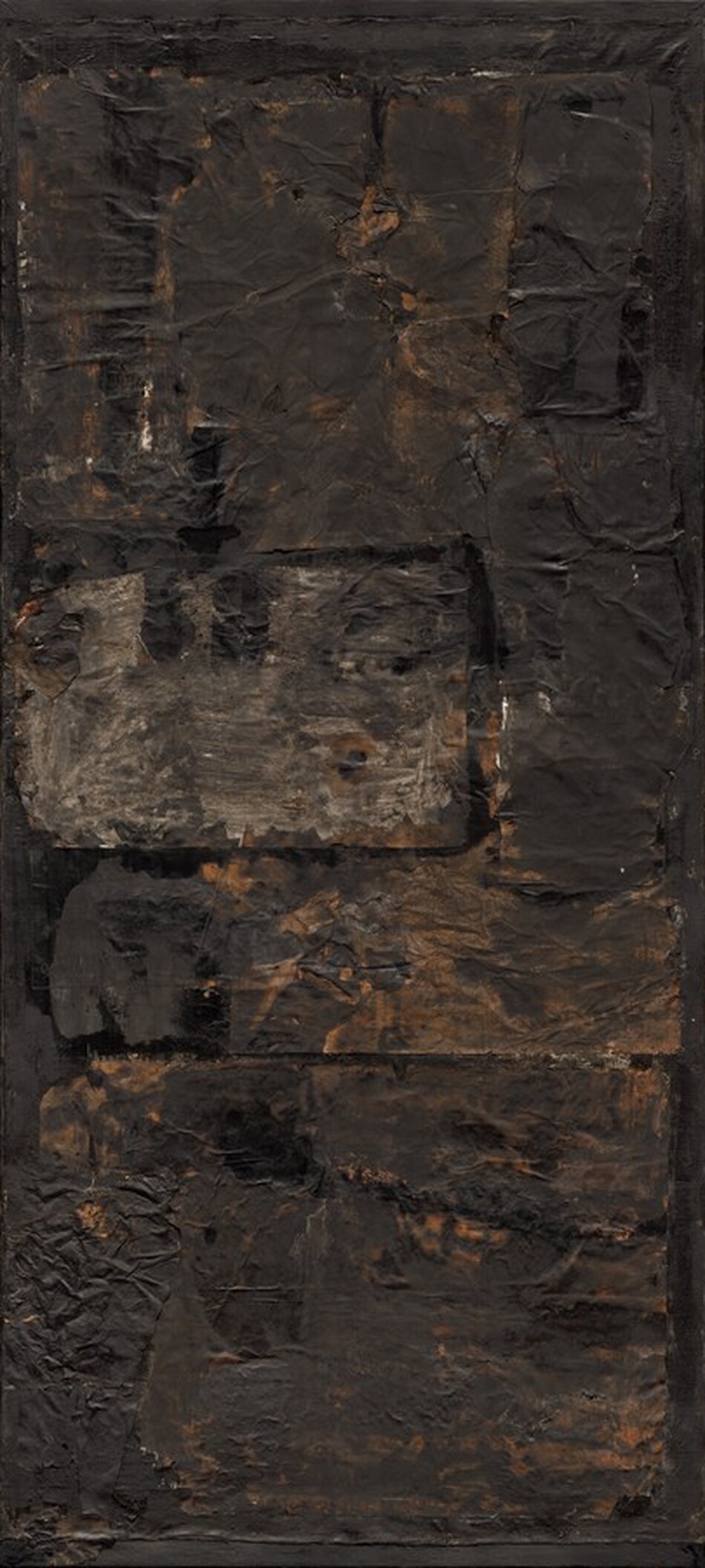
  • This painting features dark, jagged shapes and contrasting textures forming an abstract composition. Irregular patches of dark gray, light gray, and tan are visible against a black background. The surface resembles weathered metal or charred wood. The material the paint has been applied over has become puckered and crinkled, creating ridges and lines.
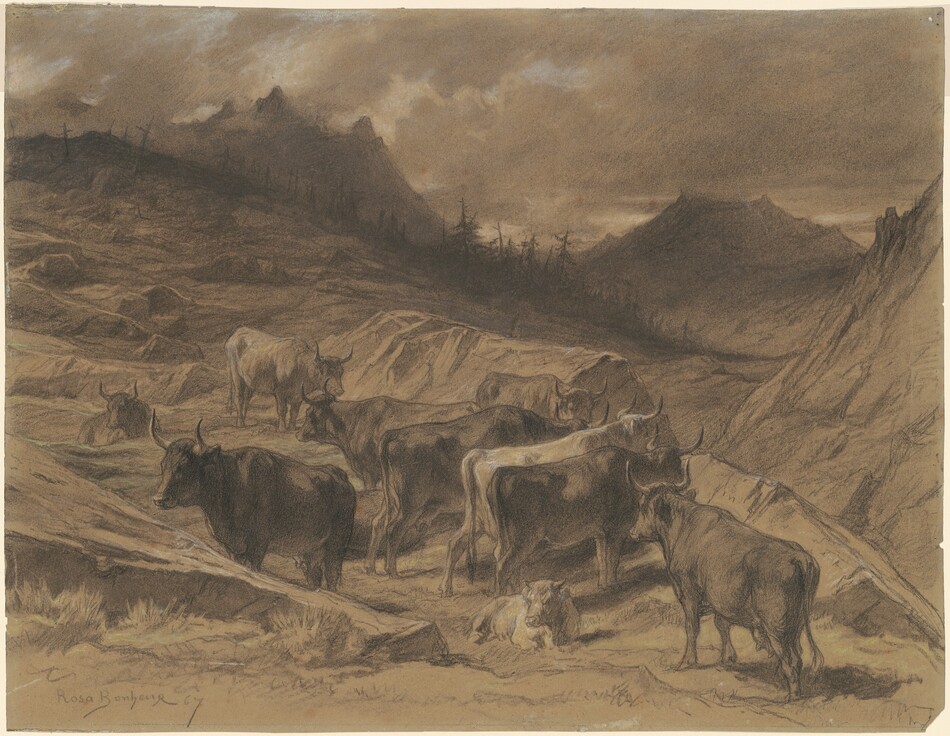
  • The image shows a group of cattle on rugged terrain, with a view looking downward from a small elevation. In the background, there are dark hills or mountains, sparse trees, and dramatic clouds in the sky. The scene is depicted with smooth and meticulous brushstrokes, capturing details in the landscape and the cattle. The color palette is mainly earthy browns and ochres, creating a sepia-toned look that emphasizes the natural elements and the animals against the sky.
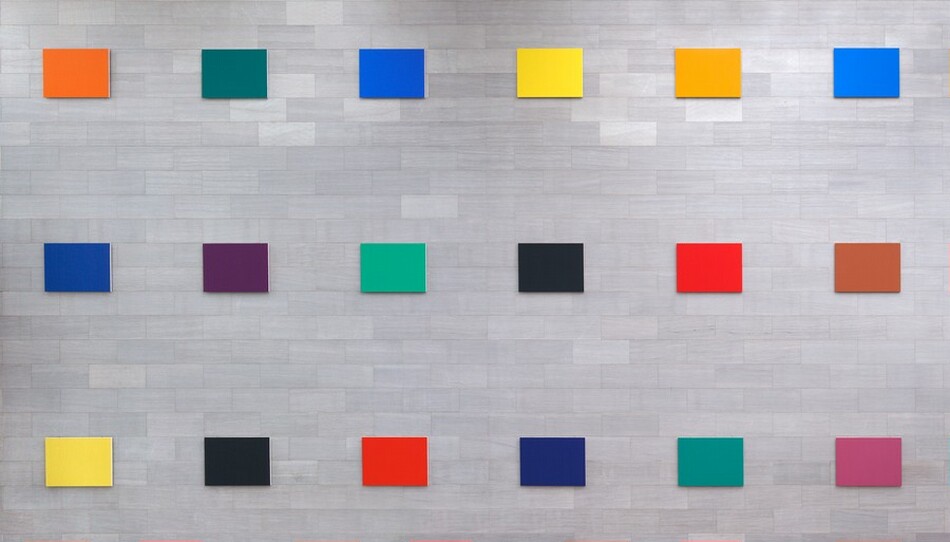
  • Three rows of six horizontal, rectangular canvases, each painted a single, saturated color, hang in a widely spaced grid against a three-story gray stone wall in this photograph. Moving from our left to right, the canvases in the top row are carrot orange, pine green, royal blue, canary yellow, marigold orange, and azure blue. The middle row has panels in marine blue, amethyst purple, shamrock green, soot black, vivid red, and rust brown. The bottom row canvases are banana yellow, black, coral red, midnight blue, emerald green, and orchid purple. The smaller, rectangular stones in the wall behind the panels are also laid horizontally, and they vary from silvery white to smoke gray.
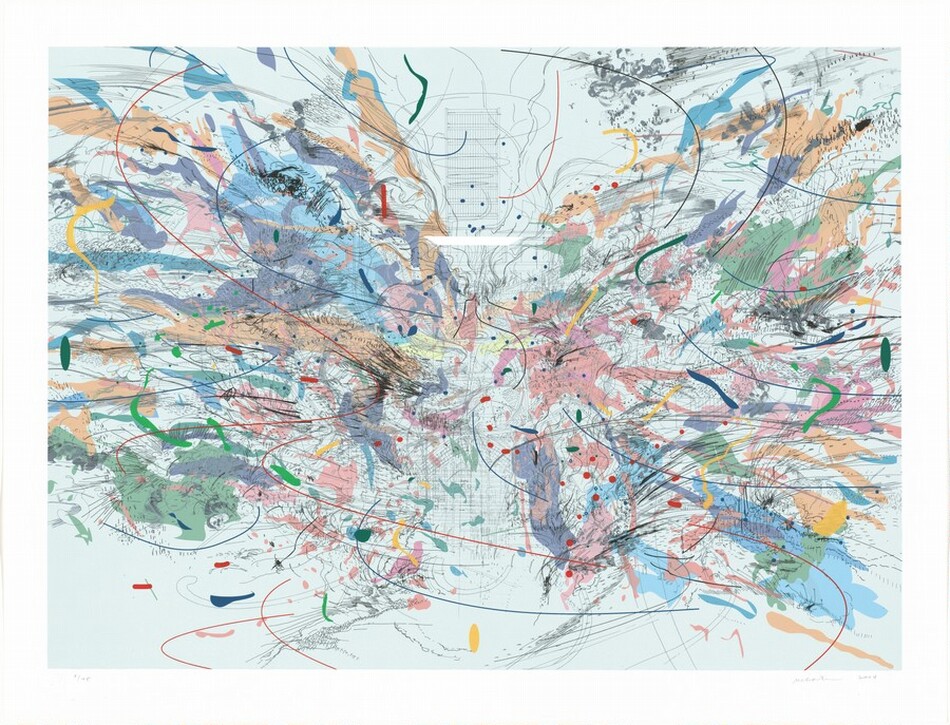
  • This print features a complex network of swirling lines, arcs, and splatters across the pale blue canvas. The swirling lines and splashes are in shades of orange, yellow, pink, green, blue, and purple. There are also thin grids of black lines in the center from which many of the colorful swirls seem to emerge.
  • This painting features several objects on a low table. Three books are stacked, with two standing upright and one placed flat horizontally on top of them. On the topmost book is a small blue vase full of flowers, and on the table next to the books are two lit red candles. There is a colorful disc hanging on the wall to the right, seen from the side, and in the upper left corner is an outline of the brow and eye of a human in profile. A dotted line travels from left to right, connecting the eye to the disc hanging across from it, and then the line continues in the other direction to the books on the table. The background is thickly painted in different colorful sections that appear to be textured, with small lumps protruding from the surface. The colors include several shades of brown and green, along with orange, yellow, pale pink, and light teal.
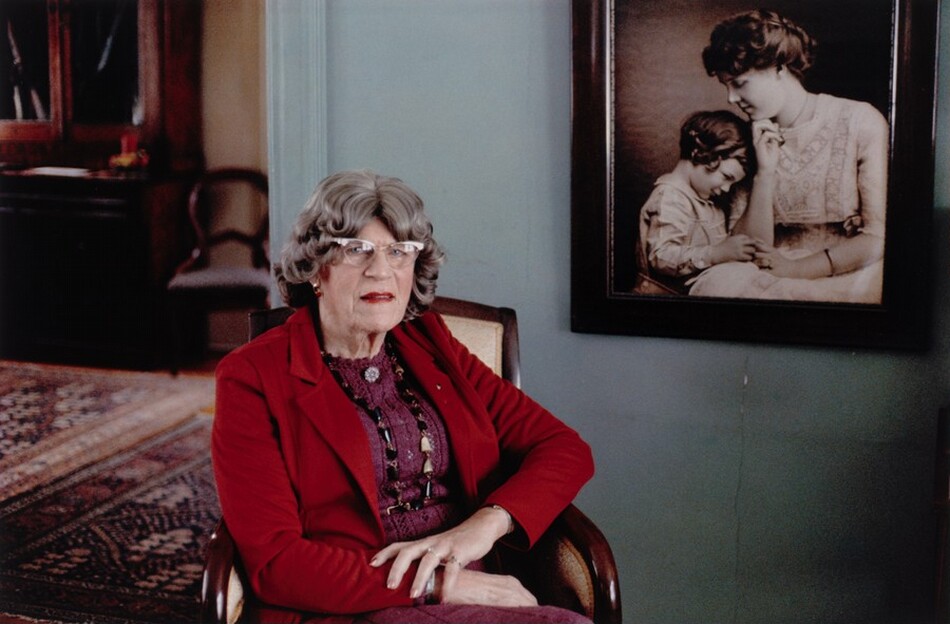
  • The image shows an older person seated in a chair, captured from the waist up. They are sitting upright, with their hands resting on the arms of the chair. The person has short, curly gray hair and wears glasses. Their facial expression appears neutral, and features include a straight nose, thin lips, and a pair of earrings. The person is dressed in a burgundy jacket over a patterned purple top, complemented with a beaded necklace and a brooch. They wear a ring on one hand, and their nails are painted. On the wall behind them is a framed, sepia-toned photograph of a woman and child in a tender pose. The setting appears to be indoors with a partial view of a carpeted floor and some furniture.
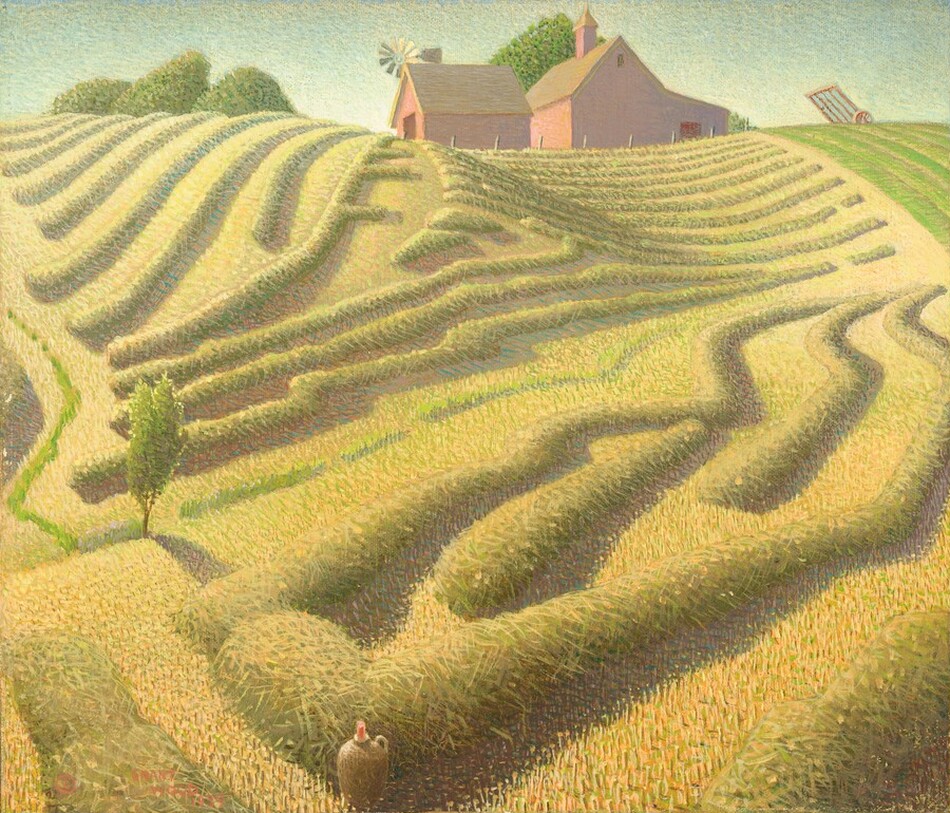
  • From a low vantage point, we look up along rolling, verdant farm fields bathed in sunlight that fill most of this nearly square canvas. Rows of stylized, gold-green hay almost fill landscape painting. The horizon line is high, almost at the top of the painting, and the hill in front of us slopes from the horizon down to a point far below us, at the bottom edge of the canvas. Along the hill, roughly parallel rows of harvested hay are bundled into distinctive tube-like mounds, with paths between them. The field is interrupted only by a small, solitary young tree near the lower left corner. Two muted, terracotta-red barns or outbuildings with pitched, tan-colored roofs perch at the top of the hill. They stand outlined against a light, clear blue sky at the top center of the composition. The canopies of several rounded trees puff up beyond the buildings, on the far side of the hill. A fan-like weathervane with flat, blade-like paddles sits atop the smaller barn. The other, larger building has a higher pitched roof with a small, lantern-shaped cupola on top and a wide door on the right side where the roof slopes down in a lean-to type of structure. A piece of farm machinery is parked in the field at the top right. At the bottom center of the canvas, a brown ceramic jug with a handle and red stopper rests on the ground in between the rows of bundled hay. The artist signed and dated the work with red paint in the bottom left corner: “GRANT WOOD 1939.” There is also a red painted copyright symbol to the left of the name.
  • This is a photograph of a typed manifesto. The text is presented on a plain white background, formatted in a block of aligned paragraphs.
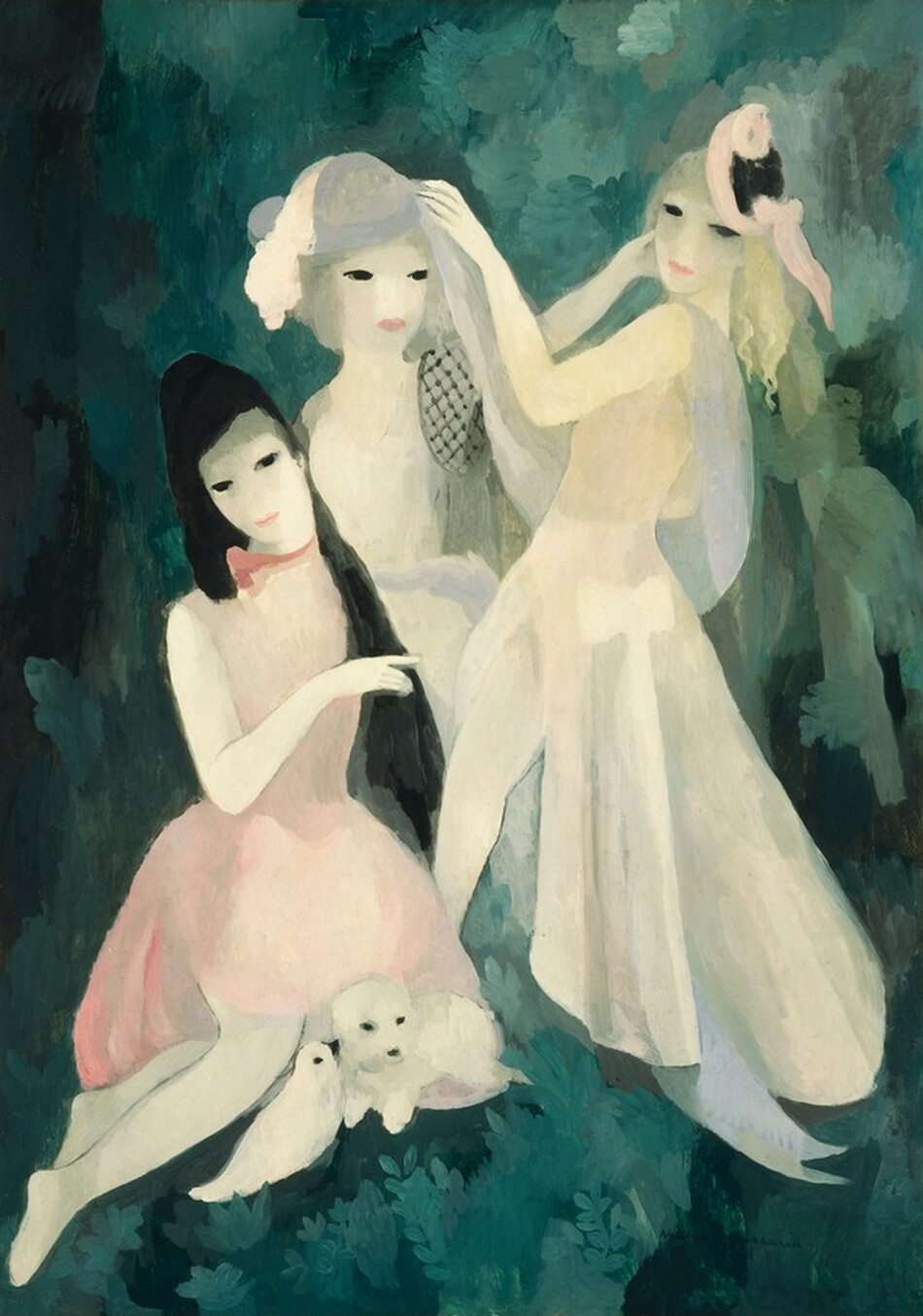
  • This painting depicts three women gathered closely together. The woman on the left appears to kneel on the ground, her face pointed towards us. She has long black hair that is partially tied up, and she wears a pale pink dress. A small white dog sits by her knees, next to another animal that may be a small white bird. Behind her and to the right is a woman who may be sitting or standing, with short gray hair, a pale blue hat with a pink plume, and a white dress with a pale blue sash and mesh sleeves. She is reaching toward the face of the woman on the right, who stands with her body turned and her hand on the central woman's blue hat. This woman on the right has wavy yellow hair and wears a pale yellow dress and a pale pink hat with a black bow and a pink ribbon. The women all have pale white skin with minimalist facial features consisting of simple black eyes and small, rose-colored lips. The background is made of overlapping patches of different shades of cool-toned green, some of which are shaped like leafy branches.
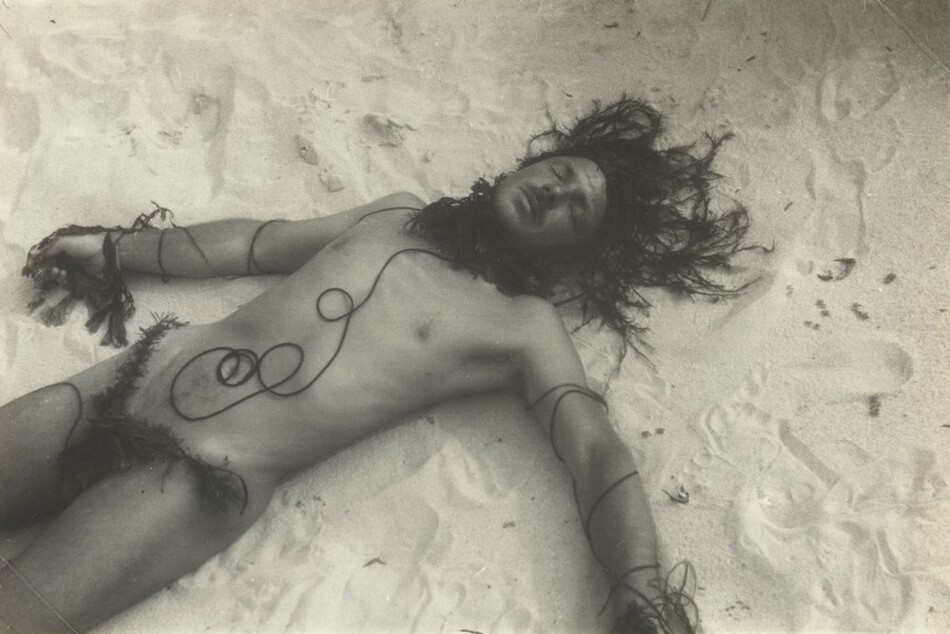
  • The image depicts a person laying on their back on a sandy surface. The individual's arms are outstretched to the sides, legs extended, and eyes closed. They have dark, tousled hair and are adorned with seaweed wrapping around their arms, neck, and lower midsection. The sandy background features natural markings typical of a beach environment.
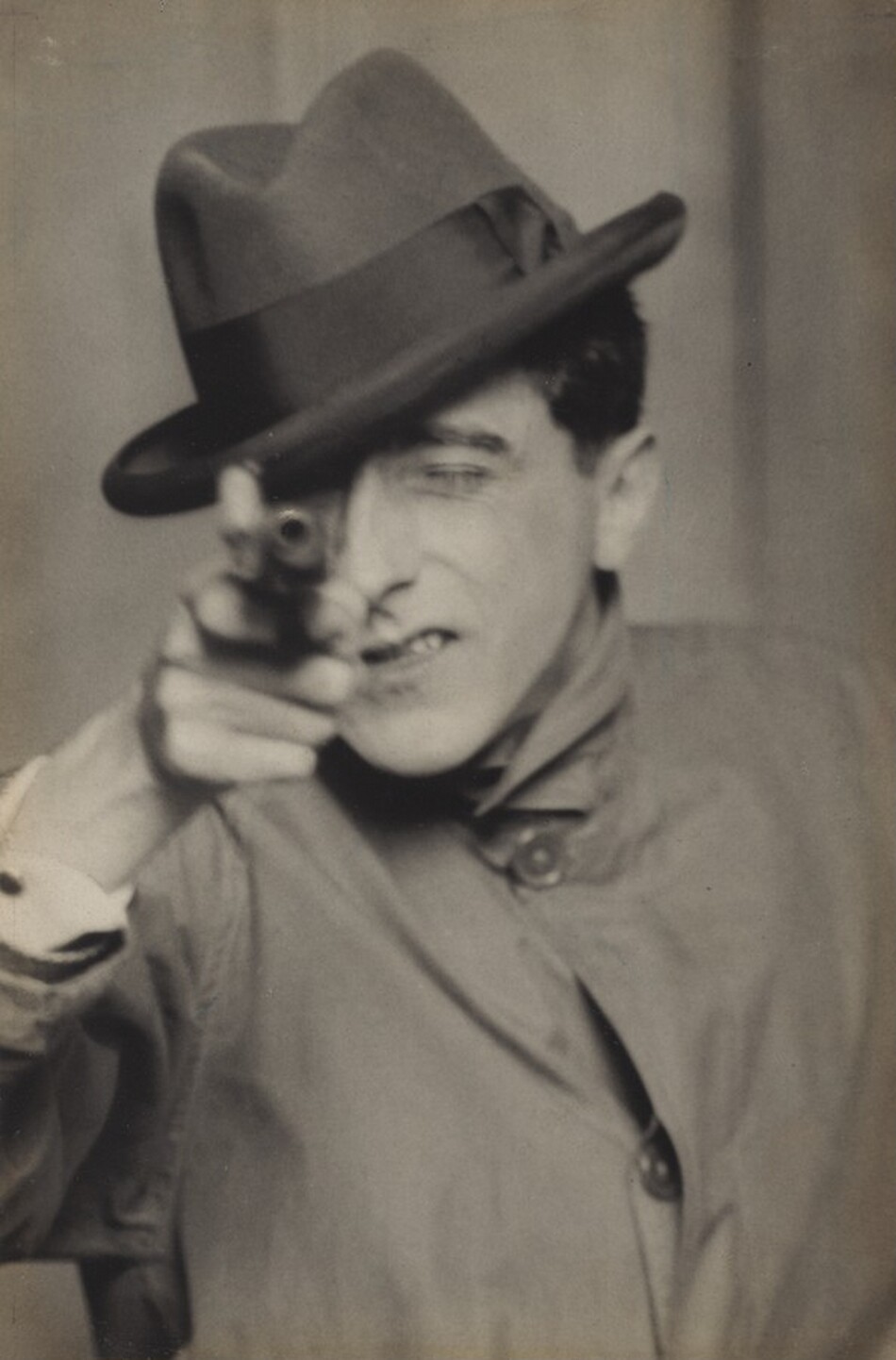
  • The image shows a man in a dynamic position, looking directly at the camera and pointing a gun with his right hand. He has a fedora hat casting a shadow over his eyes and wears a double-breasted coat.
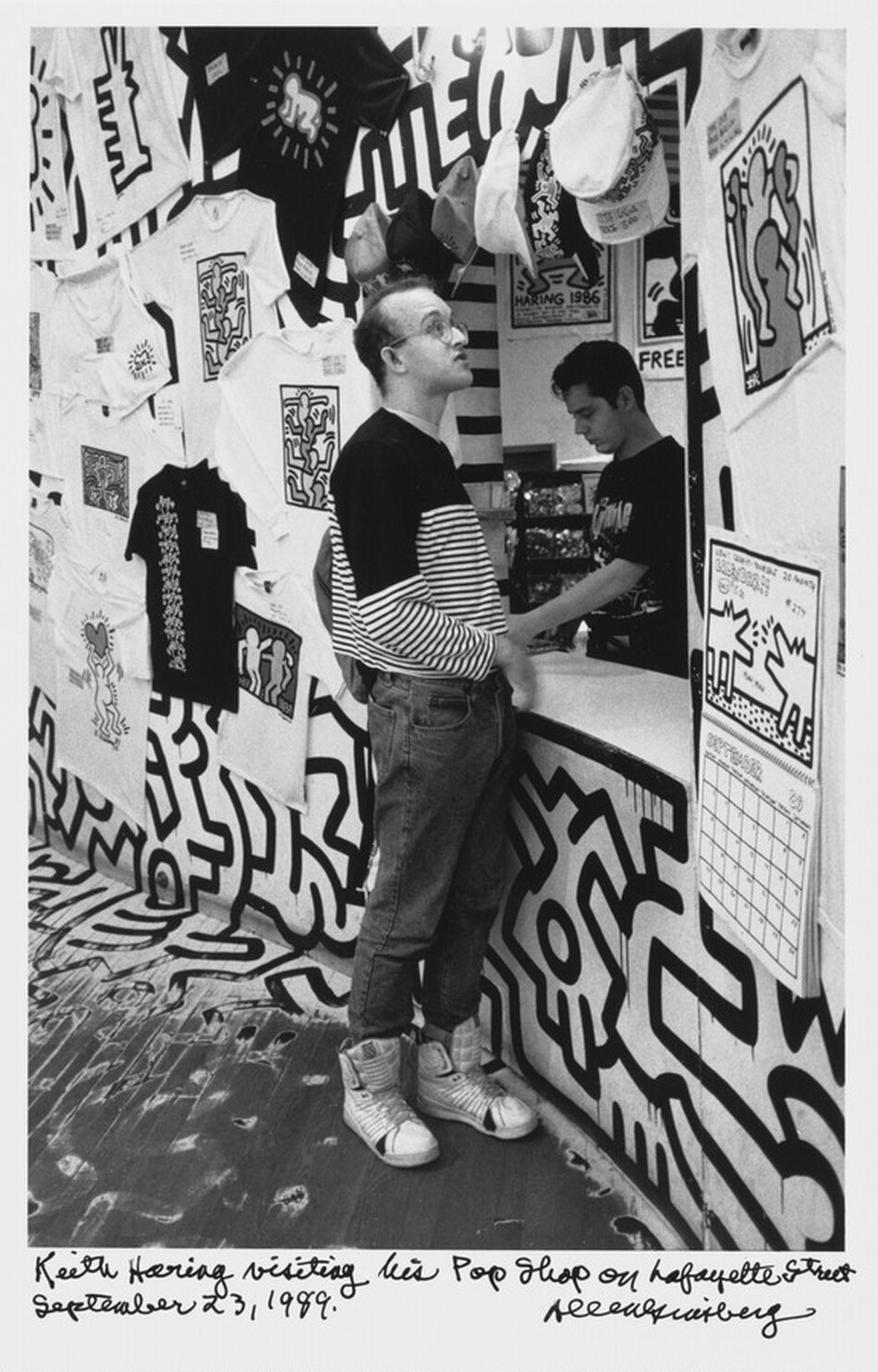
  • This is a black-and-white photograph of a store showcasing artwork and merchandise, including shirts, hats, and calendars, covered with bold line drawings of people and animals. The shop walls are covered in black and white patterns, and those patterns continue onto the wooden boards of the floor. On the right is an opening in the wall with a person standing behind it in front of more merchandise and looking down. In the center of the photograph, a man stands in front of the opening, looking upward. The man has pale skin and dark hair, and has thin, round glasses perched on his nose. He wears a striped black-and-white shirt with dark pants and chunky white sneakers. At the bottom of the photograph is a line of handwritten text.
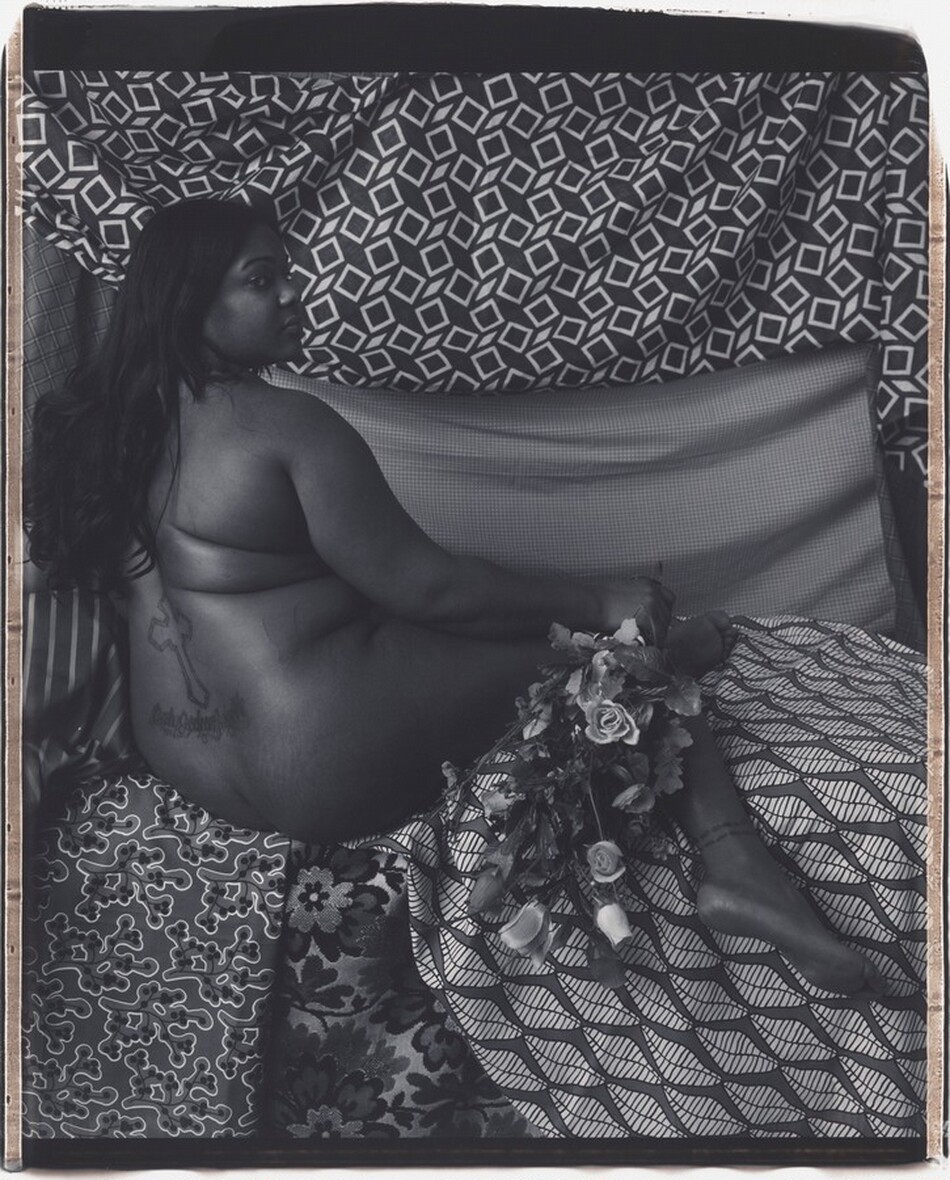
  • This black-and-white photograph shows a woman in a seated position, her legs curled to the side, with her back turned to us. She looks over her right shoulder towards us, allowing us to see her face in profile. She has high cheekbones, dark, arched eyebrows, a small nose, and lips set in a neutral position. She has dark skin and long black hair that cascades down her back. She is nude, with some visible tattoos, including the outline of a large cross on her lower back. She holds a bouquet of flowers in her right hand, partially obscuring her legs. The background and the surface she sits on are covered with a variety of textiles with geometric and floral patterns all layered over one another.
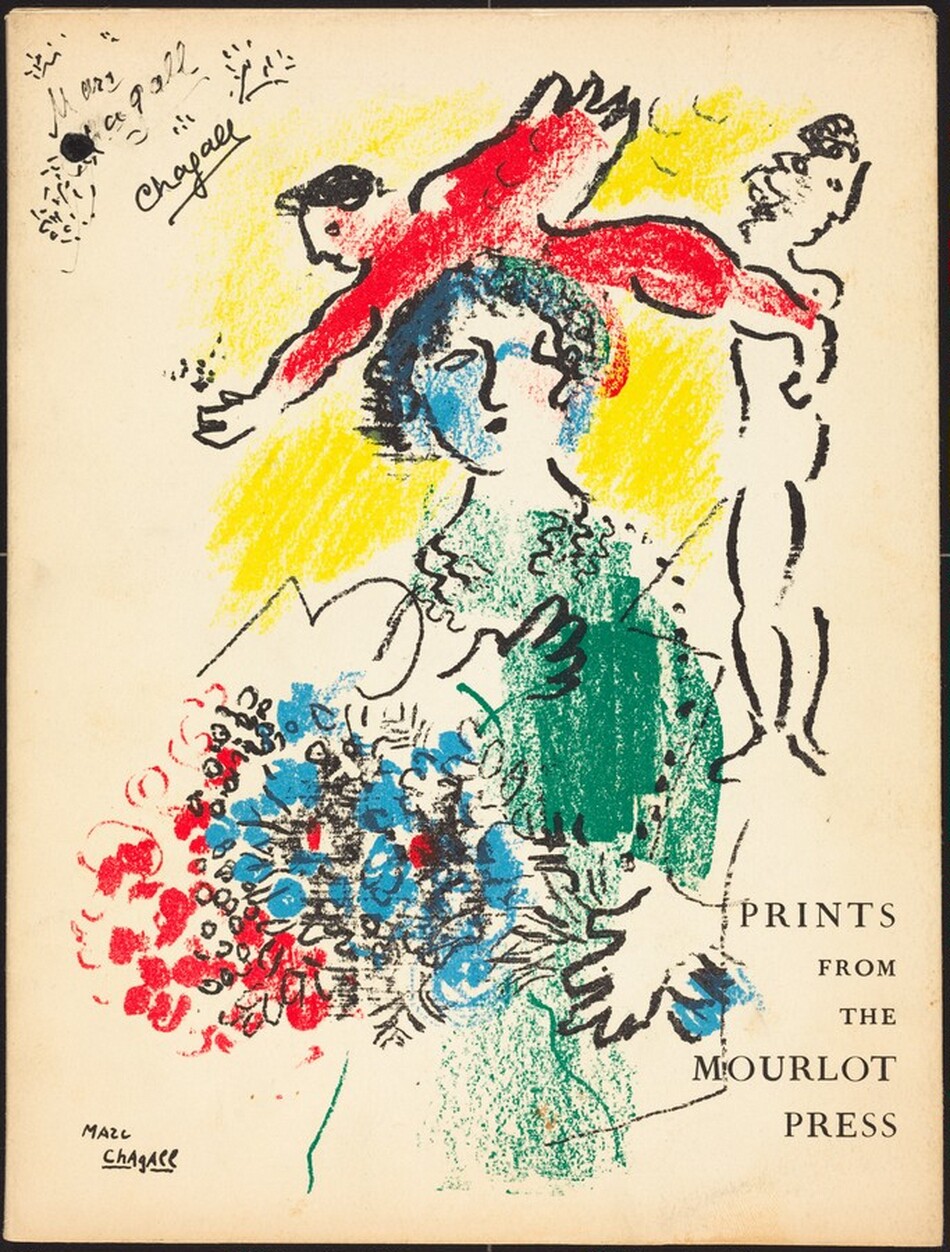
  • This print depicts three figures composed of abstract shapes and areas of bold color. The central figure is a woman facing forward, her skin and curly hair highlighted by areas of bright blue. Her facial features are abstract, and she wears a long garment colored in bright green. She is holding a vibrant bouquet of flowers made up of black outlines with overlapping circles of red and blue. Behind her, there is an abstract red figure with outstretched arms that appears to be flying in an area of bright yellow. It appears mostly human, but one of its arms looks like a bird's wing. Behind this figure and to the right is the minimal outline of another figure with long legs and no visible arms, who looks down to the right. Aside from the areas of color, the background is plain, yellowed paper. The signature "Marc Chagall" is visible in the top left and bottom left corners. The title "PRINTS FROM THE MOURLOT PRESS" is printed in black in the bottom right corner.
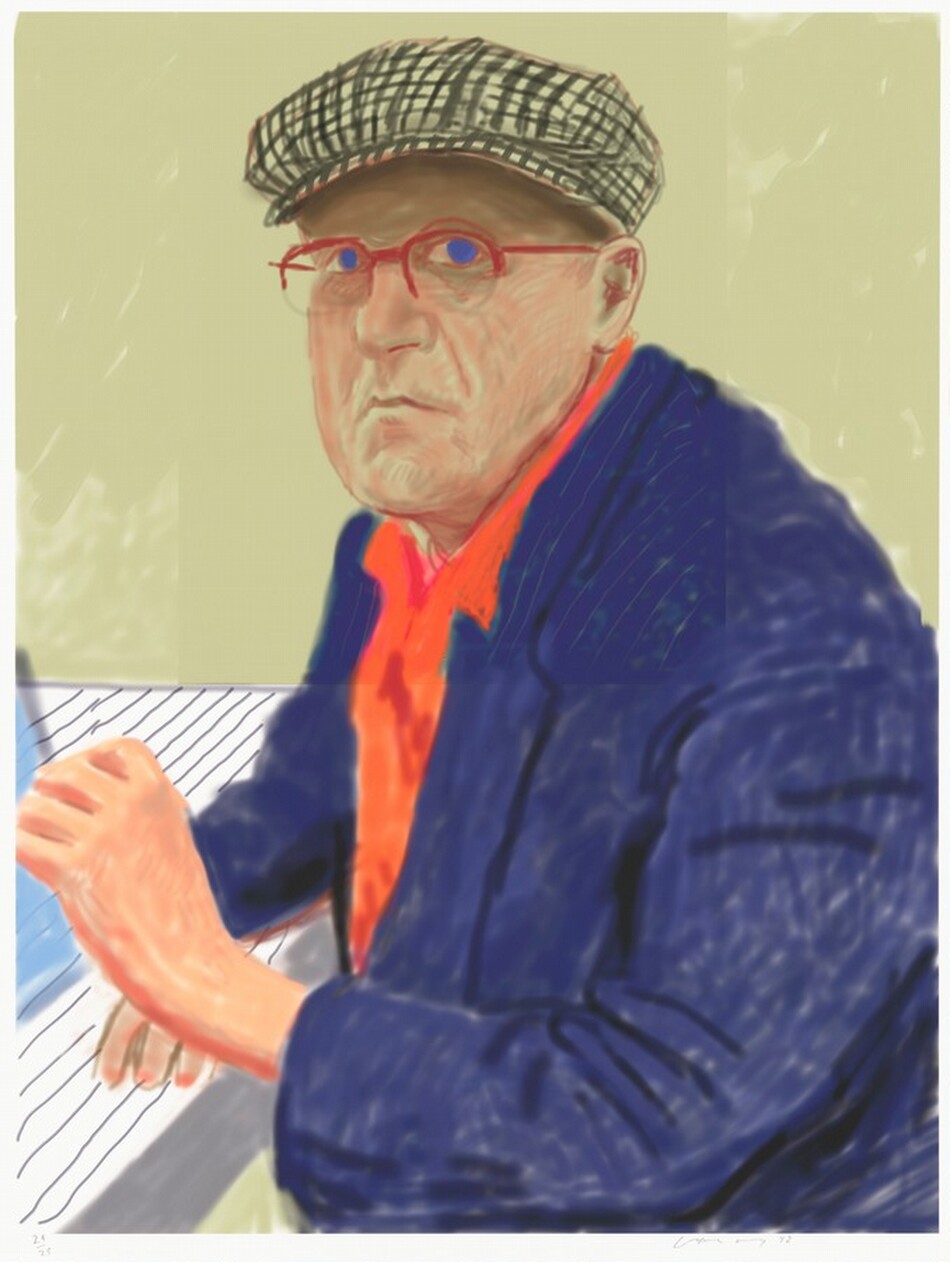
  • This image shows a portrait of a person's upper body. The individual is seated, turned slightly to the side, with one hand visible on a surface in front of them. The person has distinct facial features, including red glasses, light-colored hair mostly covered by a checkered flat cap, and a serious expression. They are wearing a navy-blue jacket over a bright orange shirt. The background features patterned lines, possibly suggesting a window or screen, and a muted solid color.
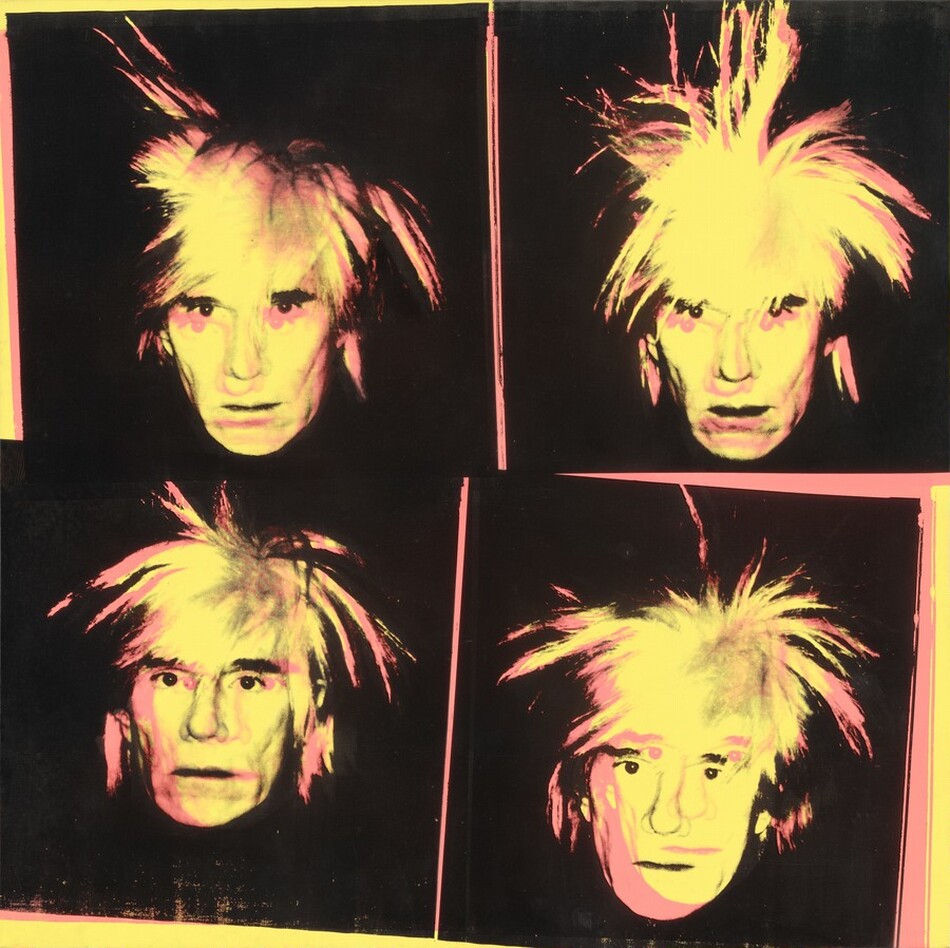
  • A man’s face printed in hot pink and banana yellow against a black background is repeated four times in this square silkscreen painting. The portraits are arranged in a grid of two by two. The man has a mop of spiky, unruly hair, heavy black brows, and a wide nose. His lips are set in a line over a rounded chin. Each one shows the man with a slightly different expression, some with his chin pulled back and others are straight on, but all look steadily at us with black eyes. The pink and yellow faces overlap but are out of alignment in each portrait. Pink and yellow edges surround each black square.
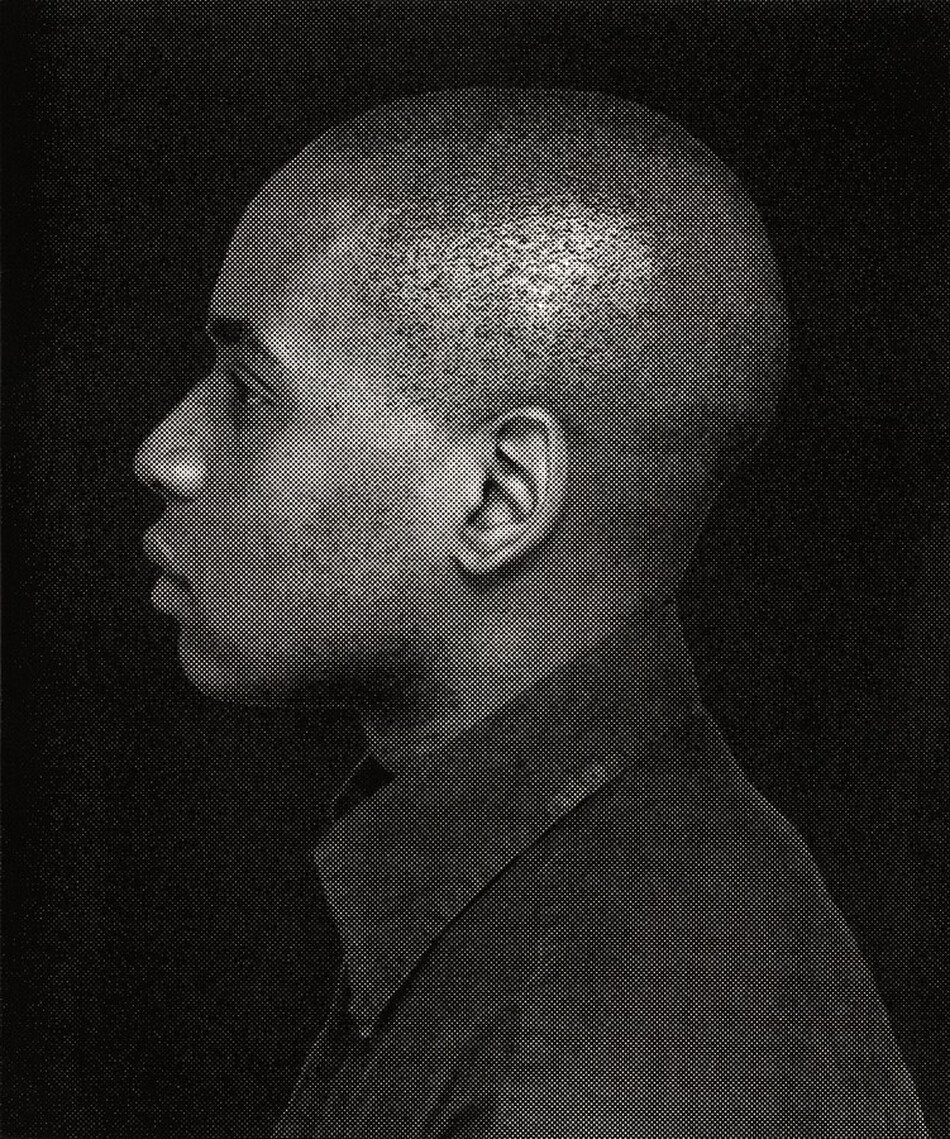
  • The image depicts a side profile of a person's head and shoulders, showing from the top of the head to the upper chest area. The person is positioned sideways, facing to the left of the frame. The individual's facial features are captured in profile; they have a clean-shaven head with closely cropped hair. Their facial structure is prominently visible, including the nose, lips, and ear. The person is wearing a dark-colored shirt, and the collar is visible. There are no visible jewelry or objects being held. The background is a plain, solid dark color.
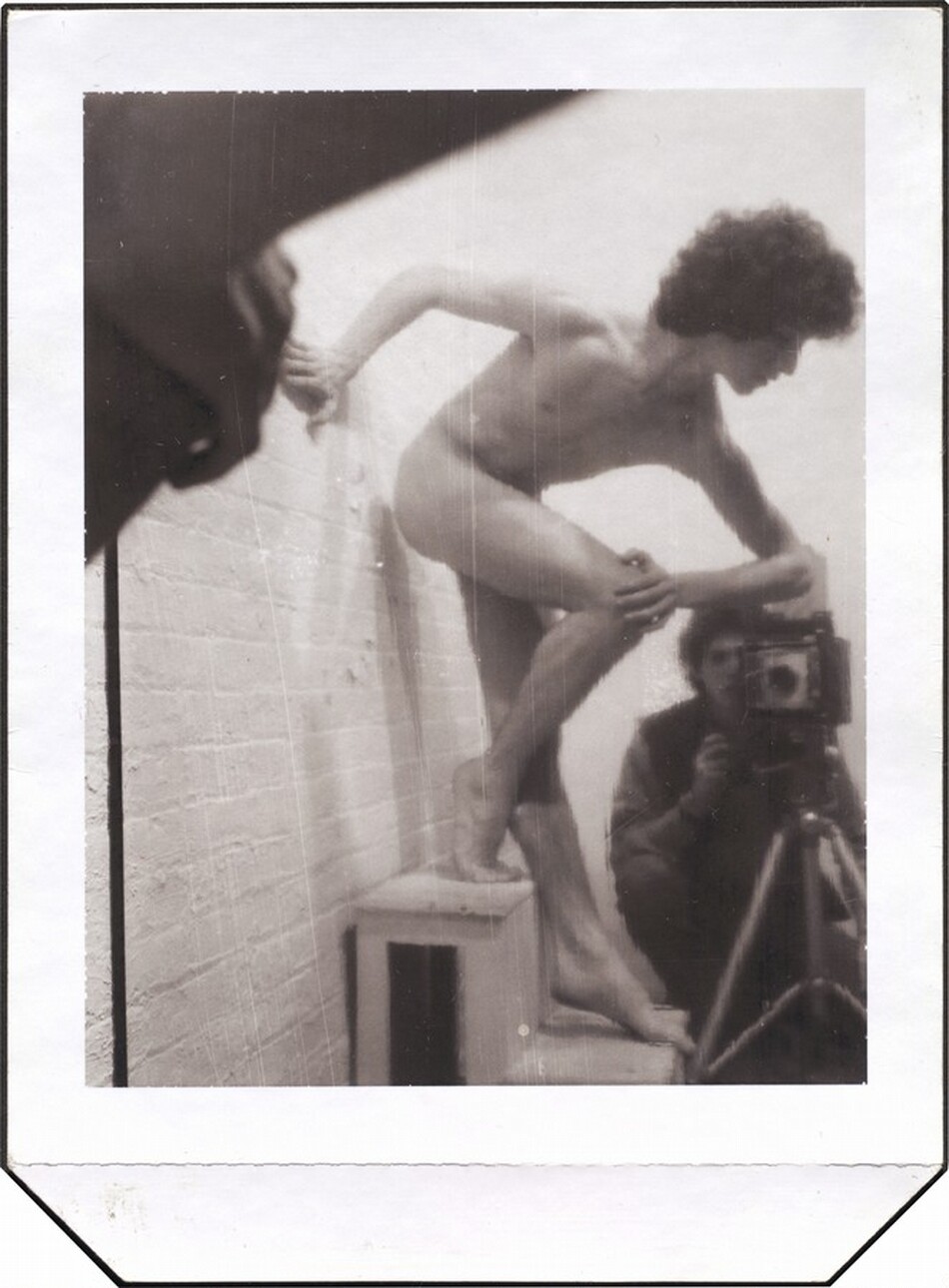
  • The image shows a nude person standing in an artistic pose on a small pedestal. They have curly hair and are standing with one foot on the pedestal and the other leg bent at the knee, with their hand resting on their shin. In the foreground, another individual is holding a camera, positioned at the lower right side of the image. The background features a plain brick wall, suggesting a studio environment with minimal distractions.
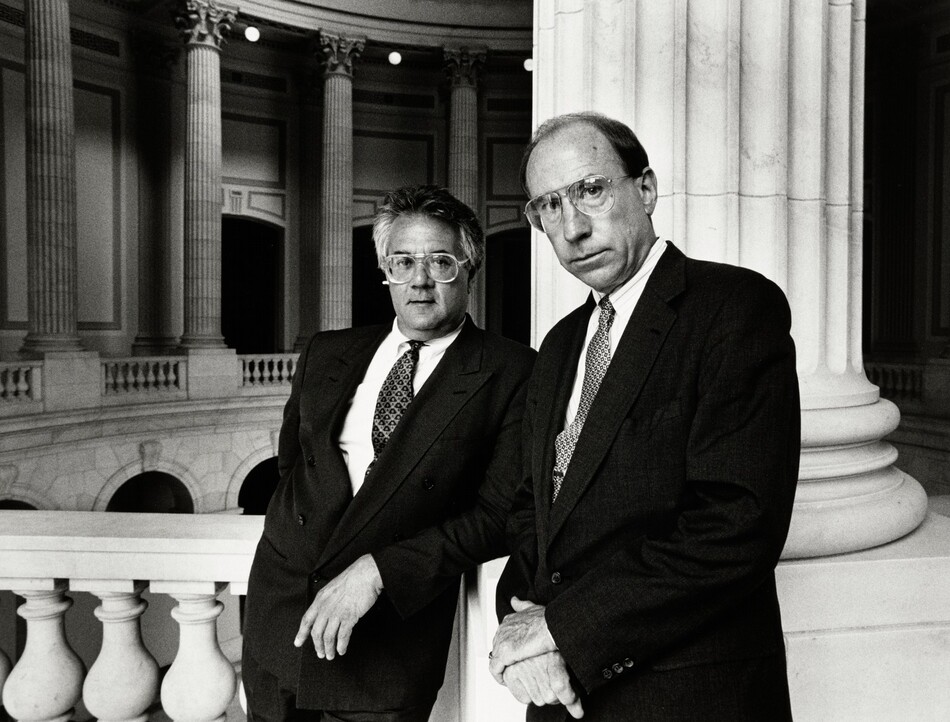
  • The image shows two men from the thighs up in front of a row of grand columns in an elegant building. The man on the left leans against a marble balustrade with a relaxed posture. He has short, light-colored hair and wears glasses, a suit, and a patterned tie. The man on the right stands upright with his arms crossed over the balustrade. He also wears glasses, a suit, and a patterned tie, with thin, combed-back hair. The background features intricate arches and columns.
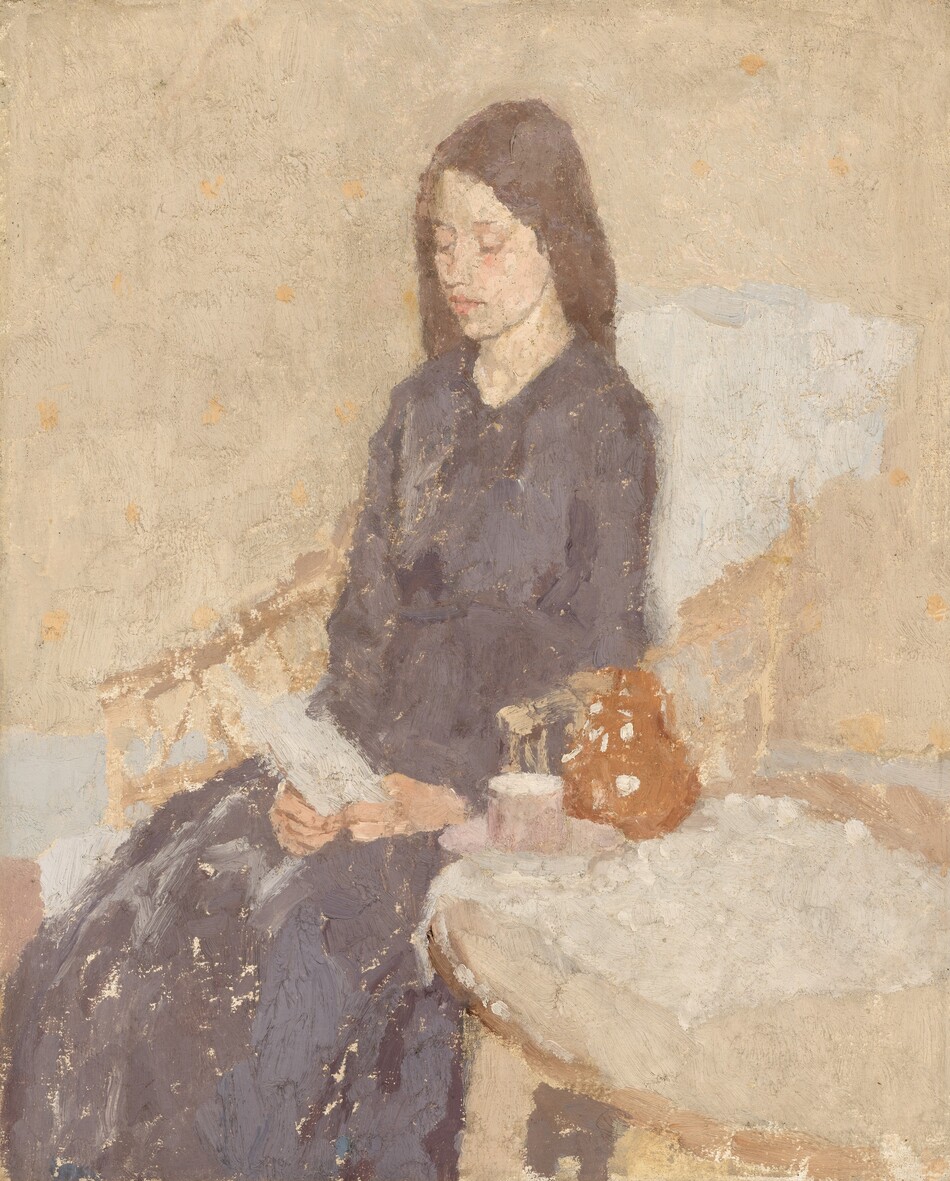
  • This painting shows a woman sitting in a chair with her legs covered by her dress. She faces slightly left of us, looking down at something in her hands that could be a light gray sheet of paper. She has pale skin and long, dark, straight hair, and she is wearing a long, dark blue dress. A teacup and teapot are on the table beside her, in the bottom right corner of the painting. She appears to sit in a wooden chair with a cloth or blanket on the back, but the details are hard to determine. The background is textured beige with some spots of light orange. The brushstrokes in the painting are thick and textured, with the paint applied in short strokes or dots. In some places, the beige color of the canvas is visible.
  • A block holding a toothbrush set with gold teeth raised in low relief on a lead sheet. The rectangular block holding the brush is almost halfway down the panel. The brush has a straight, toothbrush-like handle highlighted with shiny silver tin leaf. Four gold teeth are set in a row at what would be the brush end, to our left. Letters are stamped in the front face of the block to read, “THE CRITIC SMILES.” The artist signed and dated the work below the block with dotted lines, “J Johns ’69.” Also incised in the lower left corner of the lead sheet is “GEMINI III” with a Gemini horoscope symbol.
  • This is a photograph of a street protest. The image shows a demonstration with banners and signs held by participants on a city street, flanked by buildings and shop signs. The central banner prominently displays the words "GAY LIBERATION FRONT." Various placards carried by marchers in the background contain slogans advocating for social change and equality. The street is lined with trees and older style commercial architecture, suggesting an urban setting. The photograph is in black and white.
  • The image depicts two men seated in armchairs. The man on the left has short, light-colored hair and thick-framed glasses, holding an object in his right hand. The man on the right has short, dark hair. Both wear suits with ties and sit in a room with a window showing a railing outside. There are sunglasses on a ledge between them. The room has wooden flooring and receives natural light from the window.
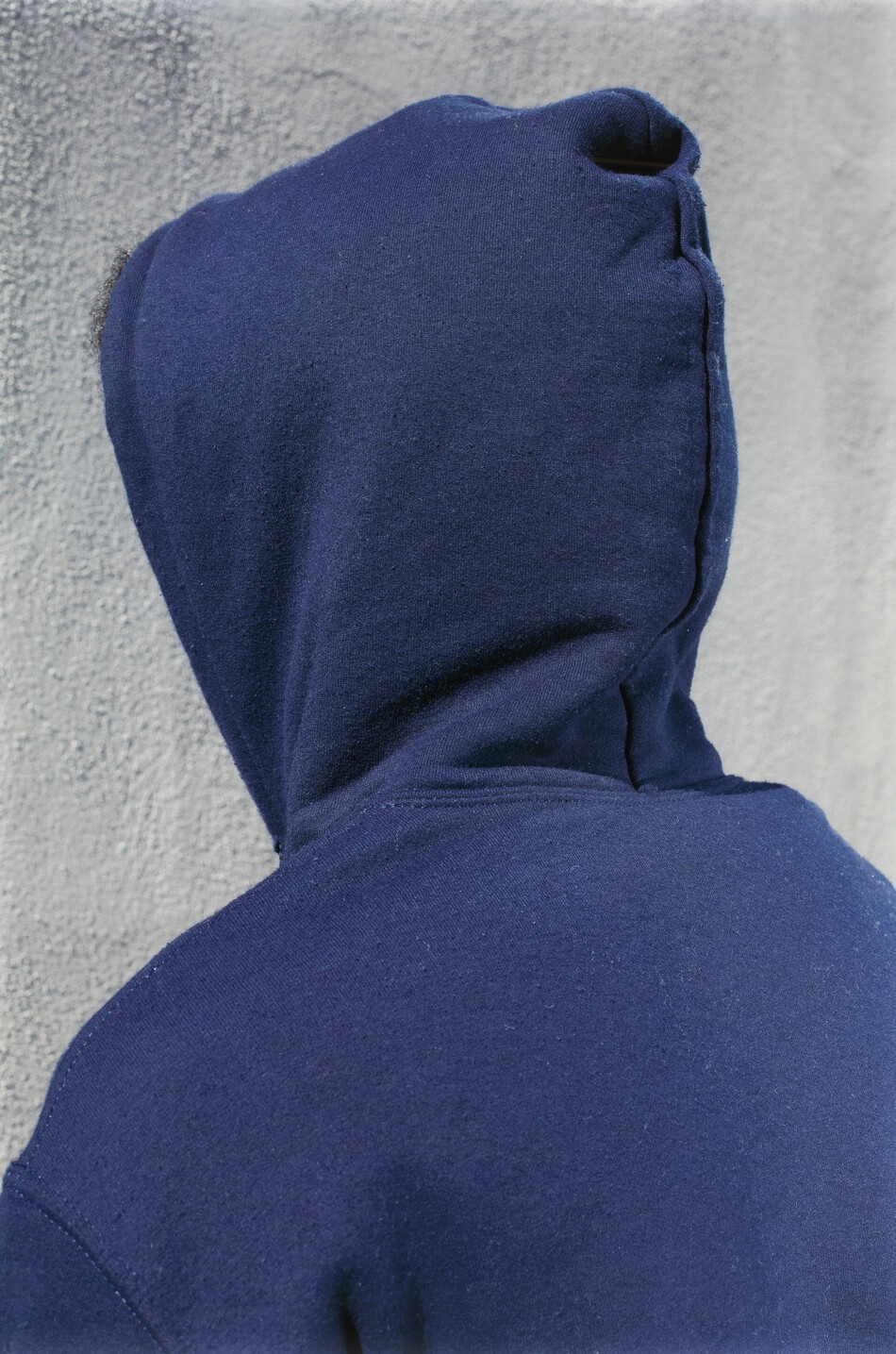
  • The image shows the upper body of a person from behind, with the head and shoulders visible. The person is slightly turned, facing away from the camera. Their face is not visible as the hood of their clothing is up, covering their head entirely. The person is wearing a dark blue hooded sweatshirt. The background consists of a textured gray wall. The image provides minimal context due to the obscured view of the person's facial features and details.
  • The image is a collage of four panels. The first panel shows a person standing in a room with a bookshelf filled with books in the background. The second panel shows a person standing on stairs with a pillow featuring a patterned cover visible. The third panel features text that reads, "What you got tell me the lines of your pretty black hair." The fourth panel displays a black and white image of a crowd during a demonstration, showing people holding signs that read "STOP THE CLAUSE" and "FIGHT FOR LESBIAN & GAY RIGHTS."
  • This is a photograph of a group of soldiers in formation. The image shows numerous soldiers wearing uniforms and helmets. They are each holding rifles on their shoulders in an organized manner. The soldiers are in a natural outdoor environment with vegetation in the background, partially shading the scene. The photograph captures a moment of serious readiness or preparation, given the organized arrangement and focused expressions. The image is presented in black and white.
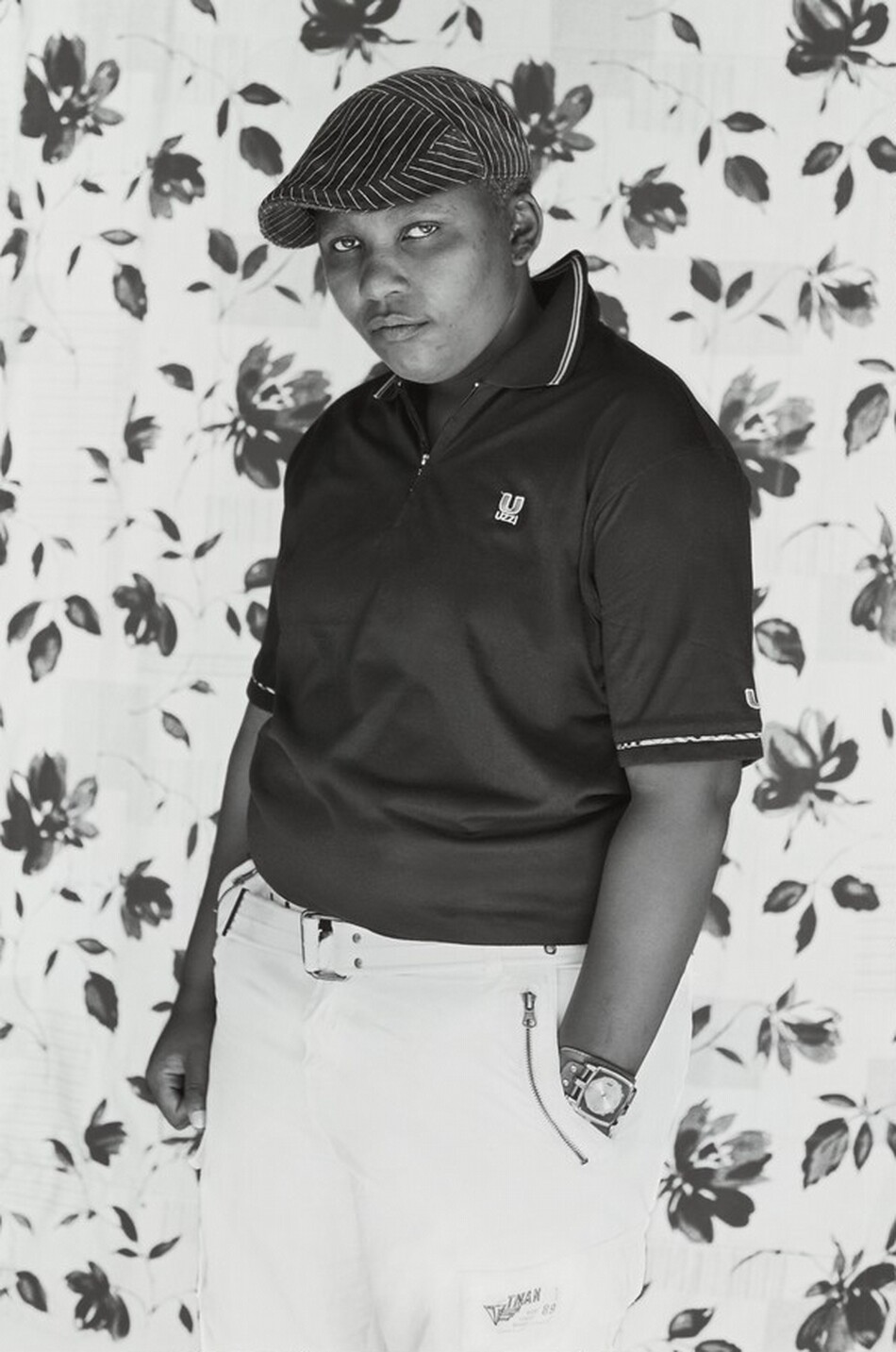
  • The image shows a person standing from the upper thigh upwards, slightly angled to the right. They are wearing a dark polo shirt with a collar and a small emblem on the left side of their chest. Their head is slightly tilted forward, and they have a short haircut styled with a striped flat cap. Their gaze is directed towards the camera with a neutral expression. They are also wearing light-colored trousers, with a visible belt and a watch on their left wrist. The background consists of a patterned floral curtain with large flowers and leaves in contrasting tones.

Stories
Educator Resources