Edgar Degas
Degas, Hilaire-Germain-Edgar
French, 1834 - 1917
The eldest son of a Parisian banker, Edgar Degas reinforced his formal academic art training by copying Old Master paintings both in Italy, where he spent three years (1856–1859), and at the Louvre. Degas early on developed a rigorous drawing style and a respect for line that he would maintain throughout his career. His first independent works were portraits and history paintings but in the early 1860s he began to paint scenes from modern life. He started with the world of horse racing and by the end of the 1860s had also turned his attention to the theater and ballet.
Soon after a trip to New Orleans, where his uncle and two of his brothers worked in the cotton trade, in 1873, Degas banded together with other artists interested in organizing independent exhibitions without juries. He became a founding member of what soon would be known as the impressionists, participating in six impressionist exhibitions between 1874 and 1886.
Despite his long and fruitful association with the impressionists, Degas preferred to be called a realist. His focus on urban subjects, artificial light, and careful drawing distinguished him from other impressionists, such as Claude Monet, who worked outdoors, painting directly from their subjects. A steely observer of everyday scenes, Degas tirelessly analyzed positions, gestures, and movement.
Degas developed distinctive compositional techniques, viewing scenes from unexpected angles and framing them unconventionally. He experimented with a variety of media, including pastels, photography, and monotypes, and he used novel combinations of materials in his works on paper and canvas and in his sculptures. He primarily viewed his sculpture as a means of researching movement and publicly exhibited only one, Little Dancer Aged Fourteen (1878–1881).
Degas was frequently criticized for depicting unattractive models from Paris’ working class, but others, like realist novelist Edmond de Goncourt, championed Degas as “the one who has been able to capture the soul of modern life.” By the late 1880s, Degas was recognized as a major figure in the Parisian art world. Financially secure, he could be selective about exhibiting and selling his work. He also bought ancient and modern works for his own collection, including paintings by El Greco, Edouard Manet, and Paul Gauguin, who became close friends. Depressed by the limitations of his failing eyesight, he created nothing after 1912; at his death in 1917, he was hailed as a French national treasure. About 150 deteriorating clay and wax sculptures were found in Degas’s studio following his death. Their existence had been unknown to all but Degas’s closest associates.
Explore selected works
See all 63 works of artArtwork
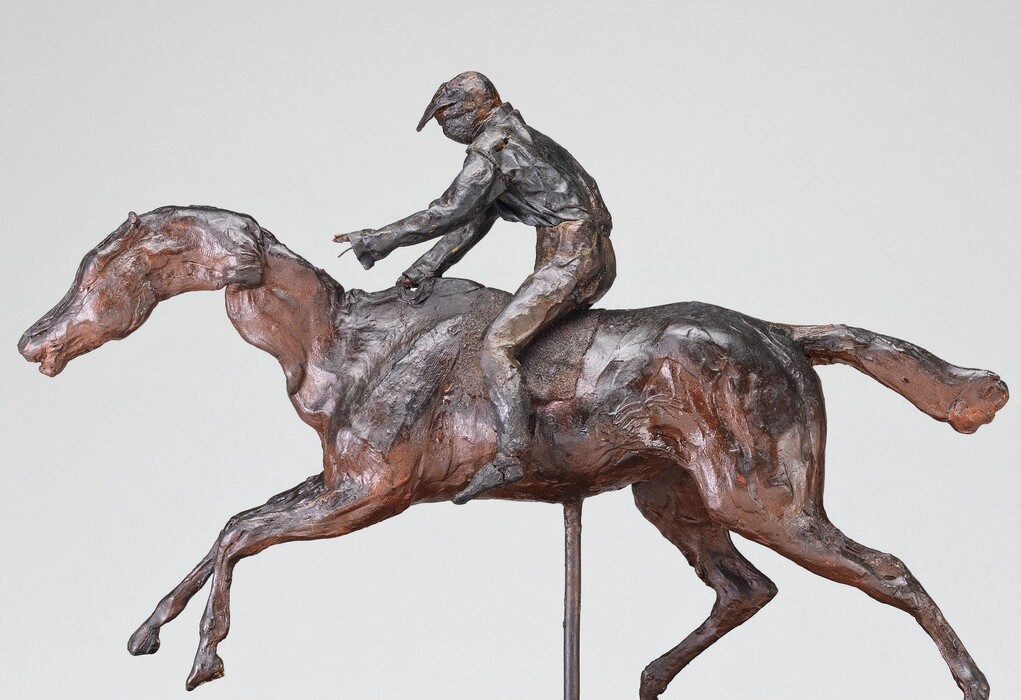
Jockey with Cap
Jockey with Cap
Edgar Degas · possibly 1890s · pigmented beeswax, metal armature, cloth, paper · Accession ID 1999.80.15
Artwork
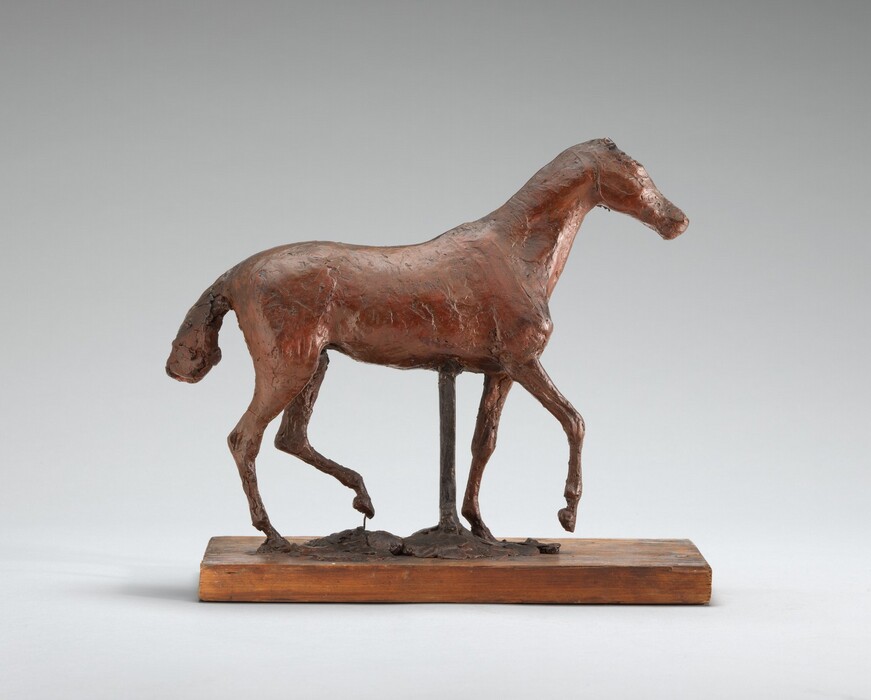
Horse Walking
Horse Walking
Edgar Degas · possibly early 1870s · pigmented beeswax, metal armature, cork, on wooden base · Accession ID 1999.80.13
Artwork
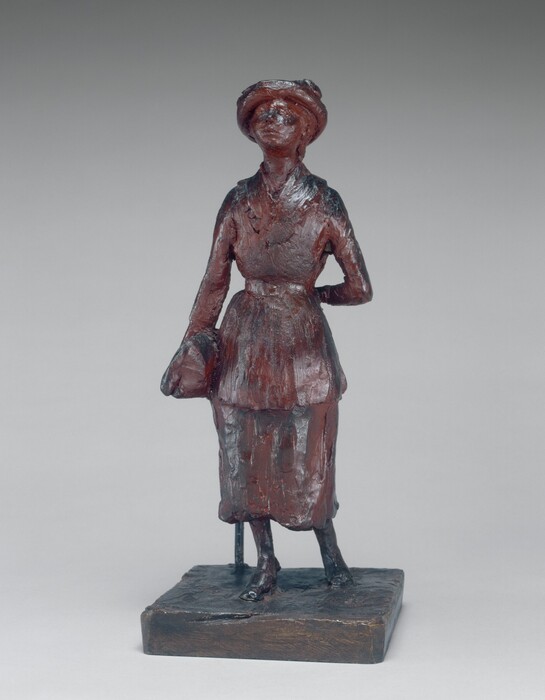
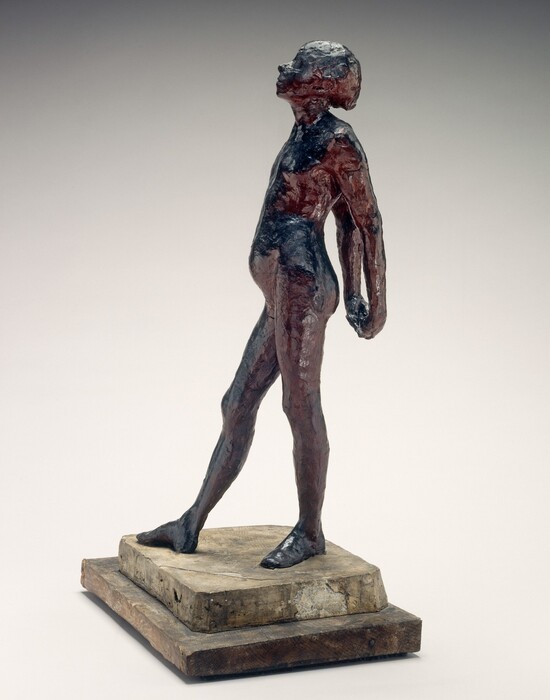
The Schoolgirl (Woman Walking in the Street)
Edgar Degas · c. 1880/1881 · pigmented beeswax, plastiline, metal armature, on plaster base · Accession ID 1999.80.18
Artwork
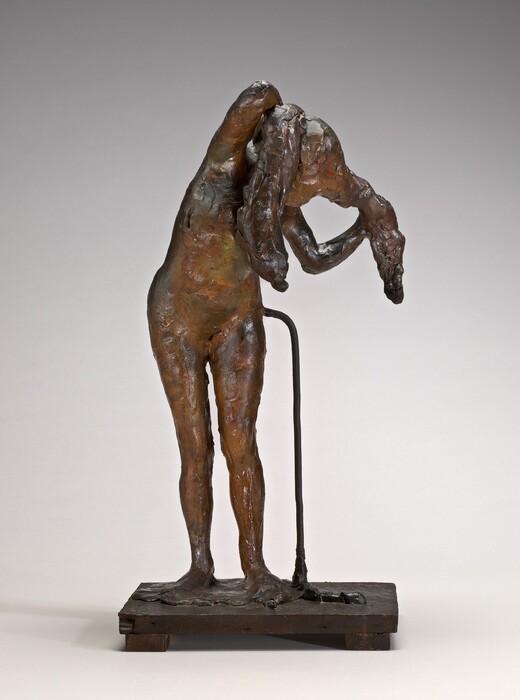
Woman Arranging Her Hair
Edgar Degas · possibly late 1880s/1890s · pigmented beeswax, clay, metal armature, cork, on wooden base · Accession ID 1999.80.30
Artwork
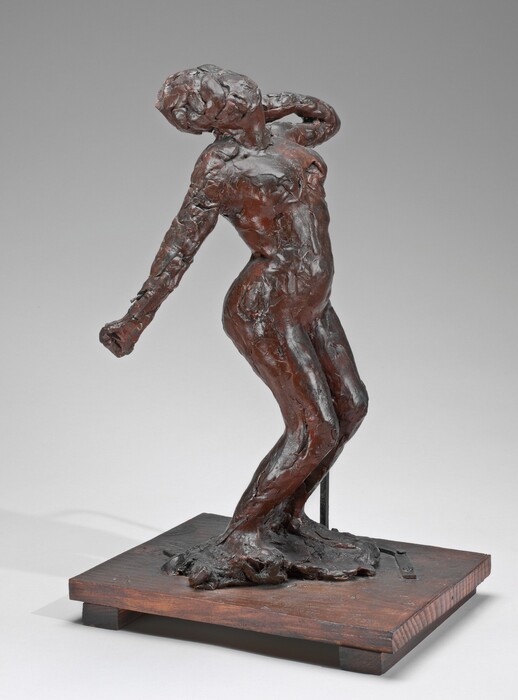
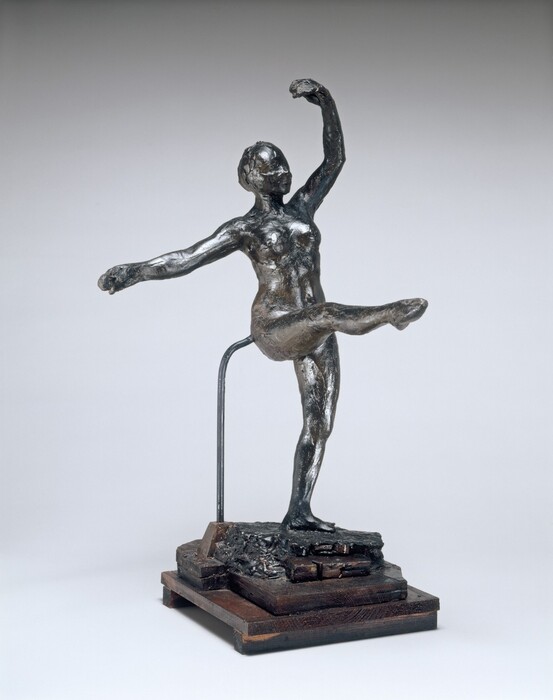
Arabesque over the Right Leg, Left Arm in Front
Edgar Degas · c. 1885/1890 · pigmented beeswax, metal armature, on wooden base and supported by exterior metal frame · Accession ID 1999.80.23
Artwork
Woman Stretching
Woman Stretching
Edgar Degas · c. 1896/1911 · pigmented beeswax, metal armature, on wooden base · Accession ID 1985.64.55
Artwork
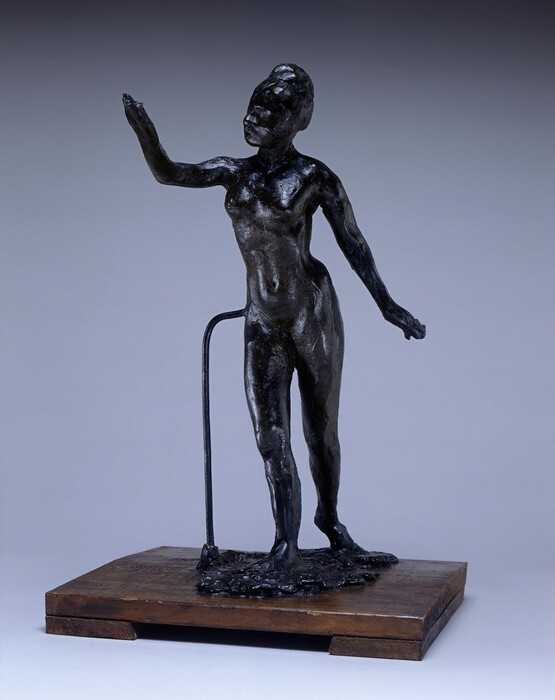
Study in the Nude of Little Dancer Aged Fourteen (Nude Little Dancer)
Edgar Degas · c. 1878-1881 · pigmented beeswax, plaster core, metal and wood armatures, on plaster and wooden bases · Accession ID 1985.64.46
Artwork
Grande Arabesque, First Time (Arabesque à terre)
Edgar Degas · c. 1885/1890 · pigmented beeswax, metal armature, wood slivers, cork, on wooden base · Accession ID 1999.80.26
Artwork
Fourth Position Front, on the Left Leg
Edgar Degas · c. 1885/1890 · pigmented beeswax, metal armature, cork, on wooden base · Accession ID 1999.80.8
Artwork
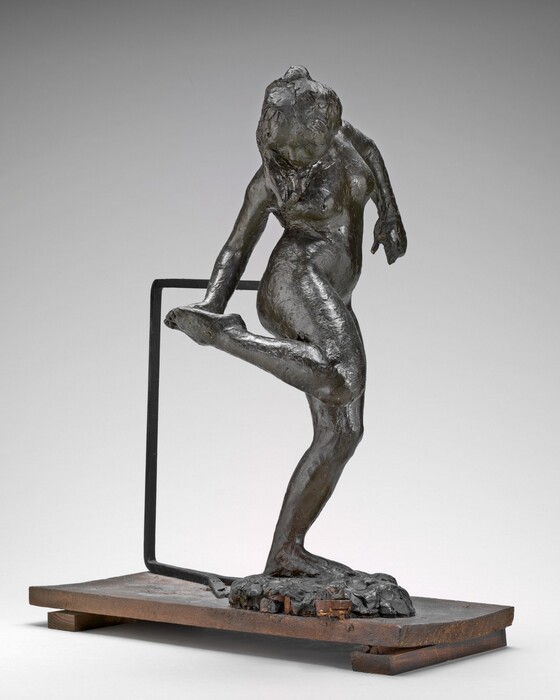
Dancer Looking at the Sole of Her Right Foot
Edgar Degas · c. 1890s · pigmented beeswax, metal armature, cork, on wooden base · Accession ID 1999.80.5
Bibliography
1918
Lafond, Paul. Degas. 2 vols. Paris, 1918-1919.
1921
Ref Numbers: 657, 658
Lugt, Frits. Les marques de collections de dessins & d'estampes; marques estampillees et ecrites de collections. Amsterdam: Vereenigde drukkerijen, 1921.
1924
Vollard, Ambroise. Degas (1834-1917). Paris, 1924.
1944
Rewald, John. Degas, Works in Sculpture: A Complete Catalogue. Translated by John Coleman and Noel Moulton. New York, 1944.
1946
Lemoisne, Paul André. Degas et son oeuvre. 4 vols. Paris, 1946-1949.
1956
Rewald, John. Degas Sculpture: The Complete Works. Translated by John Coleman and Noel Moulton. New York, 1956.
1976
Millard, Charles W. The Sculpture of Edgar Degas. Princeton, 1976.
1984
Lemoisne, Paul-André. Degas et son Oeuvre. 5 vols. New York, 1984 (reprint of Paris edition, 1946-1949).
McMullen, Roy. Degas: His Life, Times, and Work. Boston, 1984.
1986
Vollard, Ambroise. Degas: An Intimate Portrait. Translated by Randolph T. Weaver. New York, 1986.
1991
Loyrette, Henri. Degas. Paris, 1991.
Pingeot, Anne. Degas Sculptures. Paris, 1991.
2002
Czestochowski, Joseph S., and Anne Pingeot. Degas--Sculptures. Catalogue Raisonné of the Bronzes. Memphis, 2002.
2010
Lindsay, Suzanne Glover, Daphne S. Barbour, and Shelley G. Sturman. Edgar Degas Sculpture. The Collections of the National Gallery of Art Systematic Catalogue. Washington, D.C., 2010: 5-45.