Provenance

Fuller

Explore selected works

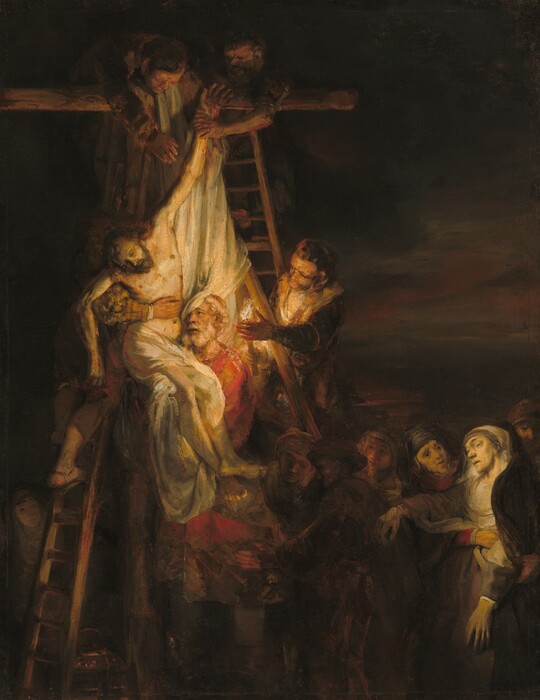
The lifeless body of a bearded young man partly wrapped in an ivory cloth is being lowered from a cross to a group of people at its foot in this vertical painting. All the people have peachy or pale skin, and most are dressed in cream white and shades of brown. The body and head of the dead man, Jesus, slump to our left, eyes closed and mouth hanging open. His arms and hands are streaked with red, and drips of blood dot his head. Two men on ladders propped against the back of the cross reach over the top crossbar, and one man on our right holds Jesus’s left wrist. A long white cloth is draped over the crossbar and falls to wrap around Jesus’s hips. Two more men stand on the ladders on either side of the cross, one with his arm around Jesus’s torso while the other reaches forward to hold a torch that dramatically lights the cluster of bodies. An older man with white hair and beard, wearing a scarlet-red tunic, stands in front and cradles the hips and legs of Jesus as he is lowered. Six people stand to the right of the old man and the cross. A strong light falls on the face of a pale, older woman. Her eyes are closed, her mouth open, and her arms limp as she is caught by the people around her. The men in the group wear hats and the women’s heads are covered with scarves. From the shadows to the left of the cross, near the edge of the painting, the pale face of a woman peers onto the scene. The landscape behind the cross and group is deep in shadow, but rust-red streaks line the horizon in the distance.
Dutch 17th Century, Constantijn van Renesse, The Descent from the Cross, 1650/1652, oil on canvas, Widener Collection, 1942.9.61

The Descent from the Cross

Dutch 17th Century, Constantijn van Renesse · 1650/1652 · oil on canvas ·  Accession ID  1942.9.61
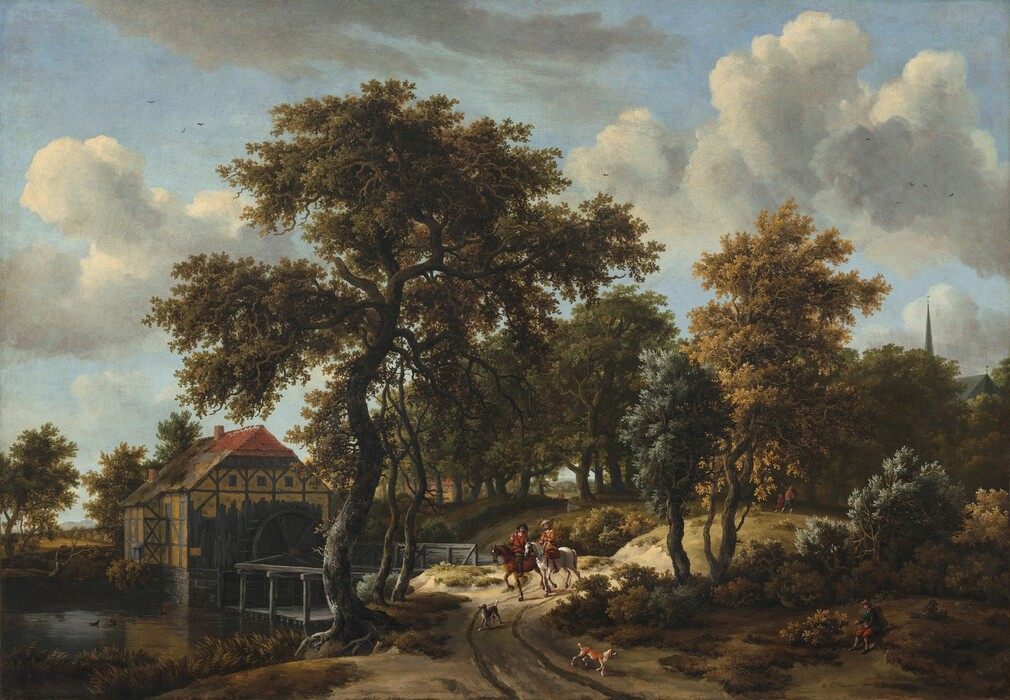
Two light-skinned men on horseback ride toward us on a rutted, country road set in a sweeping view with a watermill along a river to our left, and a screen of trees to our right in this horizontal landscape painting. The horizon comes about a third of the way up the composition, and many of the trees and the watermill are shown against the white and dove-gray clouds rolling across the pale blue sky. The riders are small in scale when compared to the landscape. The man to our left rides a chestnut-brown horse and wears a red jacket and a black, wide-brimmed hat pushed back on his head. The man to our right, on a silvery gray horse, wears a brown hat and clothing. White streaks at their necks and cuffs suggest lace or linen undershirts. Both horses walk with their bodies angled slightly to our left on the curving path. Two dogs trot ahead of the riders, toward us. A charcoal-gray, wooden bridge beyond the men to our left leads to the watermill. The squat, wide building is constructed on a stone foundation with wooden posts and beams that make a geometric pattern within the canary-yellow stucco. The gabled roof is covered with terracotta-red tiles at the peak closest to us, but the rest is thatched in gray and tawny brown. One small chimney rises from the center and the other from the end farther from us. A tall, water wheel is affixed to the shaded side of the building closest to us. A few ducks float in the grass-lined river near the lower left corner of the composition. The trees that dominate the right half of the canvas are painted with shades of moss, sage, and pine green and golden yellow. Only closer inspection reveals the tip of a church spire rising behind the treetops to our right. In the shadows beneath the trees, we also find a man wearing a tall sack on his back and holding a walking stick as he sits on a low rise near the lower right corner, and a man and child walking away from us along the path in the distance, into the trees.
Meindert Hobbema, The Travelers, 166[2?], oil on canvas, Widener Collection, 1942.9.31

The Travelers

Meindert Hobbema · 166[2?] · oil on canvas ·  Accession ID  1942.9.31