Provenance

Watson B. Dickerman

American, 1846 - 1923

Explore selected works

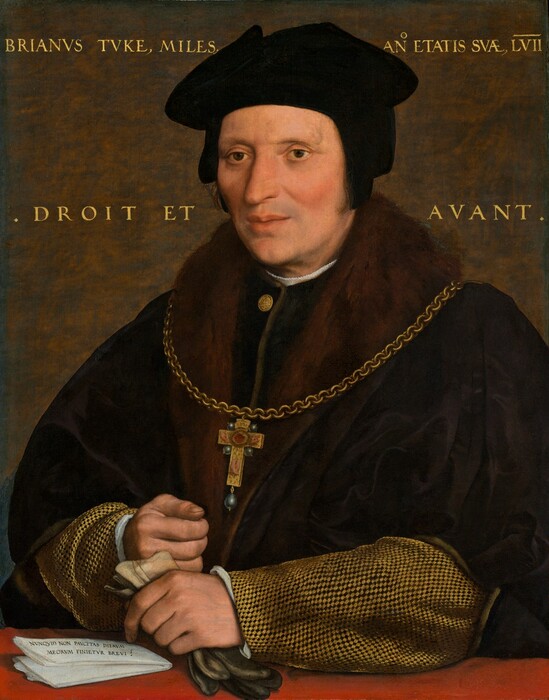
Shown from the waist up, a cleanshaven man with pale, peachy skin, wearing a black cap and a voluminous fur-lined, black cloak, is positioned behind a crimson-red ledge or tabletop in this vertical portrait painting. His head and torso nearly fills the composition. His body is angled to our left, and he looks off in that direction with dark brown eyes under faint eyebrows. His high cheeks are lightly flushed, and he has a pointed nose and a hint of a five o-clock shadow. His soft black cap has flaps that cover his ears. The wide, fur lapels of his black cloak nearly reach his shoulders. The sleeves of the garment beneath has a tan and black checked pattern, and a white undershirt peeks out at his neck and cuffs. A cross hanging from a heavy gold chain has black pearls in the cross of each arm and a teardrop-shaped black pearl hangs from the bottom. The cross has a hand on each short arm, two feet on the long leg, and a red circle at the center. The sitter’s left hand, on our right, rests on the red ledge holding a pair of gloves that are ivory white around the wrist and charcoal gray at the fingers. His right hand, father from us, rests in a loose fist near his other wrist. A folded piece of white paper with black writing lies to our left of the hands. It reads, “NVNQVID NON PAVCITAS DIERVM MEORVM FINIETVR BREVIS.” The background behind the man is mottled with rust brown and steel gray. Gold writing spans the background to either side of the man’s head, reading, “BRIANVS TVKS, MILES, ANO ETATIS EVAE LVII” along the top and “DROIT ET AVANT” below.
Hans Holbein the Younger, Sir Brian Tuke, c. 1527/1528 or c. 1532/1534, oil on panel, Andrew W. Mellon Collection, 1937.1.65

Sir Brian Tuke

Hans Holbein the Younger · c. 1527/1528 or c. 1532/1534 · oil on panel ·  Accession ID  1937.1.65
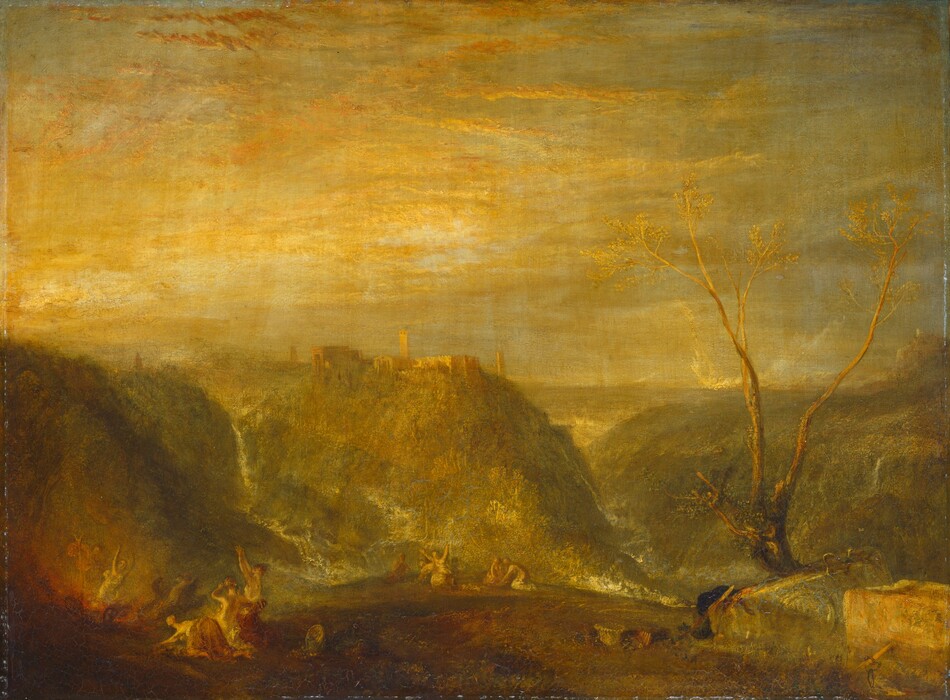
About a dozen people, tiny in scale, flail their arms or huddle in small groups in a vast, mountainous landscape in this gold-toned, horizontal painting. A grassy expanse stretches across the bottom edge the canvas into the middle distance, where it meets steep hills separated by deep valleys. White water, falls or rivers, separate some of the mounds. Two tall branches of a sparse, V-shaped tree cut into the sky to our right. The horizon comes about halfway up the composition, and the landscape and people are painted loosely so details are difficult to make out. The people cluster in two groups in the landscape, which is painted with tones of eucalyptus and laurel green. To our left, a person runs from what appears to be a fire-lined opening in the ground. A basket, a set of pan pipes, perhaps a cloak, and maybe some tools are gathered near the tree to our right. A walled building complex high on a flat hilltop in the distance is warmed to peanut brown by the setting sun. A blanket of dark buttercup-yellow and rust-orange clouds mostly hides an icy blue sky.
Joseph Mallord William Turner, The Rape of Proserpine, 1839, oil on canvas, Gift of Mrs. Watson B. Dickerman, 1951.18.1

The Rape of Proserpine

Joseph Mallord William Turner · 1839 · oil on canvas ·  Accession ID  1951.18.1