Provenance

John Chaplin

active 1839

Explore selected works

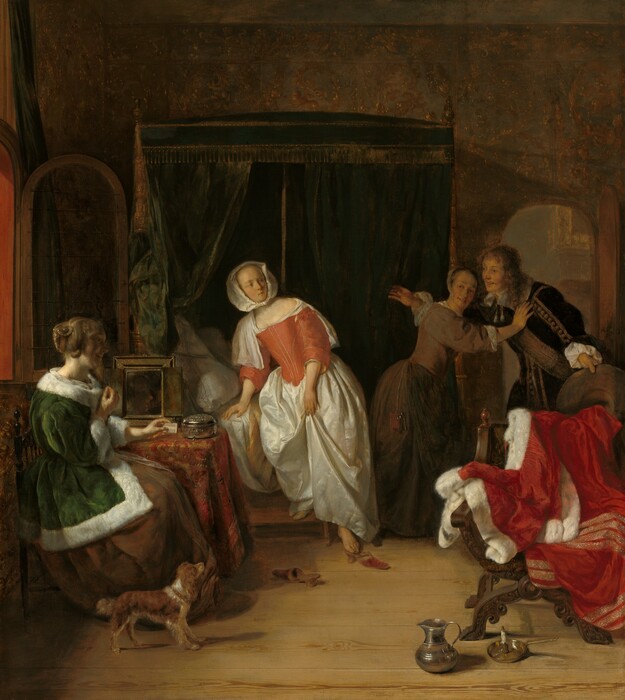
A young, smiling man bursts through the door of a dimly lit bedroom occupied by three women in this vertical painting. All four people have pale skin. The arched door is to our right and the man faces our left with his arms spread wide. He leans slightly forward as he holds the wide brim of his hat out by his left side, to our right. Shoulder-length chestnut-brown hair frames his face, and he wears a velvety brown jacket trimmed with tan stripes and pompoms down the front and along the sleeve we can see. A broad sash crosses his chest and tassels hang from his wide, white collar. Between us and him, a wooden chair is draped with a crimson-red cloak trimmed with white fur and bands of gold. A pewter pitcher and candlestick rest on the pine floor in front of it, near the lower right corner of the painting. The man is stopped at the door by a woman wearing a sable-brown gown with a tight-fitting bodice and a white cap on the back of her head. Her body faces the man as she leans toward him with her outstretched right hand resting on his shoulder, and she turns her smiling face back over her shoulder. Light from an open window on the left illuminates the woman in the center, who steps down from a bed enclosed by forest-green, velvet curtains trimmed with gold fringe and tassels. The curtains are parted behind her to reveal white pillows. She wears a long, gleaming white satin skirt topped by a tight-fitting coral-red bodice stitched with thin lines of gold. A white neckerchief covers her shoulders and is partially tucked into the bodice. Her head is covered by a white kerchief knotted under her chin. Her body faces us with one foot on a step stool, and the other foot reaches down to a gold and red shoe on the floor. Its mate lies nearby, pointing away from us. Her head is turned to our right to look at the man. She has a thin face with a high forehead, and small mouth is closed or pursed. Closest to us and near the lower left corner of the painting, the third woman sits alongside a small table under the open window. She wears a long, pine-green jacket trimmed with white fur over a brown skirt. Her auburn hair is partially coiled around her head, while some locks fall in bunched curls. She sits facing our right in profile with her back to the window, so her smiling face is mostly in shadow. Her left arm rests on the table, which is draped with a red and copper patterned cloth, and she holds a white comb in that hand. A mirror and round silver box sit on the table next to her. A small brown and white dog stands by her feet, its head tilted up to look at the others. The far wall of the room is covered with a faint pattern of golden brown vines and leaves against a forest-green background. The artist signed the painting on the face of the step leading up to the bed, “G. Metsu.”
Gabriel Metsu, The Intruder, c. 1660, oil on panel, Andrew W. Mellon Collection, 1937.1.57

The Intruder

Gabriel Metsu · c. 1660 · oil on panel ·  Accession ID  1937.1.57
The partial ruins of a stone lion on a tall pedestal stands at the edge of a body of water in a verdant green landscape in this horizontal painting. The lion statue is broken so only the back half of the body and one front paw remain. The animal’s tail winds through the back legs, and the front paw rests on a ball. The pedestal is chipped and cracked, and some of the surface on the front is worn away to show brick underneath. A pale-skinned man lies on the ground with one elbow propped on the base of the pedestal. His chest is bare. A white cloth drapes over his head, hiding much of his face, and a pale yellow cloth lies across his hips. He holds in other hand to his chest and looks down at a book propped on a rock. A wooden cross, about the length of the man’s torso, also rests against the rock. Grasses and plants cover the ground around the man. A bank of deeply shaded trees rises up the left side of the canvas. Another person sits and one more stands at the foot of the trees, both wearing tan-colored robes. The seated person has short hair and bare feet. He looks down on the open pages of a book in his lap. The standing man has a long white beard, a hooded robe, and a walking stick. The waterline curves in a sharp C to our right, from behind the lion statue to near the trees. On the far side is a low arched entrance, perhaps to a grotto. The heavy branches of a willow tree bow over the water’s surface and leafy vines hang down a rocky cliff nearby. The water winds into the distance to our right, back toward a line of trees and bushes. In the deep distance, smoke wafts out the top of a mountain, presumably a volcano. White puffy clouds float against a pale blue sky above.
Richard Wilson, Solitude, c. 1762/1770, oil on canvas, Paul Mellon Collection, 1983.1.45

Solitude

Richard Wilson · c. 1762/1770 · oil on canvas ·  Accession ID  1983.1.45

Bibliography

2013

  • Sebag-Montefiore, Charles, with Julia I. Armstrong-Totten. A Dynasty of Dealers: John Smith and Successors 1801-1924. The Roxburghe Club, London, 2013: 447.