Provenance

Edouard André

French, 1833 - 1894

Explore selected works

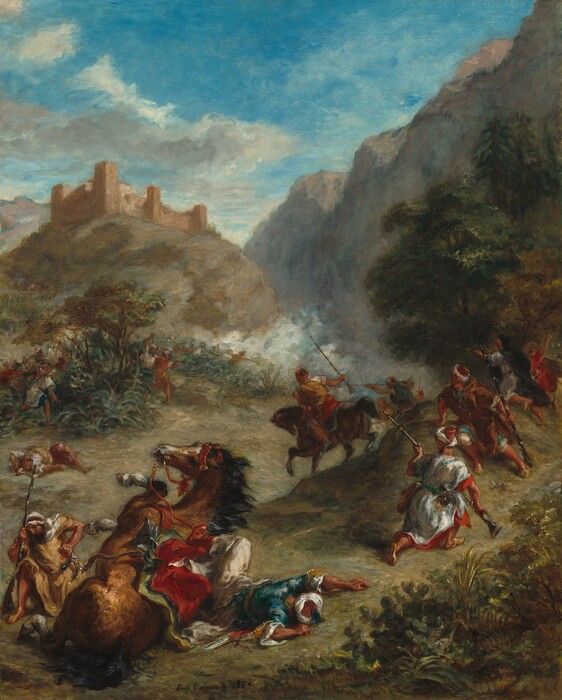
Set in a valley carpeted in sage green, about a dozen armed men, on foot and horseback, close to us, line up and face off against an attack advancing from the back left in this vertical painting. The men, clothing, and horses closest to us are painted with dashes and swirling brushstrokes, which contrasts with the soft look of the approaching crowd and landscape beyond, which are painted indistinctly with loose and blended brushstrokes. All the men we can see have medium brown skin and are armed with rifles. The men close to us wear long tunics and boots in shades of teal blue, ivory white, crimson red, earth brown, and golden yellow. Most of them wear turbans and some have straight or curved daggers hanging from their waists. Closest to us in the bottom left, a chestnut-brown horse with a black mane collapses on its rider, who sprawls along the ground with arms overhead. The horse lifts its head and twists back toward us facing our left, so the white blazes down its nose are visible. Near the horse’s legs and along the left edge of the painting, a man wearing a mustard-yellow tunic kneels and leans his forehead against the barrel of his rifle, which he braces like a walking stick. His other hand rests on the hilt of his dagger at his waist. To our right of the fallen horse, six men line up along a low rise that angles to our right and into the distance, where it meets a grove of green trees. At the front of that group, near the lower center of the composition, a rider on a dark horse charges the approaching men. Those men emerge from a line of emerald-green trees and growth at the foot of a steep, rocky hill. These men are more loosely painted so details are difficult to make out, but several are backlit by white smoke, presumably from firing their rifles. The hill above is mottled with warm taupe, light gray, cinnamon-brown, and moss-green growth. Atop the hill and to our left, a walled building complex with thick, square towers faces a row of sheer cliffs that march in from the upper right to enclose the space. Their jagged faces are shadowed with cool tones of slate blue, pewter gray, and touches of rust red. An azure-blue sky, scattered with thin layers of steel-gray and white clouds, spans the top of the composition. Bright sunlight flows in from the upper right, illuminating the fallen horse and the men near it. Sunlight also warms the face of the terracotta building and the hill, as well as the peaks of the mountains on the right. The artist signed and dated the work in black in the lower center: “Eug. Delacroix 1863.”
Eugène Delacroix, Arabs Skirmishing in the Mountains, 1863, oil on canvas, Chester Dale Fund, 1966.12.1

Arabs Skirmishing in the Mountains

Eugène Delacroix · 1863 · oil on canvas ·  Accession ID  1966.12.1
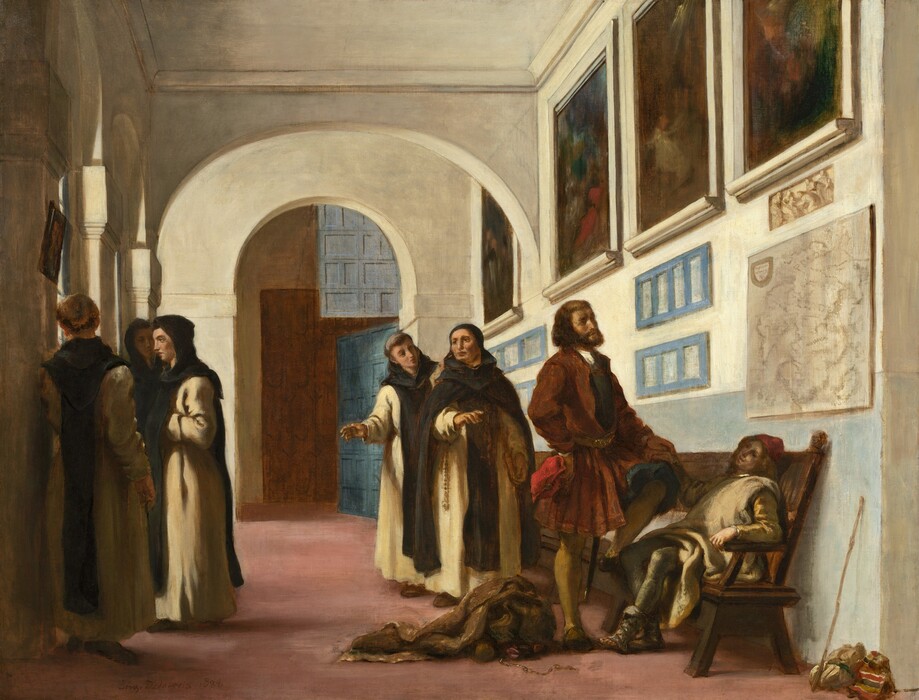
A bearded man, a young man, and five monks stand in a cream-white hall hung with a map and paintings in this horizontal painting. The people all have pale, peachy skin. The scene is lit from windows lining the wall to our left, where three monks stand, presumably talking. They and the other two monks wear long white robes with marine-blue hoods and cloth panels that hang down the fronts of the cassocks. Two monks have their hoods up and the other two have their hair cut into rings around their heads. The bearded man, Christopher Columbus, stands to the right on the other side of the hall, looking at a map hanging there. He has chin-length, dark hair and wears a bronze-brown, knee-length jacket, dark blue, knee-length pantaloons, and golden yellow stockings. His right hand, closer to us, is planted palm out against his hip, and he holds a red hat in that hand. The other foot is perched on a long bench that stretches along that wall. The young man sits and leans back on the bench with one forearm along the bench’s armrest. His other hand rests on Columbus’s knee, and Columbus rests his hand on that. The boy has long brown hair and wears a red cap, a parchment-white robe over yellow sleeves, sage-green stockings, and laced, toeless boots. Two bundles and a long stick are against the wall on our side of the bench. An object on the floor next to Columbus’s standing leg is covered by a brown cloth. A gold chain and a pink hoof protrude from the blanket. One of the monks standing behind Columbus wears a tight-fitting blue cap. A rosary hangs over his cassock from his waist, and extra panels of blue fabric drape down over his shoulders. Four paintings in our view hang near the high ceiling of the hall, which has arched openings and a pink floor. Doors or oversized shutters swing into view at the far end of the hall. The artist signed and dated the painting in the lower left corner, “Eug. Delacroix. 1838.”
Eugène Delacroix, Christopher Columbus and His Son at La Rábida, 1838, oil on canvas, Chester Dale Collection, 1963.10.127

Christopher Columbus and His Son at La Rábida

Eugène Delacroix · 1838 · oil on canvas ·  Accession ID  1963.10.127