Talks & Conversations

The Art of Looking: Ambrogio de Predis, Bianca Maria Sforza 

Shown from the waist up, a young, pale-skinned woman faces our left in profile, filling the height of this vertical portrait painting. She is brightly lit from the left and set against an inky black background. A faint eyebrow arches over the green eye we can see, and her blush pink lips are closed. Her auburn-red hair is pulled back with a few loose strands brushing her pale cheek. A cluster of jewels, like a brooch, is affixed to a thin, black band that encircles her brow, over her ear. The brooch has an azure-blue jewel over a knot of four topaz-brown gems, all set in gold. Four pink pearls hang from the bottom edge, and a banner with the words “MERITO ET TEMPORE” intertwines among the jewels along the top. Long, black loops hang from the headband to brush the woman’s shoulder. The headband wraps over an elaborate headdress that covers the back of her head like a cap. The headdress is a golden net adorned with pearls, garnets, and other gems. A thick ponytail falls down her back past her waist, and is wrapped with crisscrossing strands of black and white pearls. Her dress has a low-cut, square neckline, a tight-fitting bodice, and a flaring skirt. The fabric is patterned with stylized flowers and leaves outlined in brown against honey gold. A strand of gleaming white pearls hangs around her thin, long neck over a gold chain with a pendant made up of black and ruby-red gems. One more teardrop-shaped pearl hangs from the bottom of the pendant. A gem-studded, gold belt wraps around her waist. A red carnation is tucked into the belt near her elbow. The sleeve we can see is tied onto the bodice at the shoulder with black cord over cream-white fabric, which cascades out from the wide seams across the shoulder and down the back of the arm.
Ambrogio de Predis, Bianca Maria Sforza, probably 1493, oil on poplar panel, Widener Collection, 1942.9.53

Ambrogio de Predis’ Bianca Maria Sforza is the inspiration for this interactive conversation. Join us for a one-hour virtual session and share your observations, interpretations, questions, and ideas about this work of art.

These conversations will encourage you to engage deeply with art, with others, and with the world around you as you hone skills in visual literacy and perspective-taking. 

The program is free, open to the public, and is designed for everyone interested in talking about art. No art or art history background is required. Ages 18 and over.     

You may also like

A sky streaked with azure blue stretches over a gray landscape in this surreal, vertical painting. The sky and land meet halfway up the canvas at a series of short, sharp, charcoal-gray peaks, like canine teeth. Small, diffuse, butter-yellow ovals waft above the peaks. Nine fluffy, cotton-ball like shapes cast narrow shadows across the gray-streaked plane. Three amorphous shapes float over the land closer to us. A ginger-brown, drippy form is to our left, a teal-green, bean-shaped object surrounded with fuzzy white tentacles is to our right, and a peacock-blue, L-shaped drip floats in the distance near the horizon. Thinly painted white and gray lines squiggle or sweep onto the canvas from the left edge. The artist signed and dated the painting in the lower right, “Yves Tanguy 29.”

virtual

Talks & Conversations:  The Art of Looking: Yves Tanguy, The Look of Amber

Registration Required
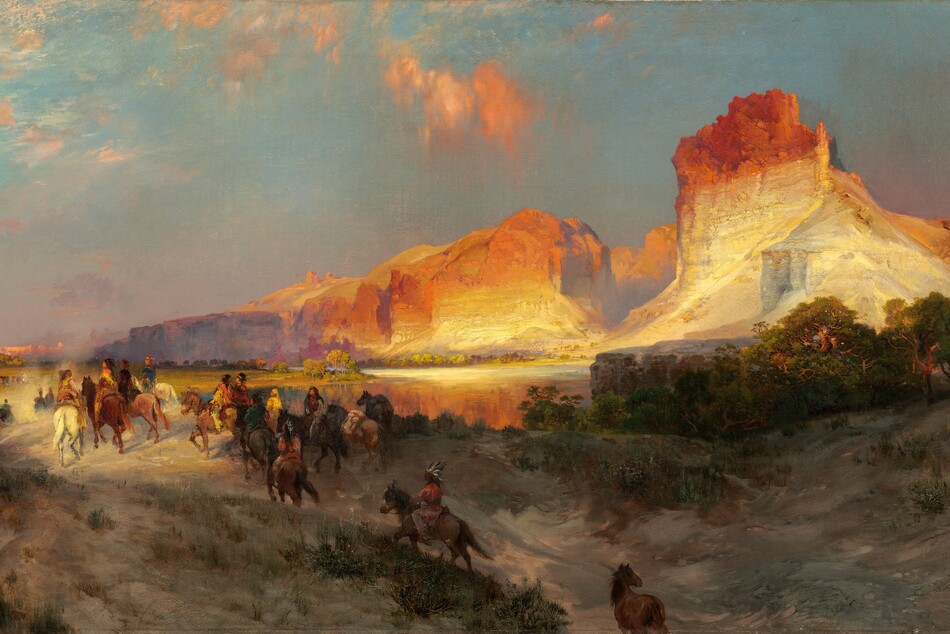
Sheer, vertical, cliffs, brightly lit in cream white and rust orange by the low sun, tower over a band of people riding horses into the distance in this long, horizontal landscape painting. The glowing cliffs dominate the upper right quadrant of the painting. They lighten from burnt orange along the jagged tops to flame orange down the steep sides, and are and warm, parchment white near the earth. One tall, narrow promontory to our right looms over a range of lower, rounded cliffs. As the cliffs move into the distance, they are shrouded with a lavender-purple haze. The land closest to us dips into a shallow valley at the bottom center of the composition, leading away from us. The dirt-packed earth is dotted with pine-green, scrubby bushes and vegetation and a grove of low, gnarled trees a short distance to our right. One chestnut-brown horse walks along the path at the bottom center of the composition, lagging behind a cluster of at least two dozen horses and riders winding into the distance. The horses range from ivory white to tawny brown and charcoal gray. The riders are loosely painted so some details are indistinct, but they all seem to have brown skin and dark hair. They wear feathered headdresses and garments in teal blue, fawn brown, or golden yellow. They ride over a low hill toward a crystal-blue river, and then back along a flat expanse toward a row of minuscule, triangular tepees lining the horizon in the deep distance. The horizon comes halfway up the composition, and the tepees are backed by a row of rose-pink, flat-topped cliffs. A pale yellow disk hangs low in the sky, over the distant cliffs. The sky above deepens from soft, lilac purple along the horizon to ice and sapphire blue along the top. A few wispy clouds are burnished orange in the sunlight. The artist signed and dated the painting in the lower right corner, “TYMoran 1881,” with the T, Y, and M overlapping to make a monogram.

Talks & Conversations:  Finding Awe: Thomas Moran’s Green River Cliffs, Wyoming 

Registration Required
Sheer, vertical, cliffs, brightly lit in cream white and rust orange by the low sun, tower over a band of people riding horses into the distance in this long, horizontal landscape painting. The glowing cliffs dominate the upper right quadrant of the painting. They lighten from burnt orange along the jagged tops to flame orange down the steep sides, and are and warm, parchment white near the earth. One tall, narrow promontory to our right looms over a range of lower, rounded cliffs. As the cliffs move into the distance, they are shrouded with a lavender-purple haze. The land closest to us dips into a shallow valley at the bottom center of the composition, leading away from us. The dirt-packed earth is dotted with pine-green, scrubby bushes and vegetation and a grove of low, gnarled trees a short distance to our right. One chestnut-brown horse walks along the path at the bottom center of the composition, lagging behind a cluster of at least two dozen horses and riders winding into the distance. The horses range from ivory white to tawny brown and charcoal gray. The riders are loosely painted so some details are indistinct, but they all seem to have brown skin and dark hair. They wear feathered headdresses and garments in teal blue, fawn brown, or golden yellow. They ride over a low hill toward a crystal-blue river, and then back along a flat expanse toward a row of minuscule, triangular tepees lining the horizon in the deep distance. The horizon comes halfway up the composition, and the tepees are backed by a row of rose-pink, flat-topped cliffs. A pale yellow disk hangs low in the sky, over the distant cliffs. The sky above deepens from soft, lilac purple along the horizon to ice and sapphire blue along the top. A few wispy clouds are burnished orange in the sunlight. The artist signed and dated the painting in the lower right corner, “TYMoran 1881,” with the T, Y, and M overlapping to make a monogram.

Talks & Conversations:  Finding Awe: Thomas Moran’s Green River Cliffs, Wyoming 

Registration Required