Talks & Conversations

The Art of Looking: Rembrandt van Rijn, The Mill

A windmill stands on a promontory cutting into a waterway under a partially stormy sky in this square landscape painting.
Rembrandt van Rijn, The Mill, 1645/1648, oil on canvas, Widener Collection, 1942.9.62

Rembrandt van Rijn’s The Mill is the inspiration for this interactive conversation. Join us for a one-hour virtual session and share your observations, interpretations, questions, and ideas about this work of art.

These conversations will encourage you to engage deeply with art, with others, and with the world around you as you hone skills in visual literacy and perspective-taking.

The program is free, open to the public, and is designed for everyone interested in talking about art. No art or art history background is required. Ages 18 and over.

You may also like
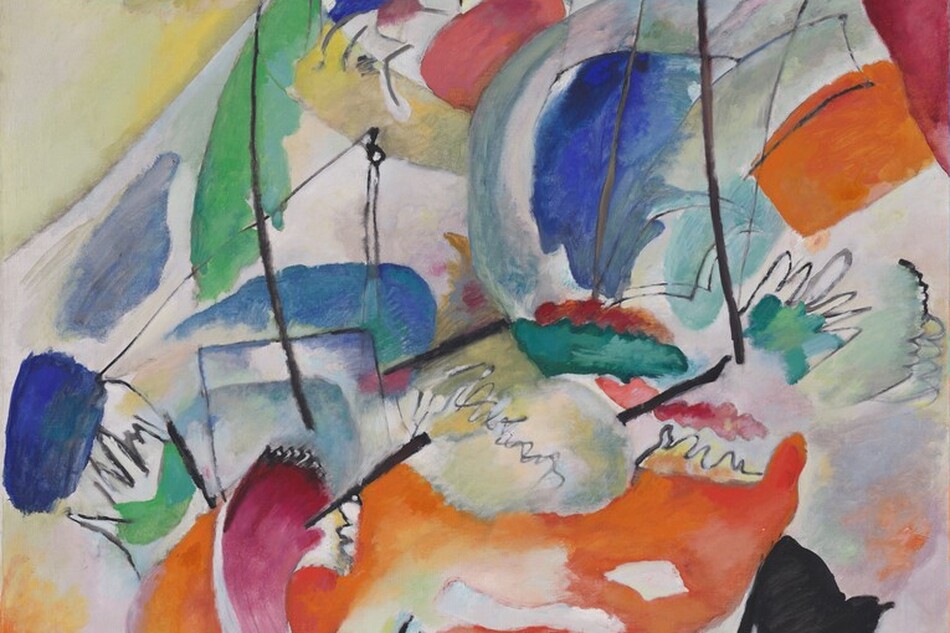
Black lines and one small, black triangular shape stand out against patches of color, in indigo and sky blue, pumpkin orange, butter yellow, emerald green, and ruby red, against a white background in this vertical, abstract painting. The paint seems thinly applied, resembling watercolor. Near the lower right corner, the black shape is roughly triangular and has five curving, parallel lines emanating from the bottom. Given the title of this painting, Improvisation 31, Sea Battle, the black lines could represent tall masts and outlines of sails amid areas of vibrant color that make up a boat and water around it.

Talks & Conversations:  The Art of Looking: Wassily Kandinsky, Improvisation 31 (Sea Battle)

Registration Required
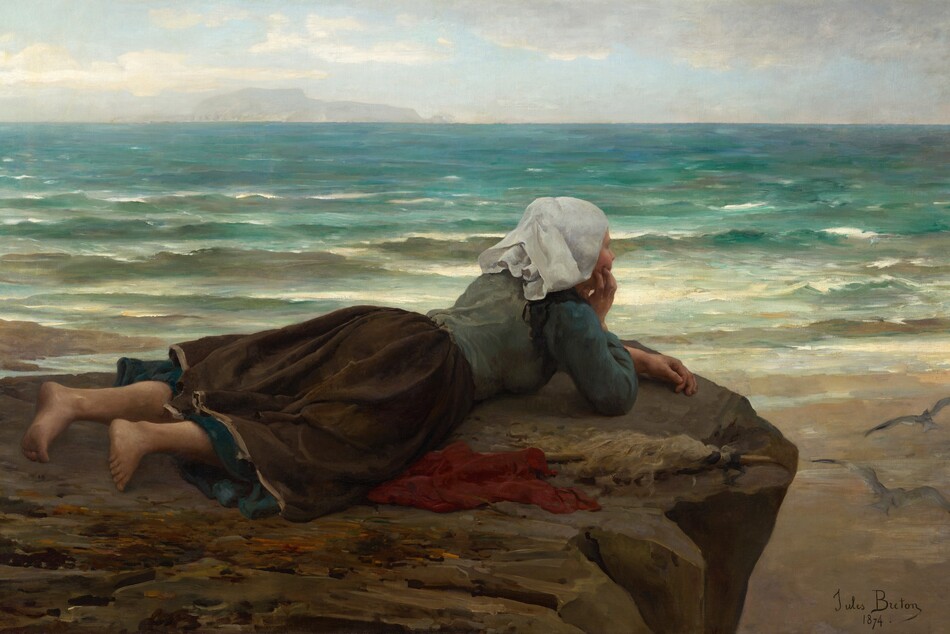
This painting shows a young woman lying on her stomach on a brown, rocky surface near the water's edge, looking towards the sea. The woman's bare feet are towards the bottom left corner of the painting, while her head is in the center, resting on her hand. She faces the right, and we see her back and side. She wears a pale green shirt with blue sleeves, a brown skirt, and a white cloth on her head. There is a red cloth on the ground next to her, as well as a pointed wooden stick that appears to be covered in white strips of cloth or feathers. The ground below her on the right is a tan, sandy color, and behind her is the sea, which is painted in vibrant turquoise and green shades, with white lines capping small waves. The sky is light blue with puffy white clouds, and distant landforms are visible in light gray across the water.

Talks & Conversations:  The Art of Looking: Jules Breton, The Cliff (La Falaise)

Registration Required
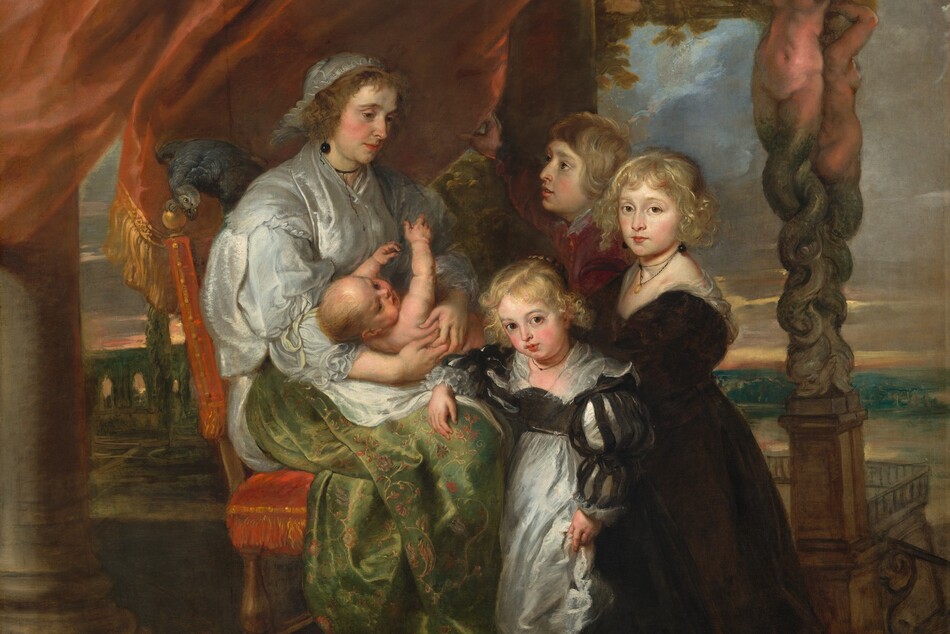
A seated woman with an infant on her lap and three children are clustered on a terrace overlooking green hills and a body of water in this square painting. They all have pale skin with flushed cheeks. The group is centered in the composition, and the woman sits to our left, facing our right, almost in profile. The wooden chair is upholstered in scarlet-red fabric and a large slate-blue bird perches on the backrest. Gold-edged, red drapery hangs behind the woman, suspended from stone columns on either side of her. The woman’s brown hair is covered by a frilly, silvery-gray cap with a matching shawl layered over a short, three-quarter sleeve jacket. Her fern-green skirt, covered with a pattern of coral-red flowers and gold vines, gleams in the soft light coming from behind us. A thin black band encircles her neck, and a round, black earring dangles from the ear we can see. She bows her head slightly and gazes down at the children. The infant lies across her lap with its head coming toward us, its chubby arms reaching up to the woman while turning to look at the three standing children. They appear to be a young boy and two girls, and they all have blond hair, large brown eyes, and delicate rose-red mouths. They crowd together at the woman’s knees. The boy is taller than the girls and stands behind them, visible from the shoulders up. He is dressed in red garments and stands almost in profile to gaze up at the woman. The girls turn their heads to look directly at us. At the center of the trio, the taller girl wears a long, voluminous brown gown. Her hair is pulled back and long ringlets frame her face. She also wears round black earrings and two delicate black cords around her neck, one of which holds a gold ring. At the front, the shortest girl wears a black and white gown with a sheer neckerchief along neckline, and she rests one arm across the woman’s lap. The girl’s long, puffy, black sleeves are slashed to create openings for white fabric to show through. Her hair is also upswept with ringlets framing her face. To the right of the group is a column made of two creatures with pink female heads, faces, and nude torsos with scaly, olive-green, twisting, snake-like legs. One creature faces us and the other faces our right. The sky beyond the terrace is filled with clouds that transition from slate gray at the top to tan and rust orange where it meets the distant hills.

Talks & Conversations:  The Art of Looking: Sir Peter Paul Rubens, Deborah Kip, Wife of Sir Balthasar Gerbier, and Her Children

Registration Required