Talks & Conversations

Book Launch—Talking Classics: The Shock of the Old

In honor of her newest book, Talking Classics: The Shock of the Old, join us for a conversation between Mary Beard, distinguished classicist, international bestselling author, and beloved television personality, and National Gallery director Kaywin Feldman. This witty, approachable book asks why—for better or (sometimes) worse—antiquity continues to exert such a powerful hold on the contemporary imagination. 


A book signing will follow in the East Building Gallery Shop.   

Mary Beard

Mary Beard is professor emerita of classics at the University of Cambridge, a fellow of Newnham College, and professor of Ancient Literature at the Royal Academy, as well as being the classics editor of the Times Literary Supplement, a fellow of the British Academy, and an international member of the American Academy of Arts and Sciences. Her books include SPQR: A History of Ancient Rome, Women and Power: A Manifesto, Twelve Caesars: Images of Power from the Ancient World to the Modern, and Emperor of Rome: Ruling the Ancient Roman World. 

Kaywin Feldman

Kaywin Feldman is the National Gallery’s fifth director and the first woman to lead the museum. Her vision for the National Gallery focuses on expanding the museum’s service to the nation. Dedicated to connecting people to art through the power of wonder, Feldman has initiated new programs and exhibitions, expanded the National Gallery’s audience, and increased the national collection through acquisitions that reflect a wider spectrum of art history. 

You may also like

Six black, wedgelike shapes, one dark blue arrowhead shape, and six red triangular shapes with rounded corners are connected with thin rods to form this abstract sculpture. In this photograph, we look up at the piece to where it hangs from the glass ceiling of a light-filled interior space with marble walls. The paddle-like shapes are attached to the end of the curved rods, which are linked together like branches. In our view, the black arm curves up across the top of the picture and the red arm curves down into the lower right corner, and to our left. Each red paddle is smaller as they move from the central armature to the end of the branch.

Talks & Conversations:  Art for the People: Public Sculpture and Calder's Monumental Last Works

–
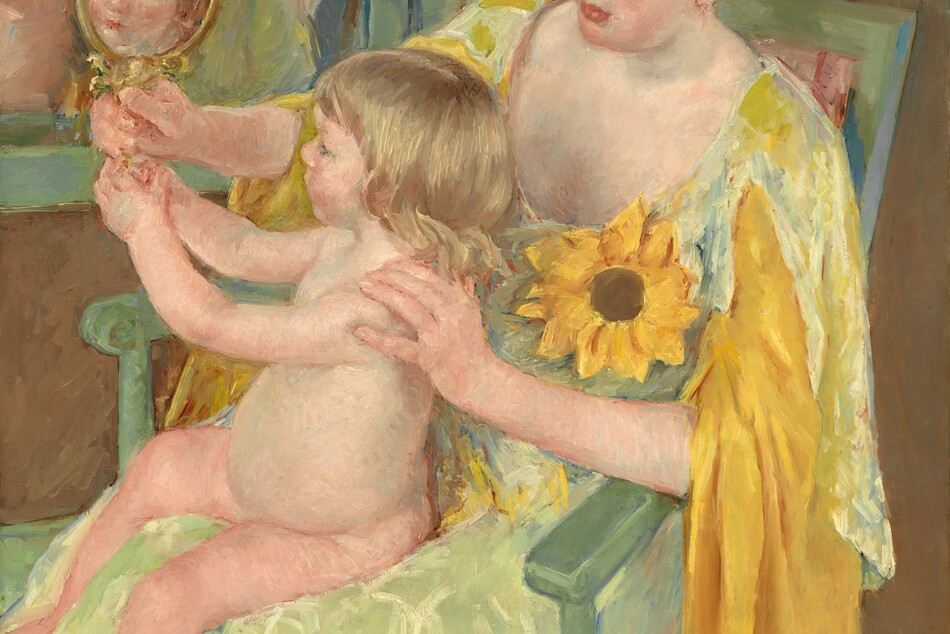
We look slightly down onto a woman dressed in golden yellows, sitting in a pale green chair, with a nude child sitting in her lap as they both gaze into a mirror in this vertical portrait painting. Both the people have pale, peachy skin. The chair is angled to our left so the woman’s knees and child cant down toward the lower left corner of the composition, and the woman leans onto the arm closer to us. The chair is painted mint green and the rose-pink upholstery is visible on the seat and a corner behind the woman’s shoulder. To our right, the woman’s vibrant, copper-colored hair is pulled loosely to the back of her head. She has a rounded nose, flushed cheeks, and her full, coral-pink lips are closed. Her long dress has a low, U-shaped neckline. The fabric shimmers from pale, cucumber green to light sunshine yellow. The sleeves of the dress split over the shoulder and a second long, goldenrod-yellow sleeve falls from her elbow off the bottom edge of the canvas. An oversized sunflower, larger than the woman’s face, is affixed to her dress near her left shoulder, closer to us. She looks with dark eyes down toward the small, gold-rimmed mirror she holds in her right hand, farther from us. The child also holds the handle of the mirror with both hands, and in the reflection, the child looks back at us with dark eyes, a button nose, and pink lips. The child’s hair in the reflection is the same copper color as the woman’s, but the child on her lap has blond, shoulder-length hair. The woman rests one hand on the child’s left shoulder, closer to us. The child has a rounded belly and smooth, rosy limbs. The woman and child are reflected in a second mirror hanging on the wall alongside them, opposite us. Their reflections are very loosely painted. The wall behind the pair is sage green across the top and it shifts to fawn brown across the bottom. Brushstrokes are visible throughout, especially in the woman’s dress and hair, and are more blended in the bodies and faces. The artist signed the painting in the lower right corner, “Mary Cassatt.”
virtual

Talks & Conversations:  The Art of Looking: Mary Cassatt, Woman with a Sunflower

–
Registration Required
A smiling young child holds the latch of an open wooden door as she looks toward a woman to our right in this almost square painting. The woman and child both have pale skin and stand in a bedroom. To our left, the child is the same height as the door handle, and she faces us. Her blond, upswept hair is backlit, and light falls on her from windows to our left. She turns to look at the woman with dark eyes, a slight smile on her pink lips. She wears a garment with a mauve-gray bodice and sleeves, a sage-green apron over a honey-yellow, ankle-length skirt, and dark shoes. She holds the ring of the door latch with her right hand, to our left, and holds a ball by her side in her other hand. The room has white walls with thick wood beams above, wood molding around the door and window, and a clay-red tiled floor. On the wall to either side of the girl and about the same height as she is, white tiles painted with scenes in azure blue line the walls. Wooden chairs to either side of the door have lion-shaped finials and a diamond pattern on the cloth-covered backs. A landscape painting in a black frame hangs over the door, and a wood table covered with a red cloth, holding a ceramic jug, sits to our left, along the wall coming toward us. The rightmost third of the composition is spanned by a bed set within a ceiling-high, cabinet-like enclosure. The woman stands in front of the bed, her body facing our left in profile. A white kerchief covers her hair and is tied under her chin. She wears a red shirt with white at the chest and cuffs, which are rolled back. A marine-blue skirt falls to her ankles. She holds a brown cloth in front of her, and another cloth is draped over a chair. A gleaming, squat, brown jug sits on floor nearby. A forest-green curtain lines the squared opening to the bed, and another green curtain is pulled to one side of a window next to the open door. Through the door and window, we see a second door across a shallow entryway, which leads outside. Both halves of the outer, Dutch door are open, though the top half swings in a little more than the bottom half. The space beyond has a fence or trellis, green plants, and the edge of a red roof.
virtual

Talks & Conversations:  The Art of Looking: Pieter de Hooch, The Bedroom

–
Registration Required