Puellae (Girls)

1992

Magdalena Abakanowicz

Associated Names
Magdalena Abakanowicz

Sculptor, Polish, 1930 - 2017
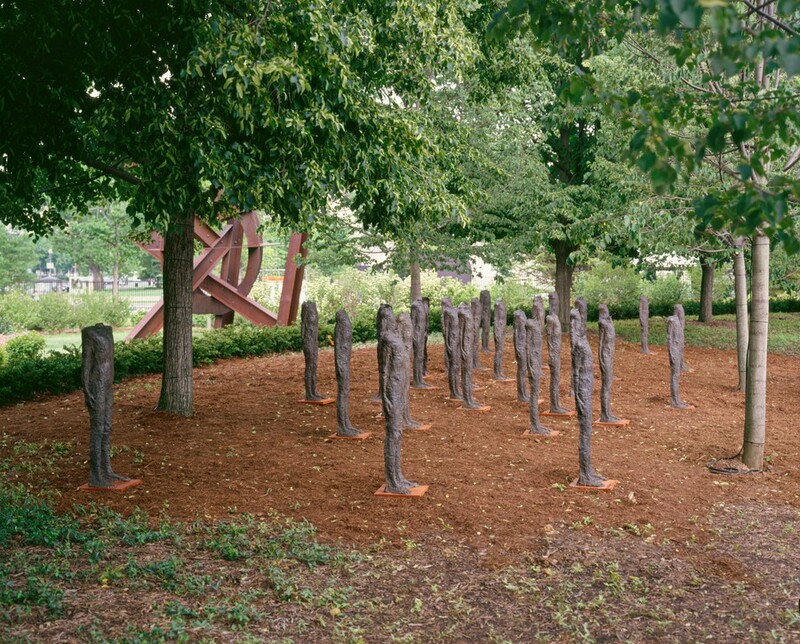
Twenty-one, free-standing, bronze sculptures of headless people are arranged under the green canopies of trees in this horizontal photograph. The earth-brown surfaces of the sculptures are rough. In this view, they cluster together at various distances from each other, and the bodies of all are angled to our right. They stand erect with their legs together and arms pressed tightly along their sides. From this angle, one person is positioned farther from the rest, to our left. Each person stands on a square base that sits on the ground, which appears to be fine mulch or pine needles. Six trees are spaced around the group, and together their canopies fill the top third of this photograph. Beyond the trees is a low, green hedge that encloses the whole group. Sunlight illuminates the front, right-hand surfaces of the sculptures.
This object’s media is not available for download. Contact us about image usage.

The sculpture of Polish artist Magdalena Abakanowicz is largely drawn from her experience of World War II and its aftermath. She is best known for her "crowds" (as she calls them) of headless, rigidly posed figures whose anonymity and multiplicity have been regarded as the artist's personal response to totalitarianism.

Each of the thirty bronzes in Puellae (meaning "girls" in Latin) is unique, made from individually sculpted wax forms based on a body cast of a single child model. Abakanowicz applied burlap to each of the forms prior to casting to give them a rough, organic texture. This work refers to an account the artist heard while growing up in Poland about a group of children who froze to death as they were transported in cattle cars from Poland to Germany during the war.

On View

Sculpture Garden, Northeast Quadrant


Artwork overview

More About this Artwork

Shown from the shins up, two elegantly dressed women and two young boys, all with light skin, sit together on a bench in front of a stone balustrade with a forest landscape beyond in this horizontal portrait painting. The people are brightly lit from our left but the darkened sky suggests dusk. The boys lean onto the woman at the center of the composition, and the second woman sits to her right, our left. All of the people have pale skin, rosy cheeks, delicate noses, and their pink lips all turn up in slight smiles. The woman on our left sits with her body angled toward her friend but she turns her face to look at us with brown eyes under curving brows. Her wavy, flint-gray hair is loosely bound up so it frames the sides of her face and curls over her shoulders. Her swirling, white head covering is edged in gold and tied in a bow over her left ear, on our right. Her long-sleeved dress has a tight-fitting bodice and a low, scooped neckline lined with pleated white fabric. Her dress shimmers from sapphire blue to dusky pink, suggesting it is iridescent taffeta. Large pearls hang off the end of round, gold, hoop earrings, and a glimmering gold sash is tied around her waist. She sits with her left hand resting on her friend’s right shoulder, closer to her, and she gestures toward one of the young boys leaning on the friend’s lap with her other hand. The second woman sits with her body facing us, and she looks off to our left with gray-blue eyes. Her silvery gray, upswept hair is covered with a long piece of white fabric with pink stripes, twisted loosely into a turban-like head covering. She wears dangling gold earrings, and her dress is striped with parchment white and rust red. Her right hand, on our left, rests on her friend’s knee, and her other arm is wrapped around the older boy. He kneels on the bench and leans forward, wrapping the arm we can see around her torso. His face near hers, he looks up at her from under his lashes. A dimple marks the flushed cheek we can see. His chestnut-brown hair falls around his shoulders, and he wears a gingerbread-brown suit. The smaller and younger of the two boys rests his head on his crossed hands on her thigh, and looks out at us. He wears a white garment with a lilac-purple sash tied in a bow around his waist. There is a pale pink rosebush in the lower right corner of the painting, near the kneeling boy’s foot. The landscape beyond the balustrade is filled with dark green trees against a slate-blue sky. The painting is created with blended brushstrokes, giving it a soft look.

Article:  Your Tour of Women Artists at the National Gallery

See these 10 works by trailblazing women artists during your next visit.


Artwork history & notes

Provenance

(Marlborough Gallery, Inc., New York); purchased 1 February 1999 by NGA.

Associated Names

Bibliography

2013

  • Cigola, Francesca. Art Parks: A Tour of America’s Sculpture Parks and Gardens. New York: Princeton Architectural Press, 2013: 101.

Inscriptions

on rear, the artist's symbol, with the date

Wikidata ID

Q63861949

You may be interested in

Loading Results