


Empire Triumphant over Avarice
1610
Adriaen de Vries
Artist, Netherlandish, c. 1556 - 1626
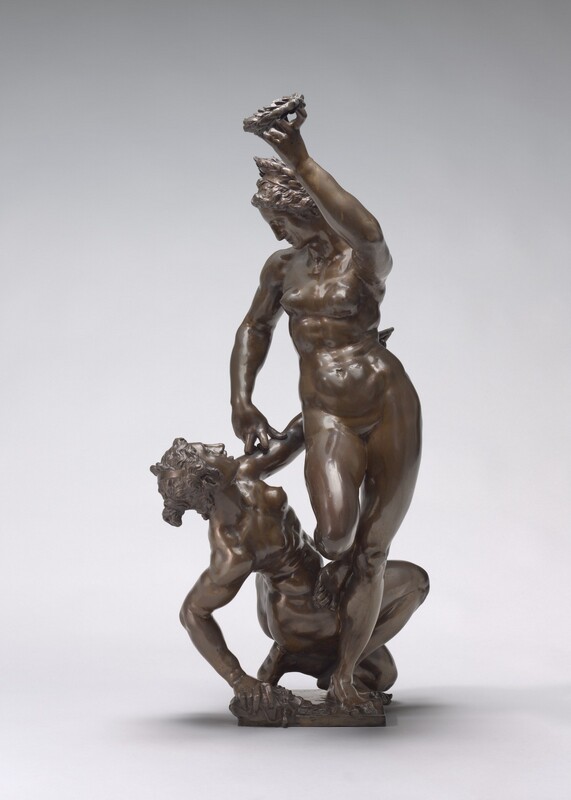
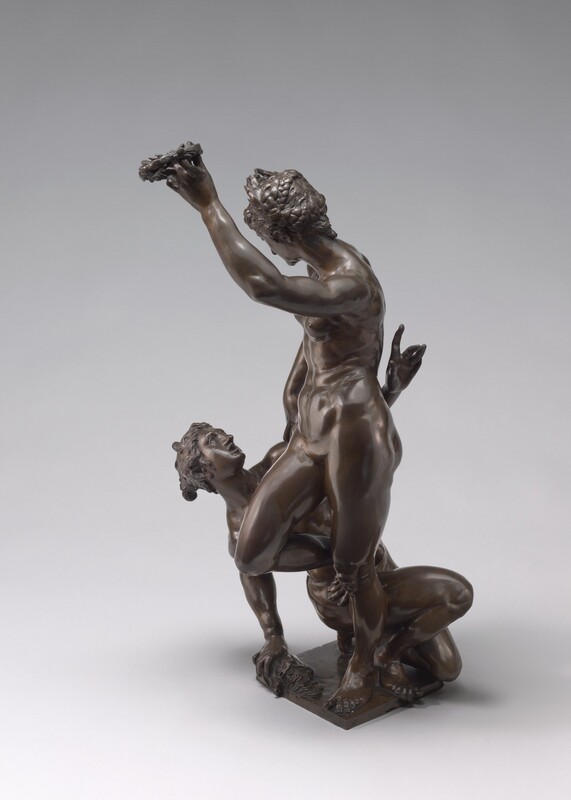
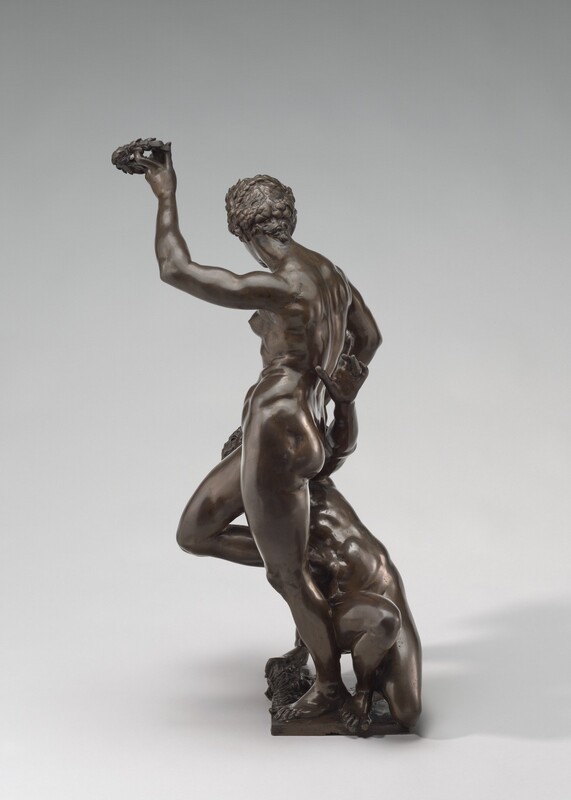
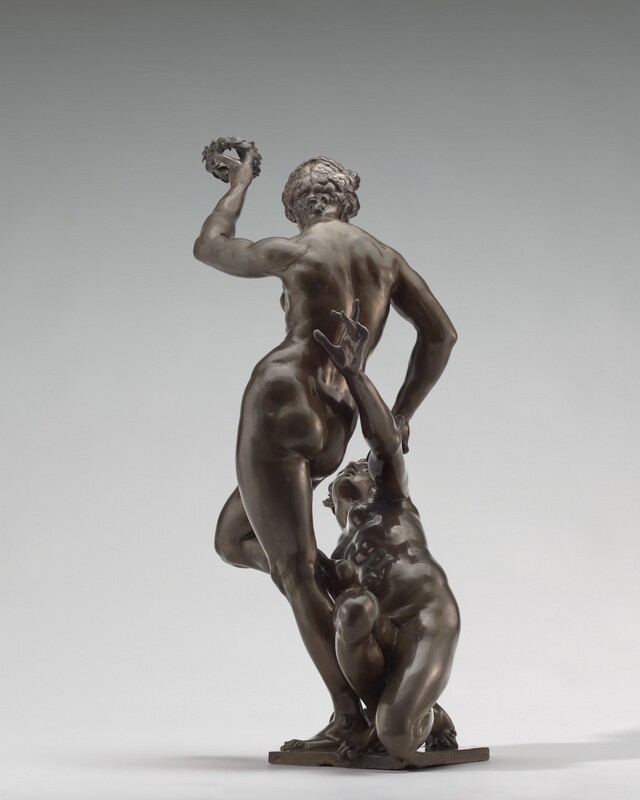
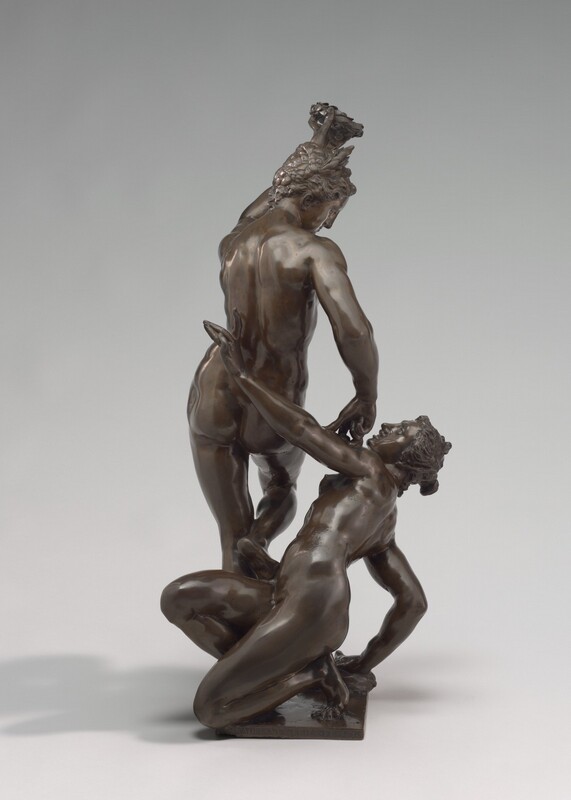
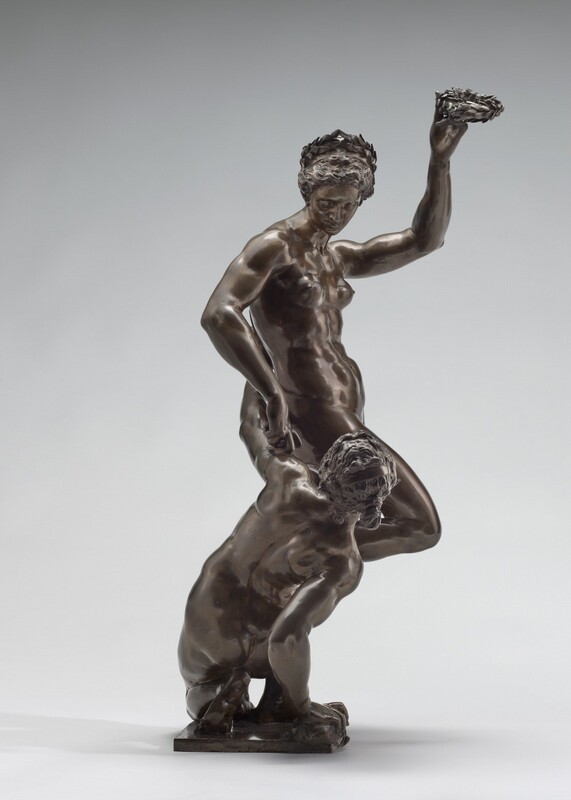
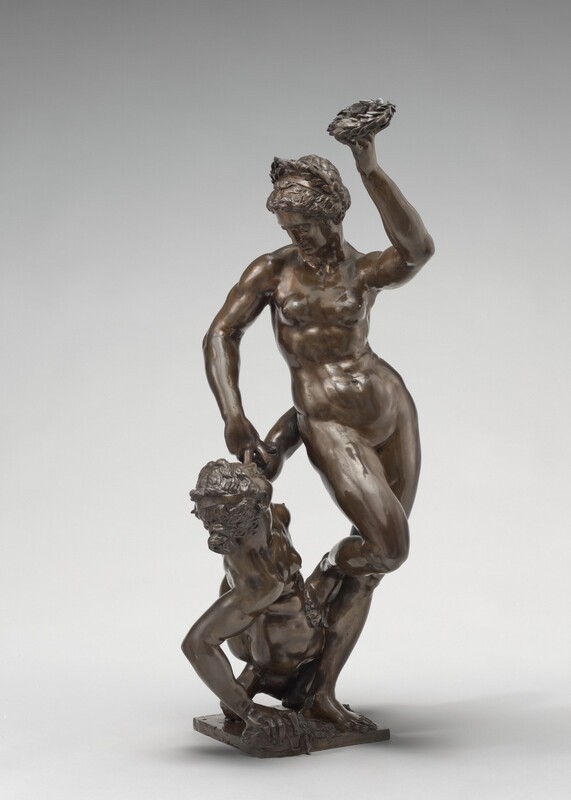
Adriaen de Vries won international fame for active bronze figures that reflect both his study of nature and his training in Florence with Giovanni Bologna, the greatest 16th-century sculptor after Michelangelo. De Vries's complicated poses continued the style known as mannerism, but he also saw ancient bronze sculpture as a model to surpass. He devised this group for Emperor Rudolph II, who had appointed him court sculptor in Prague in 1601. The figures were cast in one pour, a feat the emperor, fascinated with transformations in metal and other materials, would have appreciated. De Vries gave psychological force to this allegory through the rippling tension of the figures and the gaze that passes between them.
West Building, Main Floor, Gallery M21
Artwork overview
-
Medium
bronze
-
Credit Line
-
Dimensions
overall: 77.3 x 34.8 x 31.8 cm (30 7/16 x 13 11/16 x 12 1/2 in.)
-
Accession Number
1942.9.148
Artwork history & notes
Provenance
Rudolf II, Holy Roman Emperor [1552-1612], Prague.[1] By 1880, Baron François Florentin Achille Seillière [1813-1873], Château de Mello, Oise, France;[2] (his estate sale, George Petit, Paris, 5-10 May, 1890, no. 452); George Charles Spencer-Churchill, 8th Duke of Marlborough [1844-1892], Blenheim Palace; by inheritance to his son Charles Richard John Spencer-Churchill [1871-1934];[3] purchased 1906 by Peter A.B. Widener [1834-1915], Lynnewood Hall, Elkins Park, Pennsylvania;[4] inheritance from Estate of Peter A.B. Widener by gift through power of appointment of Joseph E. Widener, Elkins Park, Pennsylvania; gift 1942 to NGA.
[1] The bronze shows up in an inventory of Rudolf II’s Kunstkammer drawn up between 1607 and 1611, described as Ein gruppo di bronzo von Adrian de Fries, ist ein nacket weiblin, helt ein lorberkrantz in der hand endtbor, das imperium triumphante bedeuttendt, under ihren füssen ligt ein ander weib mit einem beuttel vol gelt, bedeut die Avaritia (A bronze group by Adrian de Fries is a small nude woman holding a laurel wreath aloft, representing the Triumphant Empire, under her feet lies another woman with a purse full of money, representing Avarice). See Rotraud Bauer and Herbert Haupt, ed., “Das Kunstkammerinventar Kaiser Rudolfs II, 1607-1611,” Jahrbuch des Kunsthistorischen Sammlungen in Wien, 72 (1976): 104, no. 1978).
[2] The owner is given as MM Seillière, château de Mello, in Germain Bapst, Le musée retrospectif du metal à l'exposition de l'Union centrale des beaux-arts, 1880, Paris 1881: repro. opposite 58, as La gloire terrassant la vertu, 63.
[3] According to the 1998 Rijksmuseum exhibition catalogue, Adriaen de Vries, 1556-1626 (Amsterdam, 1998: 179, no. 24), the bronze was at Blenheim from 1890-1906.
[4] The 1935 Widener estate inventory of the objets d’art at Lynnewood Hall gives the provenance of the Duke of Marlborough without a date of transfer to Widener, but an even earlier typewritten manuscript from the Widener estate titled “An Allegorical Bronze Group Work of Art of the Early XVII Century By Adriaen de Vries 1650-1627…” annotated with the date 1914 (NGA curatorial file) suggests that the work was acquired in 1906 directly from Blenheim.
Associated Names
Exhibition History
1988
Prag um 1600: Kunst und Kultur am Hofe Rudolfs II, Kulturstiftung Ruhr, Villa Hügel, Essen-Bredeney, Federal Republic of Germany; Kunsthistorisches Museum, Vienna, Austria, 1988, no. 60, repro.
1993
Dawn of the Golden Age: Northern Netherlandish Art 1580-1620, Rijksmuseum, Amsterdam, 1993-1994, no. 182, repro., as Allegory of the Triumph of Virtue over Vice.
1997
Rudolf II and Prague: The Imperial Court and Residential City as the Cultural and Spiritual Heart of Central Europe, Prague Castle Picture Gallery, 1997, no. I.129.
1998
Adriaen de Vries (1556-1626), imperial sculptor, Rijksmuseum, Amsterdam; Nationalmuseum, Stockholm; J. Paul Getty Mus., Los Angeles, 1998-2000, no. 24, repro., as Allegory of Imperium triumphant over Avaritia (shown only in Stockholm and Los Angeles)
2013
L'Europe de Rubens, Musée du Louvre-Lens, 2013, no. 140, repro.
Bibliography
1942
Works of Art from the Widener Collection. Foreword by David Finley and John Walker. National Gallery of Art, Washington, 1942: 9, as Virtue and Vice.
1948
Paintings and Sculpture from the Widener Collection. National Gallery of Art, Washington, 1948 (reprinted 1959): 157, repro., as Virtue and Vice.
1949
Seymour, Charles. Masterpieces of Sculpture from the National Gallery of Art. Washington and New York, 1949: 182, note 48, repro. 147, 149-151, as Virtue and Vice.
1957
Shapley, Fern Rusk. Comparisons in Art: A Companion to the National Gallery of Art, Washington, DC. London, 1957 (reprinted 1959): pl. 54.
1965
Summary Catalogue of European Paintings and Sculpture. National Gallery of Art, Washington, 1965: 173, as Virtue and Vice.
1968
National Gallery of Art. European Paintings and Sculpture, Illustrations. Washington, 1968: 153, repro., as Virtue and Vice.
Seymour, Charles, Jr. "The Mercury in the Rotunda of the National Gallery of Art." Studies in the History of Art (1968-69):1-25, repro.
1978
Kaufmann, Thomas Dacosta. "Empire Triumphant: Notes on an Imperial Allegory by Adriaen de Vries." Studies in the History of Art vol. 8 (1978):63-75, repro.
1984
Walker, John. National Gallery of Art, Washington. Rev. ed. New York, 1984: 639, no. 1004, repro.
1992
National Gallery of Art, Washington. National Gallery of Art, Washington, 1992: 296, repro.
1994
Sculpture: An Illustrated Catalogue. National Gallery of Art, Washington, 1994: 235, repro.
2000
National Gallery of Art Special Issue. Connaissance des Arts. Paris, 2000: repro. 58, 59, 61.
Inscriptions
on base: ADRIANUS FRIES FE 1610
Wikidata ID
Q63809169