


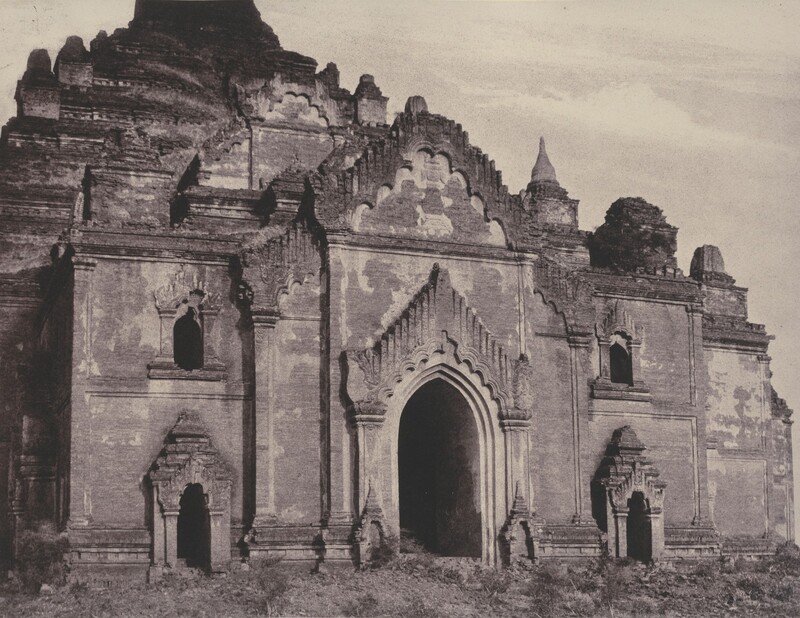
Pugahm Myo: East Facade of Damayangyee Pagoda
August 20–24, 1855
Linnaeus Tripe
Artist, British, 1822 - 1902

Artwork overview
-
Medium
albumen silver print
-
Credit Line
-
Dimensions
image/image: 26.5 × 34.3 cm (10 7/16 × 13 1/2 in.)
mount: 45.6 × 58.3 cm (17 15/16 × 22 15/16 in.) -
Accession Number
2012.87.24
-
Series Title
Burma Views
Artwork history & notes
Provenance
Linnaeus Tripe [1822-1902]; presented to James Broun-Ramsay, 1st Marquess of Dalhousie [1812-1860], Governor-General of India [1848-1856], February 1857; by descent to the Broun-Ramsay family; (sale, Sotheby's, London, 9 May 2012, part of lot 211); NGA purchase (through Hans P. Kraus, Jr., Inc., New York), 2012.
Associated Names
Inscriptions
signed by artist, lower right on print in black ink: L. Tripe; printed in typeset on white paper adhered to mount, lower center beneath photograph in black ink: No. 21. Pugahm Myo. East facade of Damayangyee Pagoda. / The Pagoda of which this is a part, is one of the best examples of design, and in some parts of it, of workmanship at Pugahm. It is about 30 feet larger in length and breadth than Thapinyu. It is very ruinous. In the / vestibule on the East face, the vaulting of brickwork has been laid bare, and shows less careful work in that important part, than in the walls below. This, with its having been more neglected than the other / temples, may account for its dilapidated condition. The central aisles have been blocked up, but not so carefully as to escape notice. This shuts up all the centre of the building; / for what purpose is unknown. A strong wall 12 feet high, surrounds it. It dates from about the Year 1154 A. D.
Markings
artist’s blindstamp on mount, upper center: BY THEE I DRAW
Wikidata ID
Q64157503