


Night and Day
1993
Duwawisioma (Victor Masayesva Jr.)
Artist, Hopi Tribe, born 1951
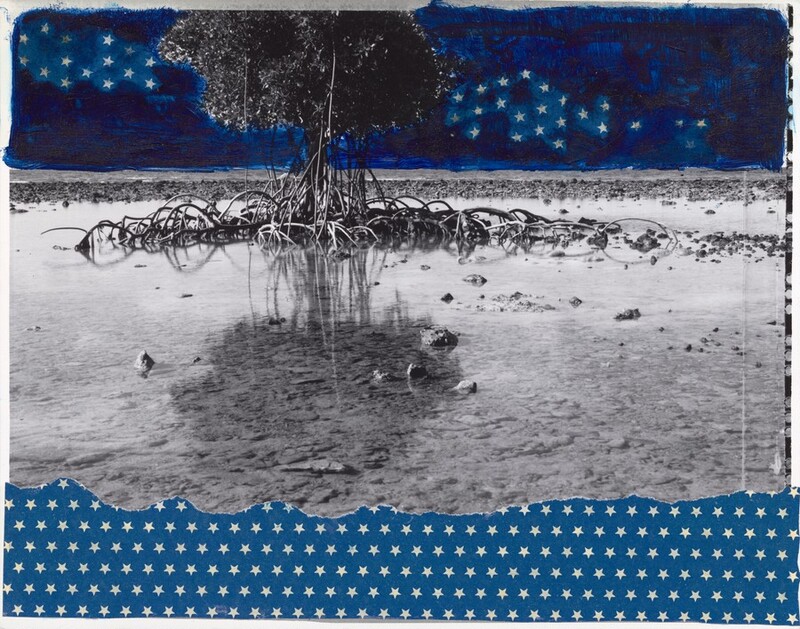
Hopi artist Victor Masayesva Jr.’s photographs and videos are often about the landscape and the place most related to his ancestry. When he photographed a rural patch of land in somber black and white, as in Night and Day, he was subverting the traditional aesthetic notion of the beautiful western landscape. Here he was concerned with the representation of Native American cultures, their close connections to time and the land, and how the media and many photographers have customarily portrayed his own Hopi community. Masayesva pushes these subjects to the surface by focusing on a detail of the landscape, where beauty may be inferred in the soft, wavy reflection of a ghostly tree in water. He refuses to allow a view of the horizon by painting the sky a deep, textured ultramarine blue, with collaged tissue paper stars peeking through to the surface of the picture. The foreground, also made from pasted stars, creates an illusory window between the sky and the surface of the photograph through which to view his highly personal impression of the landscape. The stars suggest the night sky and echo the blue field on the US flag, symbolizing American culture overlaying the land. “Time is based on the sun in the West, where God is an astronomer and a scientist, and on the moon among indigenous peoples, for whom God is a farmer,” says the artist. “Which is truer—a sun that is stable as it can be in a continually discovered universe or a moon that waxes and wanes in our imagined, complete, nighttime-only universe?”
Artwork overview
-
Medium
gelatin silver print, oil paint, and paper
-
Credit Line
Corcoran Collection (Gift of Julia J. Norrell in honor of Paul Roth, 2006)
-
Dimensions
image/sheet: 27.94 × 35.24 cm (11 × 13 7/8 in.)
-
Accession Number
2016.22.160
Artwork history & notes
Provenance
Julia J. Norrell, Washington, DC; gift to the Corcoran Gallery of Art, Washington, DC, 2006; acquired by NGA, 2016.
Associated Names
Exhibition History
2004
Common Ground: Discovering Community in 150 Years of Art, Selections from the Collection of Julia J. Norrell, Corcoran Gallery of Art, Washington, DC, October 23, 2004 – January 31, 2005
Bibliography
2004
Brookman, Philip et al. Common Ground: Discovering Community in 150 Years of Art, Selections from the Collection of Julia J. Norrell. Exh. cat. Corcoran Gallery of Art, Washington, 2004: 25, 178, no. 108.
Inscriptions
on verso, signed by artist, bottom right in graphite: "Night + Day" Victor Masayesva / 7.93; by unknown hand, bottom center: VMC/049; by Corcoran Gallery of Art, vertical along bottom right corner: 2006.014.010
Wikidata ID
Q64171449