


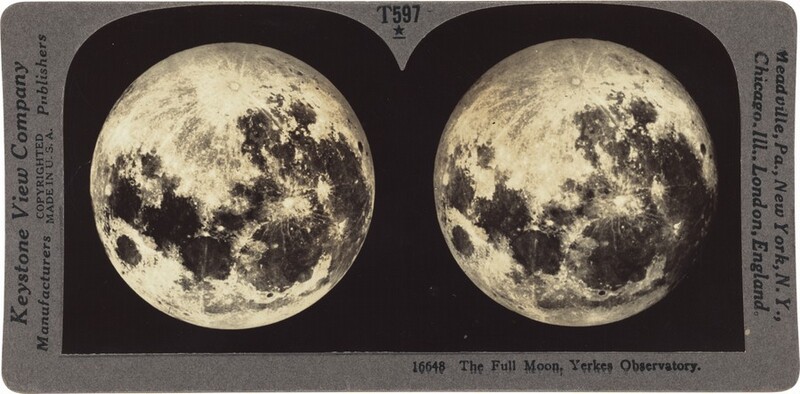
"The Full Moon. Yerkes Observatory."
after 1897
Keystone View Company
Artist, American, 1892 - 1963
Artwork overview
-
Medium
stereoscopic albumen silver print
-
Credit Line
-
Dimensions
image (each): 7.7 × 7.6 cm (3 1/16 × 3 in.)
sheet: 7.7 × 15.2 cm (3 1/16 × 6 in.)
mount: 8.8 × 17.8 cm (3 7/16 × 7 in.) -
Accession Number
2018.21.6
Artwork history & notes
Provenance
Mary and Dan Solomon, Monarch Beach, CA; gift to NGA, 2018.
Associated Names
Exhibition History
2019
By the Light of the Silvery Moon: A Century of Lunar Photographs, National Gallery of Art, Washington, 2019 - 2020, unnumbered catalogue.
Inscriptions
along left edge of mount printed in black ink: Keystone View Company / Manufacturers COPYRIGHTED / MADE IN U.S.A. / Publishers; top center: T597 / [underlined star]; along right edge: Meadville, Pa., New York, N. Y., / Chicago, Ill., London, England.; bottom right: 16648 The Full Moon. Yerkes Observatory.; on verso, center printed in black type: 594--(16648) / THE FULL MOON / This photograph of the moon shows clearly that / the moon is round or, to say it more correctly, / the moon is an almost perfect sphere. The moon / does not shine by its own light as the sun does. / Instead the moon shines by light reflected from / the sun. The sun shines on the moon and then / the moon sends the light on to us. You have / probably caught sunlight in a mirror and sent / it on, in just the same way. / When the moon is in such a position that the / whole face sends light to us, it looks round and / we call it a "full" moon. This view is of a full / moon. At other times the moon is in different/ positions and only part of its face sends light to us. Then we say the moon is new. However, / the moon is a sphere all the time, whether it looks / that way or not. It is made of the same material / as the earth, and we know the earth could not / change from a sphere to a crescent in a few days. / Children often wonder if anything lives on the / moon. Nothing that is like the people, animals, / and plants that we know could live there for the / temperature on the moon is sometimes more than / 200[degrees] below zero. On the other hand the lack of / atmosphere causes the moon's surface to become / melting hot when the sun strikes it directly. / The tides of our oceans are chiefly due to the / attraction of the moon on the water. High tide / comes regularly, about fifty minutes later each / day, just following the passing of the moon. / Scientists have decided, therefore, that the attrac-/tion (drawing power) of the moon causes the / tides. / Another stereograph tells you more about the moon. / Copyright by the Keystone View Company.