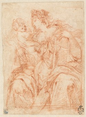
Studies of the Faces and the Figure of a Soldier

1677/1678

Lorenzo Pasinelli

Associated Names
Lorenzo Pasinelli

Artist, Italian, 1629 - 1700

Artwork overview

  • Medium

    pen and brown and black ink and red chalk

  • Credit Line

    William B. O'Neal Fund

  • Dimensions

    sheet: 21.2 × 17.2 cm (8 3/8 × 6 3/4 in.)

  • Accession Number

    2021.38.2.b

Media for this artwork is unavailable and the object is not on view. See artworks now on view

Associated Artworks

The image is a sketch showing a partial view of two figures: a woman and a child. The woman is seated, facing slightly towards the child, who appears to be standing close to her and reaching towards her. The woman's facial features are delicately drawn, with soft lines hinting at a gentle expression, and her hair is styled with an elegant, loose arrangement adorned with curls. She wears a flowing garment with visible drapery and bow-like details near the breast area. The child has curly hair and reaches towards the woman, enhancing the sense of interaction. No jewelry or objects are visible within the sketch. The background is largely undefined, focusing attention on the figures themselves, with the aged quality of the paper adding texture to the composition. A small emblem appears on the lower right corner of the paper, while another mark is visible in the lower-left area.

Study for the Sibyl of the Casa Budrioli

Lorenzo Pasinelli

1672


Artwork history & notes

Provenance

Charles Henri Marcellis [1798 - 1864], Liege (Lugt 609). E. R. Lamponi-Leopardi [second half of 19th century], Florence (Lugt 1760). Luigi Grassi [1858 - 1937], Florence. Private collection, France; (Maurizio Nobile, Paris); purchased 2020 by NGA.

Associated Names

Inscriptions

by Luigi Grassi, lower recto in pen and brown ink: [not deciphered] e cigola ad aloro / per scrite / coto[not deciphered] fini marm / [not deciphered] mate / [not deciphered] sibi / [not deciphered] me moderno / [not deciphered]

Markings

Charles Henri Marcellis [1798 - 1864], Liege (Lugt 609). E. R. Lamponi-Leopardi [second half of 19th century], Florence (Lugt 1760)


You may be interested in

Loading Results