


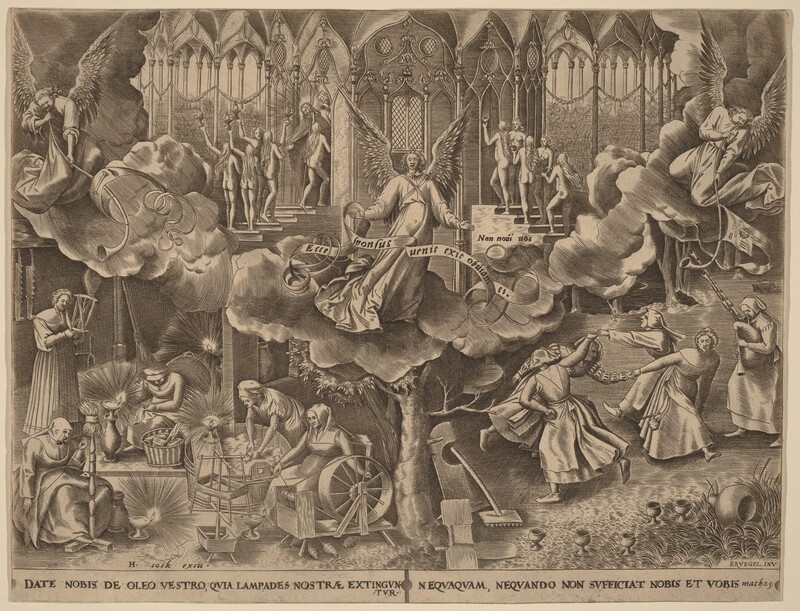
The Parable of the Wise and Foolish Virgins
c. 1560/1563
Philip Galle
Artist, Netherlandish, 1537 - 1612
Publisher, Netherlandish, 1518 - 1570
Artist After, Netherlandish, c. 1525/1530 - 1569

Artwork overview
-
Medium
engraving on laid paper
-
Credit Line
-
Dimensions
sheet (trimmed to plate): 22.3 × 28.9 cm (8 3/4 × 11 3/8 in.)
-
Accession Number
1950.1.25
-
Catalogue Raisonné
New Hollstein, no. 147, State i/ii
Artwork history & notes
Bibliography
1908
Bastelaer, Rene van. Les estampes de Peter Bruegel l'ancien. Brussels: G. van Oest et Cie, 1908.
1993
The New Hollstein Dutch & Flemish Etchings, Engravings and Woodcuts, 1450-1700. (Philips Galle, Manfred Sellink and Marjolein Leesberg, authors). Rotterdam: Sound & Vision Interactive, 1996-, no. 147, state i/ii.
Inscriptions
lower left in image: H. cock excu.; lower right in image: BRVEGEL. INV:; on stairs at upper right: Non noui vos (I know you not); on banderole at center: Ecce sponsus venit exit obviam ei. (Behold, the bridegroom cometh. Go ye out to meet him); lower center, in plate below image: DATE NOBIS DE OLEO VESTRO, QVIA LAMPADES NOSTRAE EXTINGVUN / TVR. / NEQVAQVAM, NEQVANDO NON SVFFICIAT NOBIS ET VOBIS math. 25 ([And the foolish said unto the wise,] Give us of your oil, for our lamps are gone out. [But the wise answered, saying,] Not so, lest there be not enough for us and you. [Matt. 25:8-9]) [translation from Nadine Orenstein, ed., Pieter Bruegel the Elder: Drawings and Prints. Exhibition catalogue. New York: Metropolitan Museum of Art, 2001, p. 208.]
Wikidata ID
Q65087599