


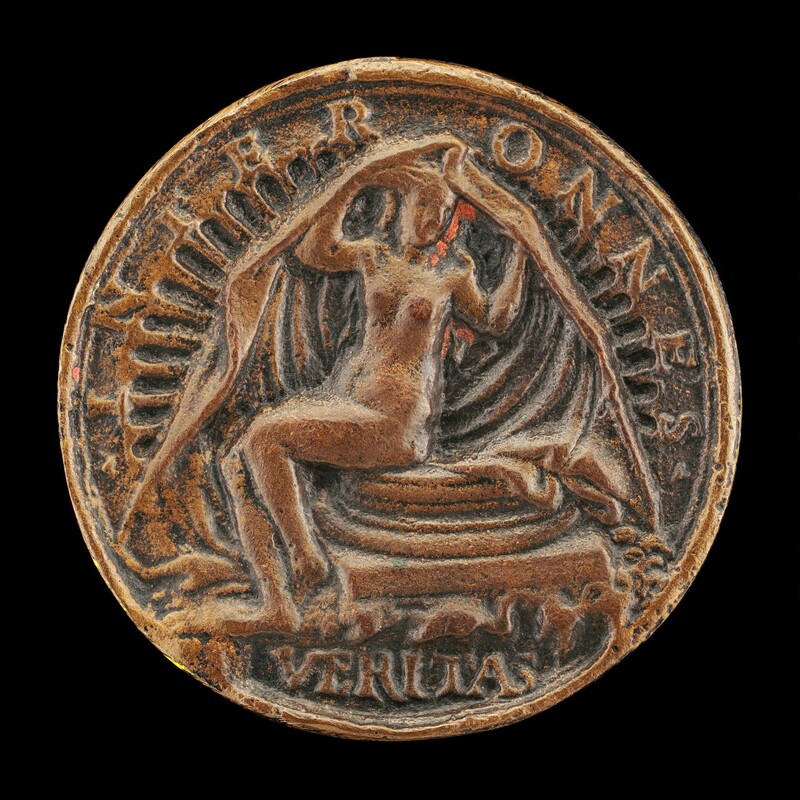
Truth Unveiling Herself [reverse]
after 1550
Pastorino de' Pastorini, called Pastorino da Siena
Artist, Florentine, c. 1508 - 1592

Artwork overview
-
Medium
bronze//Later cast
-
Credit Line
-
Dimensions
overall (diameter): 3.47 cm (1 3/8 in.)
gross weight: 19.31 gr (0.043 lb.)
axis: 12:00 -
Accession Number
1957.14.915.b
Associated Artworks
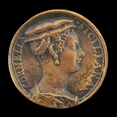
Cornelia Siciliana [obverse]
Pastorino de' Pastorini, called Pastorino da Siena
1550
Artwork history & notes
Provenance
Gustave Dreyfus [1837-1914], Paris; his heirs; purchased with the entire Dreyfus collection 9 July 1930 by (Duveen Brothers, Inc., London, New York, and Paris); sold 31 January 1944 to the Samuel H. Kress Foundation, New York;[1] gift 1957 to NGA.
[1] The Duveen Brothers Records document the firm’s sixteen year pursuit and eventual acquisition of the Dreyfus collection, which included paintings, sculptures, small bronzes, medals, and plaquettes. Bequeathed as part of his estate to Dreyfus’ widow and five children (a son and four daughters), who had differing opinions about its disposition, the collection was not sold until after his widow’s death in April 1929. Duveen did not wish to separate Dreyfus’ collection of small bronzes, medals, and plaquettes, and it was sold intact to the Kress Foundation for a price that was met by installment payments every three months. (Duveen Brothers Records, accession number 960015, Research Library, The Getty Research Institute, Los Angeles: reel 301, box 446, folders 3 and 4; reel 302, box 447, folders 1-6; reel 303, box 448, folders 1 and 2; reel 330, box 475, folder 4.) See also George Francis Hill’s discussion "A Note on Pedigrees" in his catalogue, The Gustave Dreyfus Collection: Renaissance Medals, Oxford, 1931: xii, which was commissioned by Duveen Brothers.
Associated Names
Bibliography
2007
Pollard, John Graham. Renaissance Medals. The Collections of the National Gallery of Art Systematic Catalogue. 2 vols. Washington, 2007: 1:no. 367, repro.
Inscriptions
around top circumference: INTER ONNES [sic]; across bottom: VERITAS
Wikidata ID
Q63851848