


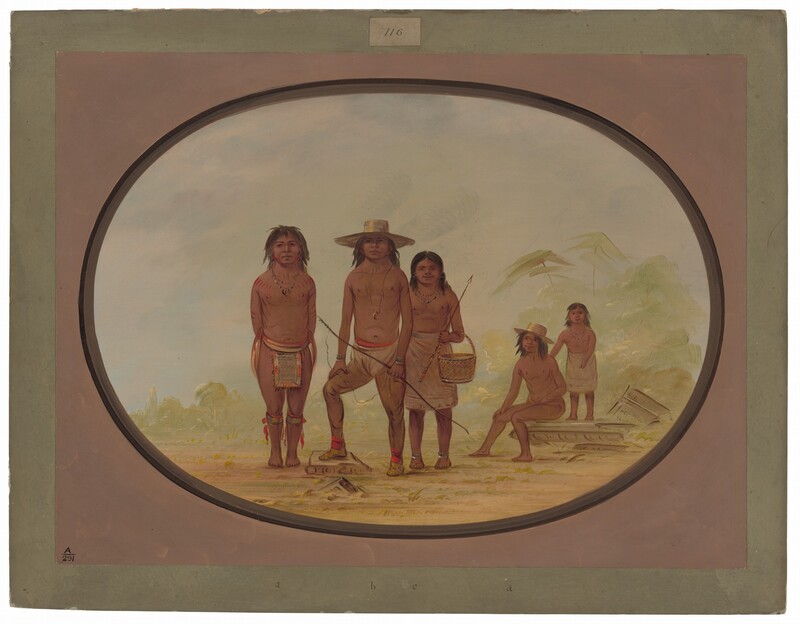
Five Maya Indians
1855/1869
George Catlin
Artist, American, 1796 - 1872

During the mid-19th century, George Catlin created two large collections of paintings featuring portraits of Native Americans, genre scenes, and western landscapes. The first collection, which he called his "Indian Gallery," included more than 500 works completed during the 1830s. Most of the surviving paintings from this group are now at the Smithsonian American Art Museum in Washington, DC. During the 1850s and 1860s, Catlin created a second collection, numbering more than 600 works, which he called his "Cartoon Collection." The surviving works from this collection were acquired by the American Museum of Natural History in New York in 1912. Paul Mellon purchased more than 300 paintings from the Cartoon Collection when they were deaccessioned. In 1965, he gave 351 works from this collection to the National Gallery of Art.
When Catlin exhibited the Cartoon Collection in New York in 1871, he published a catalog listing all the works. The catalog entries often included additional information about the subject of each painting. Catlin's catalog entry for this painting follows.
"Cart. No. 116. Máya.
a. -- Ma-há-ta-níse (-----); a medicine man and orator.
b. -- Chóoxt (-----); a hunter, armed with his bow and arrows.
c. -- (-----); a Maya woman, wife of the hunter.
Remains of the once numerous tribe of Mayas of Yucatan. These Indians are supposed by some writers to have been the builders of the stupendous edifices now in ruins in Yucatan. 1855."
Artwork overview
-
Medium
oil on card mounted on paperboard
-
Credit Line
-
Dimensions
overall: 46.5 x 62.4 cm (18 5/16 x 24 9/16 in.)
-
Accession Number
1965.16.174
Artwork history & notes
Provenance
George Catlin [1796-1872]; by descent to his daughters, Clara Gregory Catlin, Louise Catlin Kinney, and Elizabeth Wing Catlin; purchased 1912 from Elizabeth Wing Catlin by the American Museum of Natural History; sold 1959 through (Kennedy Galleries, New York) to Mr. Paul Mellon, Upperville, VA; gift 1965 to the NGA.
Associated Names
Bibliography
1970
American Paintings and Sculpture: An Illustrated Catalogue. National Gallery of Art, Washington, 1970: 34.
1980
American Paintings: An Illustrated Catalogue. National Gallery of Art, Washington, 1980: 65, repro.
1992
American Paintings: An Illustrated Catalogue. National Gallery of Art, Washington, 1992: 111, repro.
Wikidata ID
Q20188277