


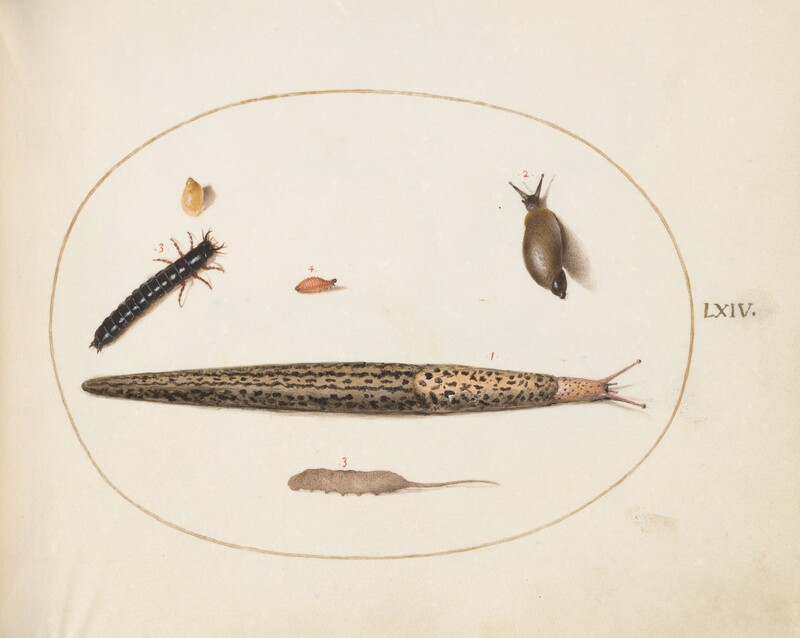
Artwork overview
-
Medium
watercolor and gold paint on parchment
-
Credit Line
-
Dimensions
page size (approximate): 14.3 x 18.4 cm (5 5/8 x 7 1/4 in.)
-
Accession Number
1987.20.6.65
-
Series Title
Vol.II, Animalia Qvadrvpedia et Reptilia (Terra)

Artwork history & notes
Provenance
Emperor Rudolf II of Austria?[1]; Secretarius Heinrich Hagen, Vienna, 1611.[2] Count Emanuel Maria Joseph von Arco, Munich, 1751.[3] Graf von Seinsheim, canon of Salzburg and Speyer, 1753. Master stonemason Rüpfel, Munich, c. 1830. Joseph Anton Niggl [1792 - 1842], Markt Tölz. Karl August von Brentano [1817 - 1896], Augsburg. (sale, Rudolph Weigel, 28 October 1861, no. 2220-a-d]; (Frederick Startridge Ellis [active 1860 - 1885], London; formerly identified as F. S. Eliot)[3]; Henry Huth [1815 - 1878], London; by descent to his son, Alfred Henry Huth [1850 - 1910], London; (sale, Sotheby's' London, 12 June 1913, no. 3722); (William Wesley & Son, London); Charles Francis George Richard Schwerdt, Old Alresford House, Hampshire (his sale, Sotheby's' London, 15 July 1946, no. 2216); (The Rosenbach Company, Philadelphia); Lessing J. Rosenwald, Jenkintown; given to Edith Goodkind Rosenwald, Jenkintown; gift to NGA, 1987.
[1] Although Van Mander claims the series was commissioned and purchased by Rudolf, this is impossible as dates scattered throughout volumes pre-date Hoefnagel's' contact with Rudolf. The series does not appear in Rudolf's' inventory, though he is likely to have owned it at one time as many copies from the volumes appear in his natural history collections, now in Vienna (see Bass 2020, 12).
[2] Vignau-Wilberg 2017, 98 without documentation.
[3]Wolfgang Wegner, Kurfurst Carl Theodor von der Pfalz als Kunstsammler, Mannheim, 1960: 13.
[4] Ellis was a book dealer who frequently sold to Huth and wrote the catalogue of Huth's' collection. He started his own business just a year before The Four Elements appeared at Weigel. Ellis is correctly identified by M. Bartels, "Ueber abnorme Behaarung beim Menschen," Zeitschrift fu¨r Ethnologie 11 (1879): 155, note 1.
Associated Names
Bibliography
1984
Hendrix, Lee. Joris Hoefnagel and the Four Elements: a Study in Sixteenth-Century Nature Painting. Ph.D. Hendrix, Lee. Joris Hoefnagel and the Four Elements: a Study in Sixteenth-Century Nature Painting. Ph.D. dissertation, Princeton University, 1984 (series).dissertation, Princeton University, 1984 (series).
2017
Vignau-Wilberg, Thea. Joris and Jacob Hoefnagel: Art and Science around 1600. Berlin, 2017: no. A6 (for series).
2019
Bass, Marisa Ann. Insect Artifice: Nature and Art in the Dutch Revolt. Princeton, 2019 (for series).
Inscriptions
center right in brown ink: LXIV.; creatures in image numbered .1., .2., .3., and .4.
Facing page: upper center in brown ink: Lingent gentes pulverem sicut serpentes: velut reptile / terrae proturbabuntur de Aedibus suis. Micheas.7. (“They shall lick the dust like serpents, as the creeping things of the earth, they shall be disturbed in their houses.” Micah 7:17) (Latin Vulgate Bible); lower center in blue/black ink: Omnis TERRA adoret te, et psallet tibi: / Psalmum dicat nomini tuo. ps.65 (“Let all the earth adore you, and sing to you; let it sing a psalm to your name.” Psalms 65:4) (Latin Vulgate Bible)
Wikidata ID
Q64590895