Domenico Fetti

Feti, Domenico
Roman, 1589 - 1623

Explore selected works

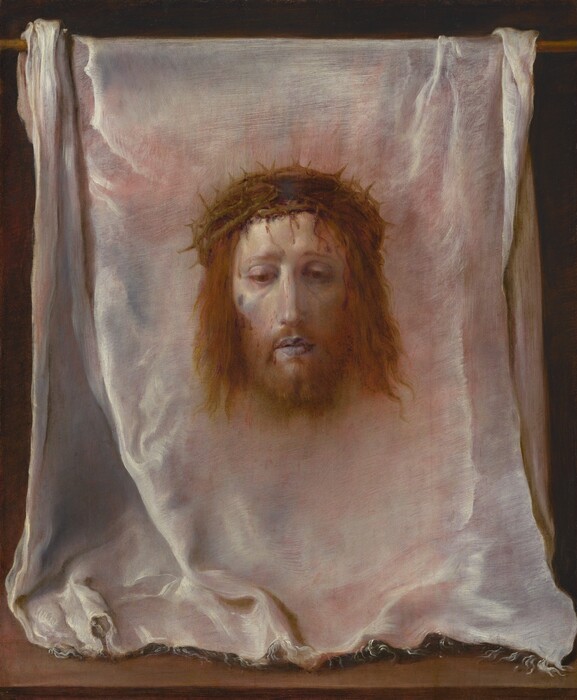
The head and pale face of a bearded man with a ring of interwoven branches of thorns over his chin-length, wavy, reddish-brown hair floats against a white cloth that has been hung over a wooden rod in this vertical painting. The cloth fills the composition. At its center, the man’s head faces us and he looks down with heavy-lidded, brown eyes. His lips are parted, and his cheeks are slightly sunken and shaded with pale lilac purple under high cheekbones. Blood drips down the man’s pallid forehead from the thorns. A brown spot high on his right cheek, on our left, might be a bruise or injury. A soft brown glow surrounds the head. The white cloth is frayed along its front edge, where it rests facing us on a wooden surface along the bottom edge of the painting. The cloth is bunched a little to each side where it drapes over the wooden rod above. The white cloth is painted with tones of pale coral pink, icy blue, silvery white, and dove gray. The background behind the cloth is black.
Domenico Fetti, The Veil of Veronica, c. 1618/1622, oil on panel, Samuel H. Kress Collection, 1952.5.7

The Veil of Veronica

Domenico Fetti · c. 1618/1622 · oil on panel ·  Accession ID  1952.5.7
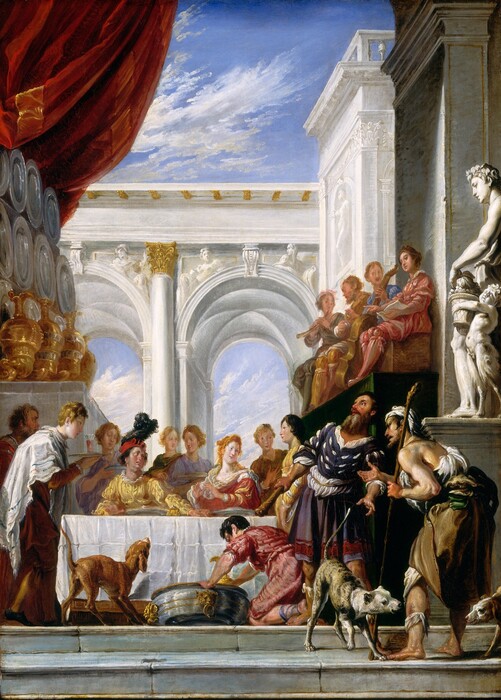
Sixteen men and women sit, stand, or play music at or around a table surrounded by white marble buildings in this vertical painting. All the people have pale skin, and most have round faces with small features and wear dresses or robes in canary yellow, rose pink, lavender purple, moss green, topaz blue, or golden brown. Two stone steps along the bottom of the composition lead up to the table, which is covered with a white cloth. Three people are on our side of the table and the rest are next to or on the other side of it. A young, clean-shaven man brings a glass filled with red liquid on a tray at the left end of the table. Two people sit at the table set with two silver platters and a gold, fist-sized vessel. To our left, the man leans away from the woman and looks up and to our right, toward the musicians who sit and play on a raised platform. The man at the table wears a red hat with a billowing black feather, and his brows are gathered. To our right, the woman holds her hands up in front of her chest, palms facing each other. She looks to our right at a pair of men standing on our side of the table in the bottom right quadrant of the composition. Those two men have darker toned, peachy-colored skin, long beards, straight, pointed noses, and angular features. Both look off to the left. In this pair, the man to our left holds a club in one hand and leans back. He wears a royal-blue jerkin, a muted purple, knee-length toga, and shin-high, toeless sandals over bare, muscular legs. Decorative slits are cut into his jerkin so puffs of the white linen shirt he wears underneath can be pulled through. To our right in this pair, the other man faces our left in profile. He leans heavily against a tall staff and wears tattered white and earthy-brown clothing. A white cloth is tied around his scraggly hair and another around a wound on one shin. Two dogs growl at each other at this man’s bare feet. The third person on our side of the table kneels next to a tub-sized, silver and gold wine cooler, which holds a gold urn. A dog next to the cooler crouches and growls at the table or musicians, the tail erect and ears back. The musicians sit on a shallow platform to the right. The platform is as high as the people standing in front of it, and it is covered with a forest-green cloth. The musicians play instruments resembling a horn, violin, and cello, and the fourth holds an open book and lifts one finger, conducting. A similar platform across from them, to the left of the table, is covered with a white cloth and holds a display of oversized gold urns and silver platters. White arches carved with statues and decorations rise behind the table and frame a view of thin clouds across a vivid blue sky. The sky also fills much of the top quarter of the composition, and a scarlet-red curtain has been pulled to the left and tucked behind the silver dishes.
Italian 17th Century, The Parable of Lazarus and the Rich Man, 1618/1628, oil on panel, Samuel H. Kress Collection, 1939.1.88

The Parable of Lazarus and the Rich Man

Italian 17th Century · 1618/1628 · oil on panel ·  Accession ID  1939.1.88

Bibliography

1955

  • Michelini, Paola. "Domenico Fetti a Venezia." Arte Veneta 9 (1955): 123-137.

1967

  • Lehmann, Jürgen. Domenico Fetti. Leben und Werk des römischen Malers. PhD. diss., Johann Wolfgang Goethe-Universität, Frankfurt am Main, 1967.

1990

  • Safarik, Eduard. Fetti. Milan, 1990.

1996

  • De Grazia, Diane, and Eric Garberson, with Edgar Peters Bowron, Peter M. Lukehart, and Mitchell Merling. Italian Paintings of the Seventeenth and Eighteenth Centuries. The Collections of the National Gallery of Art Systematic Catalogue. Washington, D.C., 1996: 84.