Masaccio

Giovanni di Mone Cassai, Tommaso di
Mone Cassai, Tommaso di Giovanni di
Florentine, 1401 - 1428

Explore selected works
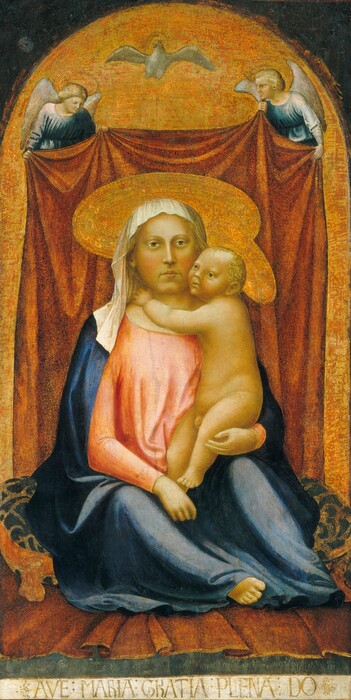
A woman holding a nude baby boy sits on a blue patterned pillow on the floor in front of a brick-red curtain held up by two angels in this vertical painting. The people all have pale, almost gold-colored skin with a green cast, though their cheeks are flushed with pale pink. The woman sits facing us and looks slightly off to our right. She has almond-shaped eyes, a straight nose, and her lips are closed. She wears a blue cloak with a white hood over a shell-pink dress. Her right arm, on our left, rests in her lap and she supports the baby with her other arm. The baby’s nude body is pudgy like a baby but his face and head are proportioned more like an adult. His body turns toward the woman and he reaches up to her neck, and he looks into the distance to our left. Both have flat, plate-like gold halos. The winged angels holding up the red curtain also have halos and they wear blue robes. The curtain falls in gentle folds behind the mother and child, and fabric of the same color underneath the blue pillow on which they sit suggests that the curtain extends onto the floor. A dove, also haloed, floats at the top center of the painting. The gold background around the curtain and behind the angels and dove is painted into an arch over the people, and the upper corners of the panel are dark. A Latin inscription is painted with capital gray letters against a white band along the bottom edge of the panel: “AVE: MARIA: GRATIA: PLENA: DO.”
Masaccio, The Madonna of Humility, c. 1423/1424, tempera (?) on panel, Andrew W. Mellon Collection, 1937.1.7

The Madonna of Humility

Masaccio · c. 1423/1424 · tempera (?) on panel ·  Accession ID  1937.1.7
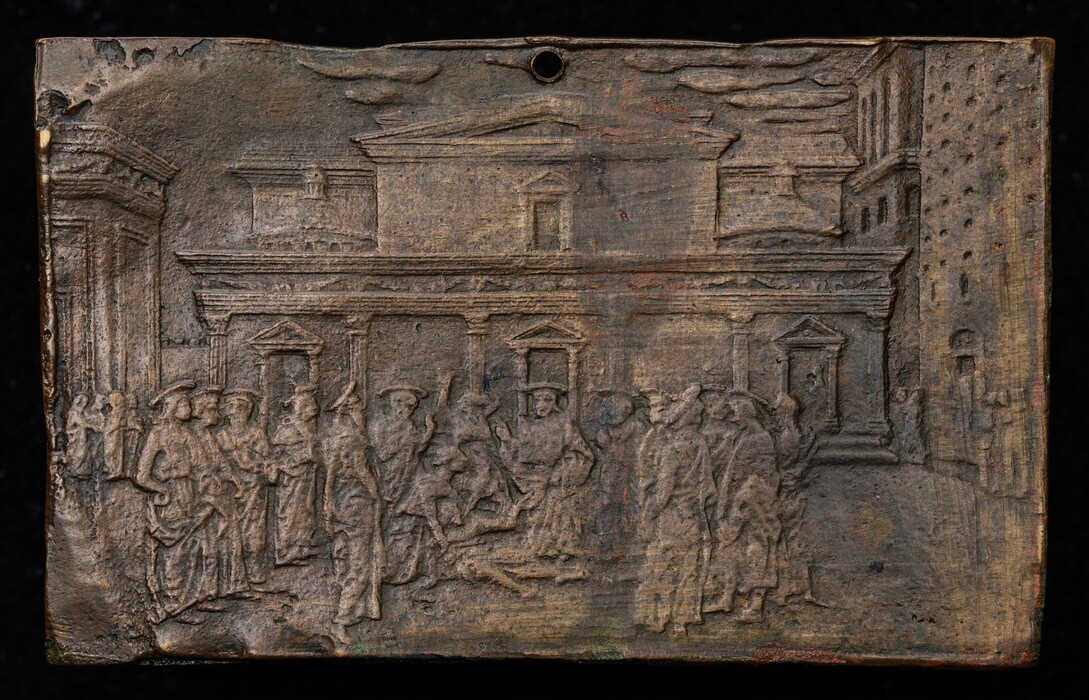
The sculpture shows multiple figures in front of a classical building with columns and a pediment. The figures are in various poses and interacting. The building has a door flanked by columns and windows on two levels. To the right of the main building is a taller structure with smaller windows. The sculpture is made of a metallic material, likely bronze, with a brown color and hints of patina. The composition is intricate and detailed, with a textured metal surface.
Anonymous Artist, Christ Healing the Possessed Boy, c. 1450/1460, bronze//Medium brown patina, Samuel H. Kress Collection, 1957.14.181

Christ Healing the Possessed Boy

Anonymous Artist · c. 1450/1460 · bronze//Medium brown patina ·  Accession ID  1957.14.181

Bibliography

1895

  • Schmarsow, August. Masacchio-Studien. 4 vols. Kassel, 1895-1899.

1940

  • Longhi, Roberto. "Fatti di Masolino e di Masaccio." CdA 5 (1940): 145-191. Reprinted in Edizione delle opere complete di Roberto Longhi. 14 vols. Florence and Milan, 1956-2000. Vol. 8, 2 parts. Part 1 (1975). Fatti di Masolino e di Masaccio....

1948

  • Salmi, Mario. Masaccio. Rome, 1932. 2nd ed. Milan, 1948.

1964

  • Berti, Luciano. Masaccio. Milan, 1964. English ed. University Park, Pennsylvania, 1967.

1977

  • Molho, Anthony. "The Branacci Chapel: Studies in Its Iconography and History." Journal of the Warburg and Courtauld Institutes 40 (1977): 50-98.

1978

  • Beck, James. Masaccio: the Documents. Locust Valley, New York, 1978.

1989

  • Berti, Luciano, and Rosella Foggi. Masaccio. Catalogo completo dei dipinti. Florence, 1989.

1990

  • Baldini, Umberto. Masaccio. Florence, 1990.

1993

  • Joannides, Paul. Masaccio and Masolino. A Complete Catalogue. London, 1993.

2002

  • Boskovits, Miklós. "Appunti sugli inizi di Masaccio e sulla pittura fiorentina del suo tempo." In Masaccio e le origini del Rinascimento. Exh. cat. Casa Masaccio, San Giovanni Valdarno. Milan, 2002.

  • Panel Paintings of Masolino and Masaccio. The Role of Technique. Ed. Carl B. Strehlke and Cecilia Frosinini. Milan, 2002.

2003

  • Boskovits, Miklós, and David Alan Brown, et al. Italian Paintings of the Fifteenth Century. The Systematic Catalogue of the National Gallery of Art. Washington, D.C., 2003: 452.