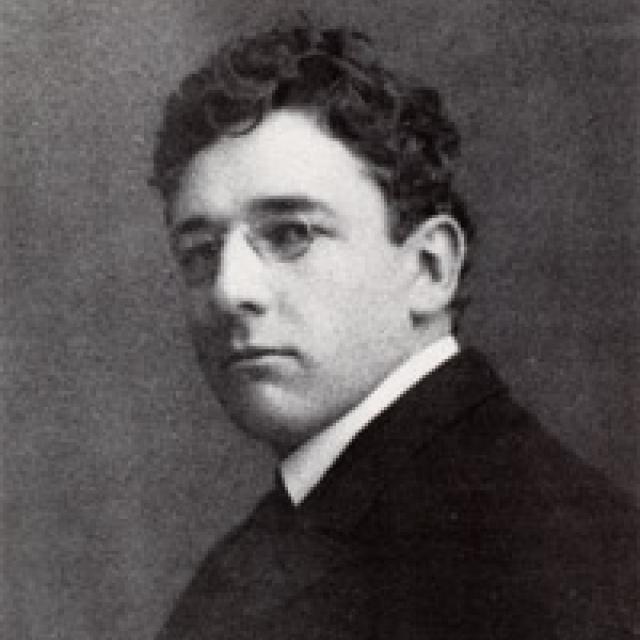
Patrick Henry Bruce

American, 1881 - 1936

Patrick Henry Bruce was born in Long Island, Virginia. After studying in New York under William Merritt Chase and Robert Henri, Bruce moved to Paris in 1903, where he remained until 1936.

In Paris, Bruce was a member of the avant-garde circles surrounding Henri Matisse and the prominent collectors Gertrude and Leo Stein. During the prewar period, he assimilated the influence of Matisse and Paul Cézanne, combining the vivid colors of fauvism with the structure of cubism in his works. In 1912 Bruce met the modernist painters Robert Delaunay and Sonia Delaunay, and he developed his large-scale, boldly hued abstract “Compositions” based on the Delaunays' orphic cubism. In 1917 Bruce began painting cubist-inspired geometric still lifes, depicting blocklike forms such as cylinders, cubes, and wedges in a palette of unmodulated blues, greens, lavenders, and reds. The “Forms,” as Bruce called them, were regularly exhibited in Paris during his lifetime but were little known in the United States until 1965, when they were included in an exhibition on synchromism at Knoedler Gallery in New York.

Suffering from melancholy and a sense of isolation, Bruce destroyed most of his paintings in 1933, sending the surviving works to his longtime friend Henri-Pierre Roché. In July 1936 he moved to New York, living with his sister on East 68th Street. He committed suicide just four months later.

Explore selected works

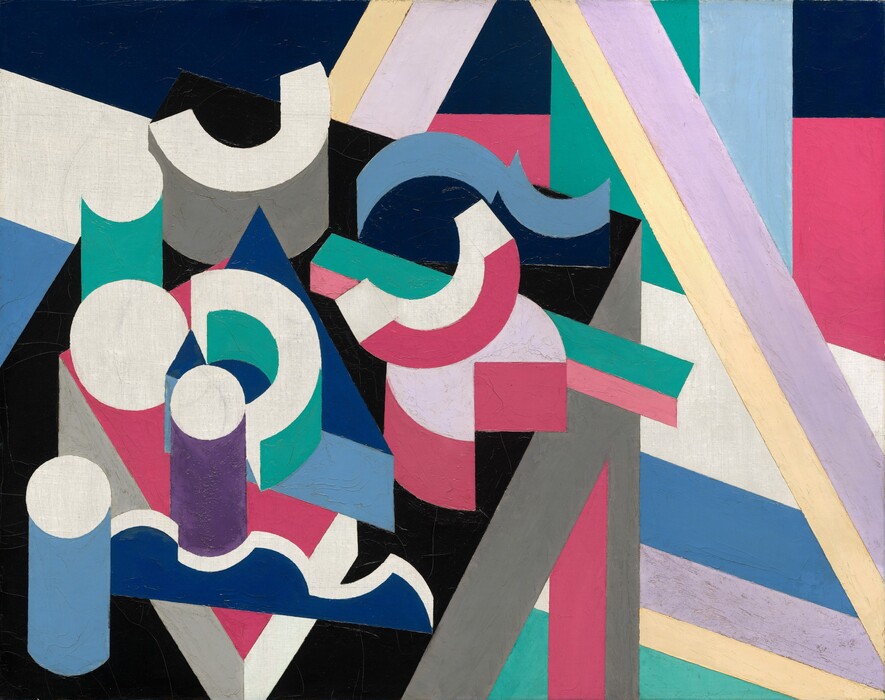
Cylindrical, C-shaped, and triangular forms are painted with flat areas of vivid pink, purple, navy, royal, and light blue, turquoise, white, black, and gray in this abstract, horizontal painting. A rectangular form, jutting into the picture from the lower left corner, suggests a table, on which the shapes are stacked. The table has square, gray legs and a black top surface. The inner surface of the one leg we can see is carnation pink. The objects on top are painted with precise, well-defined edges. Each form is made of two colors: one for a top surface, and another for the side surfaces. For instance, one cylinder, near the lower left corner of the composition, is sky blue up the side, and white on the top surface. Another cylinder nearby also has a white top, but the side is violet. A Pacman-shaped object near the back, right corner of the table is pale, shell pink on the top surface and flamingo pink on the sides. Where the objects are white, the weave of the canvas is visible. Where the objects are painted, the colors are applied thickly, with visible brushstrokes and texture. Some pencil lines are visible as well, demarcating the edges of some objects. The background behind the table has stripes angling slightly down to the right in bands of white, navy, denim blue, and turquoise. Vertical bands near the upper right corner read as an abstracted column, in shades of turquoise and light blue. A triangular form with one band of pale purple and another of light yellow stretches across the background behind the table.
Patrick Henry Bruce, Peinture/Nature Morte, c. 1924, oil on canvas, Corcoran Collection (Museum Purchase, Gallery Fund, 1968), 2014.79.8

Peinture/Nature Morte

Patrick Henry Bruce · c. 1924 · oil on canvas ·  Accession ID  2014.79.8

Bibliography

1970

  • Wolf, Tom M. "Patrick Henry Bruce." Marsyas 15 (1970-1971): 73-85.

1977

  • Agee, William. "Patrick Henry Bruce: A Major American Artist of Early Modernism." Arts in Virginia 17, no. 3 (Spring 1977: 12-32.

1979

  • Agee, William C., and Barbara Rose. Patrick Henry Bruce, American Modernist: A Catalogue Raisonné. New York, 1979.