Michel Sittow

Sithium, Michiel
Sithium, Miguel
Sittow, Michiel
Zittoz, Miguel
Netherlandish, c. 1469 - 1525

Michel Sittow was born about 1469 of German-Scandinavian stock in the Hanseatic port city of Reval, now Tallinn, in Estonia. He probably received his earliest training in Reval from his father, also a painter, yet his apprenticeship in Bruges and years of work for Queen Isabel of Castile and for allied courts gave his art a Flemish and cosmopolitan flavor.

Sittow moved to Bruges in the spring in 1484. The assumption that he studied with Memling rests only on that artist's position as the leading painter in Bruges and on Sittow's use of Memling's Madonna types. He did not register as a master with the Bruges guild and his whereabouts are unknown before 1492 when he entered the service of Isabel the Catholic. Sittow appears to have been identical with the painter "Melchoior Aleman" also mentioned in Isabel's household accounts.

At the Spanish court he was prized as a portrait painter. He is known to have collaborated with Juan de Flandes on the series of small panels of the lives of Christ and the Virgin for Isabel. While he remained in Isabel's service until her death in 1504, he was apparently absent from Spain after late 1502. Suggestions that he visited the courts of Margaret of Austria and Henry VII of England shortly after 1502 cannot be substantiated. He was in Brabant at the end of 1505 or early in 1506, working for Philip the Fair. He returned to Reval in 1506 to settle his inheritance and remained there, receiving membership in the artists' guild late in 1507 and marrying in 1509. He was called away from Reval in 1514 to paint the portrait of Christian II of Denmark, the future husband of Margaret of Austria's niece, Isabella. Sittow then began a second, shorter period of service at the court of Margaret of Austria and her nephew Charles V in the Netherlands. This was interrupted by a brief trip to Spain to negotiate the salary still owed him. By 13 July 1518, when he married again, Sittow was back in Reval. He lived there, a prosperous and respected citizen, until his death in late December of 1525. [1]

[1] His wife is mentioned as a widow as of 1 January 1526.

[Hand, John Oliver, and Martha Wolff. Early Netherlandish Painting. The Collections of the National Gallery of Art Systematic Catalogue. Washington, D.C., 1986: 228.]

Explore selected works
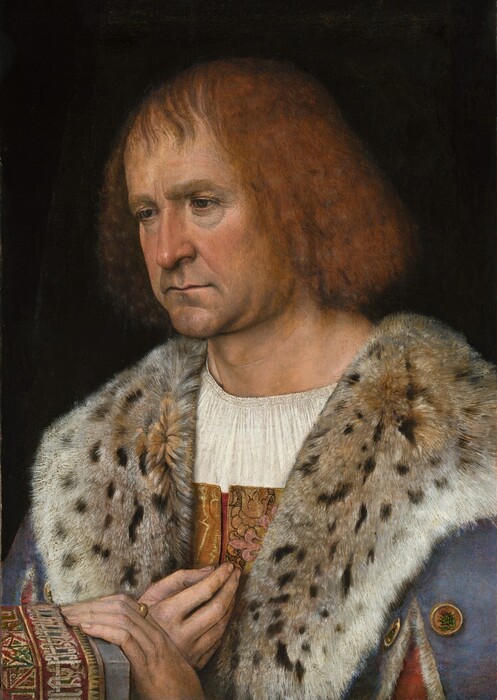
Shown from the chest up, a clean-shaven, pale-skinned man holds one hand to his chest and rests the other on a rug-covered ledge with the other in this vertical portrait painting. The man’s body is angled to our left, and he looks down in that direction with dark eyes under thick brows. Crow’s feet crinkle at the corners of his eyes, and there are dark hollows underneath. Soft jowls hang to create a slight double chin. His thin lips are set in a line over a wide, round chin, which is darkened with a five o’clock shadow. He has chin-length, reddish-blond hair, and straight, wispy bangs sweep loosely across his high forehead. He wears a white chemise under a gold, brocade garment, which is mostly hidden by a slate-blue cloak. The cloak is lined with spotted fur, which is turned over to create a wide collar across his shoulders. The sleeve on his left arm, to our right and closer to us, splits over a dusky-pink sleeve. Two gold buttons on the cloak there are decorated with thistle plants and blossoms. The fingers of his right hand, to our left, are gathered like a closed rose bud at his chest. He wears a gold ring on the index finger of the other hand, which rests on the end of the gray stone ledge so his fingertips brush the tapestry draped there. The man is lit from our left against a black background.
Michel Sittow, Portrait of Diego de Guevara (?), c. 1515/1518, oil on panel, Andrew W. Mellon Collection, 1937.1.46

Portrait of Diego de Guevara (?)

Michel Sittow · c. 1515/1518 · oil on panel ·  Accession ID  1937.1.46
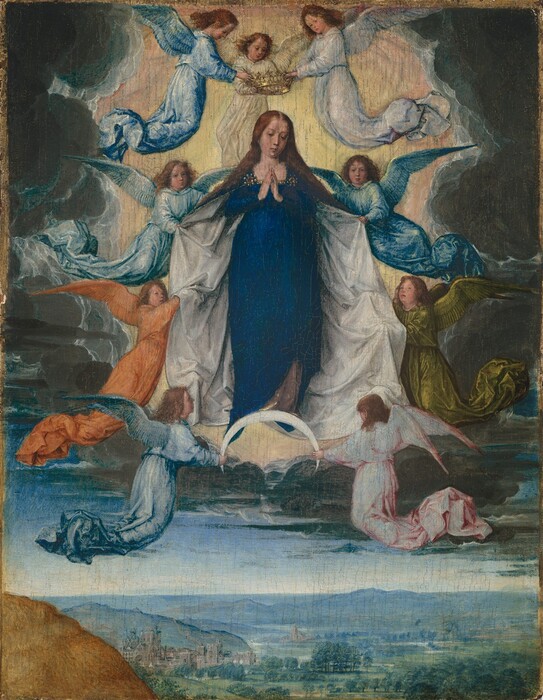
A woman wearing a long, royal-blue dress is surrounded by nine winged angels as she floats on a thin, bright white, downward-pointing crescent moon above a deep landscape with a town tucked into rolling hills in this vertical painting. The woman, Mary, and all the angels have pale, peachy skin and long, brown hair. Mary and the angels float against a pale yellow and pale peach field of light enclosed within a mass of steel-gray clouds. She presses her fingertips together in front of her chest and gazes down and to our right, her dark eyes almost closed. She has a delicate, straight nose, and her small mouth is closed. Her brown hair parts in the middle and flows down over her shoulders. The angels wear flowing gowns in sky or topaz blue, olive green, tangerine orange, white, or light pink, each with matching wings. Three angels place a gold crown on Mary's head. Four others hold up the edges of a silvery white cape, which is fastened across her shoulders with brooches of white pearls surrounding ruby-red stones. The final two angels hold up the downward-facing points of the crescent moon beneath her. In the landscape below, groupings of trees are dotted among the rolling hills, with a village in the distance to our left. The blue, hazy horizon comes about a sixth of the way up the composition. A brown boulder sits in the bottom left corner, closer to us. The paint is visibly cracked throughout.
Michel Sittow, The Assumption of the Virgin, c. 1500, oil on panel, Ailsa Mellon Bruce Fund, 1965.1.1

The Assumption of the Virgin

Michel Sittow · c. 1500 · oil on panel ·  Accession ID  1965.1.1

Bibliography

1907

  • Ref Number: XXXVI.531 (Zittoz,
    T.-B.XXXVI.531 (Zittoz, Miguel, (Tallinn, Estonia) c.1469 - (Tallinn, Estonia) 1525)

  • Winkler, Friedrich. "Zittoz, Miguel." In Thieme-Becker 1947, 36:531-534.

1915

  • Friedländer, Max J. "Ein neu erworbenes Madonnenbild im Kaiser-Friedrich-Museum." Amtliche Berichte aus den königl. Kunstsammlungen 36 (1915): cols. 177-183.

1929

  • Friedländer, Max J. "Neues über den Meister Michiel und Juan de Flandes." Der Cicerone 21 (1929): 249-254.

1940

  • Johansen, Paul. "Meister Michel Sittow, Hofmaler der Königin Isabella von Kastilien und Bürger von Reval." Jahrbuch der königlich Preussischen Kunstsammlungen (Jahrbuch der Berliner Museen) 61 (1940): 1-36.

1976

  • Trizna, Jazeps. Primitifs flamands. Contributions. Michel Sittow, peintre revalais de l'école brugeoise (1468-1525/1526). Brussels, 1976.

1986

  • Hand, John Oliver and Martha Wolff. Early Netherlandish Painting. The Collections of the National Gallery of Art Systematic Catalogue. Washington, D.C., 1986: 228.