Little is known about Adam van Breen’s early life. Van Breen is identified as a “young man from Amsterdam” in a document recording his wedding in The Hague to Maria Gelle on Feburary 13, 1611.[1] In 1612 he joined the Guild of Saint Luke in The Hague, to which he belonged until 1621. He was in Amsterdam in 1622 to appear before a bankruptcy court, and is documented there again six years later, in 1628.
Van Breen worked in Norway repeatedly, and seems to have split his time between Amsterdam and Oslo for much of his career. In 1624 Van Breen went to Oslo for the first time to paint decorations for the palace of Christopher Urne, Lord of Akershus, after it had been rebuilt following the fire that devastated much of the city that year. He returned in 1636 and again in 1639 to produce more decorations for palaces being rebuilt by King Christian IV. Van Breen apparently worked in Norway until his death; his last signed painting, a portrait, is dated 1642.[2]
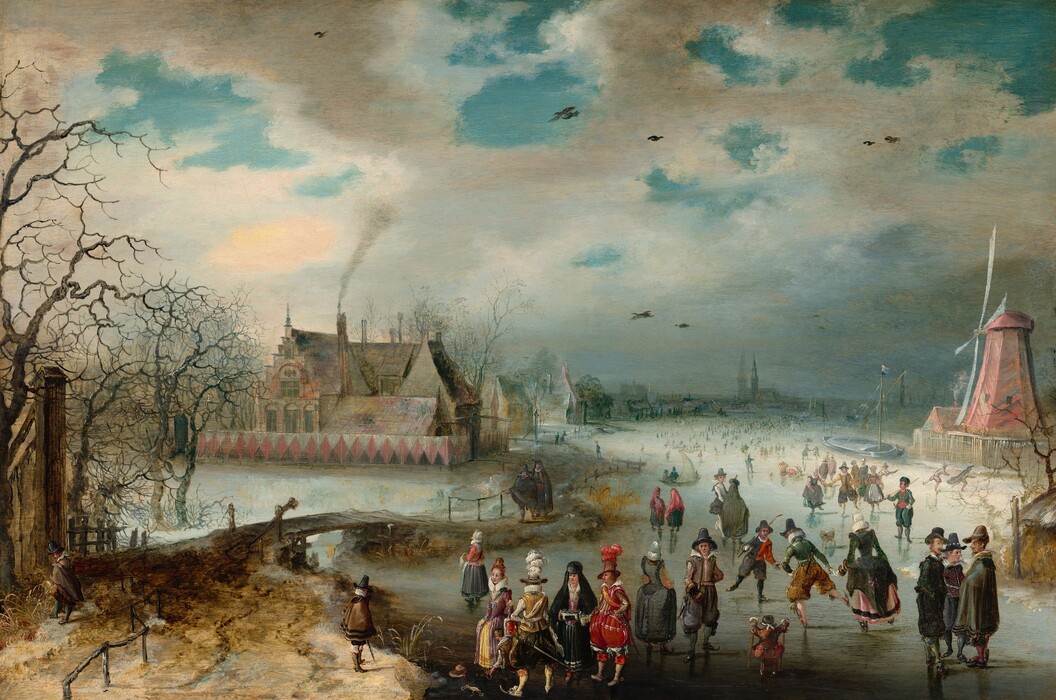
Van Breen specialized in paintings filled with figures enjoying wintry landscapes, occasionally depicting views from specific locations in Amsterdam or The Hague. While in Amsterdam he may have trained with the landscape painter David Vinckboons (1576–c. 1632). In some of his early works Van Breen borrowed both settings and figures directly from Vinckboons’s compositions.[3] In Amsterdam Van Breen also would have seen early paintings by Hendrick Avercamp (1585–1634), another Dutch artist who presumably studied with Vinckboons and depicted winter scenes with crowded frozen canals. Like Avercamp, Van Breen built up a stock of figural types that appear repeatedly in his landscapes, with minor variations. In The Hague Van Breen appears to have influenced Adriaen Adriaensz Ghibons (active 1605–1639), who also produced icy landscapes.
Yet Van Breen did not focus exclusively on winter views. Several of his paintings show elegant companies picnicking in verdant formal gardens, similar to works by Vinckboons and Esaias van de Velde (1587–1630), who joined The Hague Guild of Saint Luke in 1618.[4] Van Breen also drew figural designs for an illustrated book of military exercises and weapons, Nassaushe wapenhandelinge, van schilt, spies, rapier, ende targe, published in 1618 in The Hague by Aert Meruis.[5] The illustrations depict armored figures demonstrating stances for readying and using various types of swords, shields, and spears. Notably, in Van Breen's paintings soldiers occasionally appear amid crowds of well-to-do burghers and playing children.
[2] His 1642 portrait of Ole Bosen (1583–1646), bishop of Akershus, is currently in the Vaar Frelserskirke in Oslo.
[3] Pieter Roelofs, ed., Hendrick Avercamp: Master of the Ice Scene (Amsterdam and Washington, DC, 2009), 37.
[4] Edwin Buijsen and Charles Dumas, Haagse schilders in de Gouden Eeuw: Het Hoogsteder lexicon van alle schilders werkzaam in Den Haag 1600–1700 (The Hague, 1998), 251.
[5] He may have been inspired by the popular success of a similar illustrated manual designed by Jacob de Gheyn (1565–1629) in 1608; Edwin Buijsen and Charles Dumas, Haagse schilders in de Gouden Eeuw: Het Hoogsteder lexicon van alle schilders werkzaam in Den Haag 1600–1700 (The Hague, 1998), 107–108.
Explore selected works
Artwork
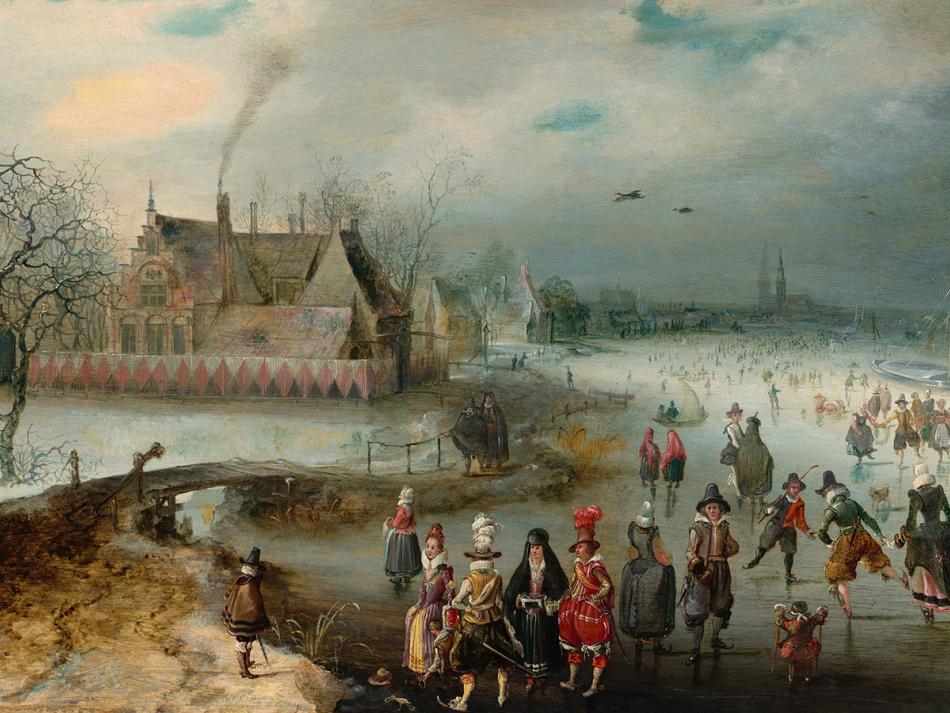
Adam van Breen, Skating on the Frozen Amstel River, 1611, oil on panel, The Lee and Juliet Folger Fund, in honor of Arthur K. Wheelock, Jr., 2010.20.1